

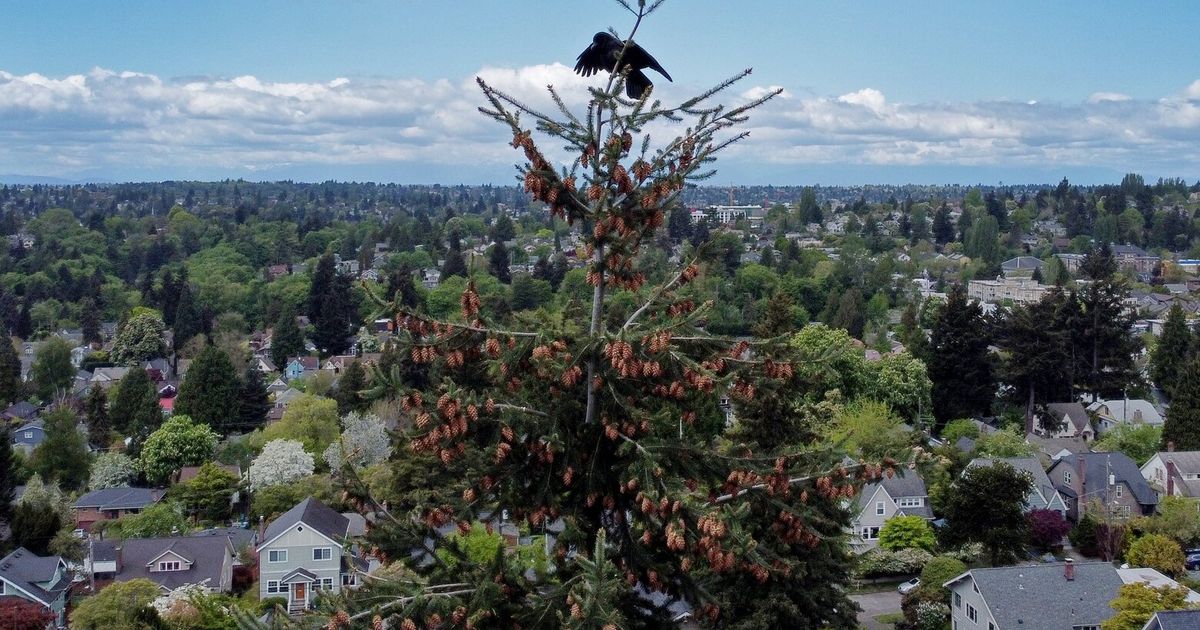
When developers look to clear-cut residential lots to put in more housing, they often point to street trees as a viable alternative to keeping the city green.
But Seattle can’t accomplish its own tree canopy goals without preserving and protecting existing trees on private properties.
That’s the takeaway of a Seattle Department of Transportation study unveiled last June that looked at street tree planting opportunities in four census tracts that represent conditions across the city.
It’s a datapoint that Seattle City Councilmembers ought to weigh heavily as they begin voting on the One Seattle Comprehensive Plan this week.
Out of more than 100 amendments, two focus on saving Seattle’s biggest trees: No. 93 and No. 102, both sponsored by Councilmember Maritza Rivera.
The SDOT study shows that even best-case scenarios for trees on public right of way come woefully short of the city’s goal of 30% tree canopy across all public and private spaces by 2037.
The Capitol Hill neighborhood has 15% tree canopy coverage. After inspecting possible planting opportunities, SDOT determined that even if all potential street trees are planted, the forecast canopy coverage would be only 20%.
In Southwest Seattle, the Roxhill neighborhood currently has 18% tree canopy. If all potential street trees are planted, that goes up to 23% — well below the 30% goal.
It’s the same story in Sodo. The industrial neighborhood’s current tree canopy is only 9%. That rises to 10% if all possible street trees are planted.
In South Park, planting street trees won’t bring relief to residents concerned about heat islands and lack of green space. According to the SDOT study, South Park’s current tree canopy of 14% rises only to 16% if all potential street trees are actually planted — well below the 30% canopy goal.
“Each neighborhood faces challenges: space limitations, utility conflicts, and maintenance concerns that limit tree planting opportunities,” read a post on SDOT’s blog.
The bottom line: Seattle needs to increase housing density while also protecting trees on residential lots. There simply isn’t enough space between the streets and the sidewalks to keep the city livable and verdant.
Here’s what Birds Connect Seattle (formerly Seattle Audubon Society) has to say about the legislation now before council.
Amendment 93: “This amendment would guarantee a minimum tree planting area to give trees the room they need to survive and thrive.”
Amendment 102: “This amendment would streamline the tree protection ordinance by creating a single, more flexible definition of ‘tree protection area,’ which determines whether protected trees may be removed during development.”
These two pieces of legislation work in tandem. Passing one without the other only pays lips service to tree protection.
Councilmembers Rob Saka, Mark Solomon, Joy Hollingsworth, Maritza Rivera, Debora Juarez, Dan Strauss, Bob Kettle, Alexis Mercedes Rinck, Sara Nelson: Give the city something to cheer. Champion what makes Seattle great. Approve the tree protection amendments.
