

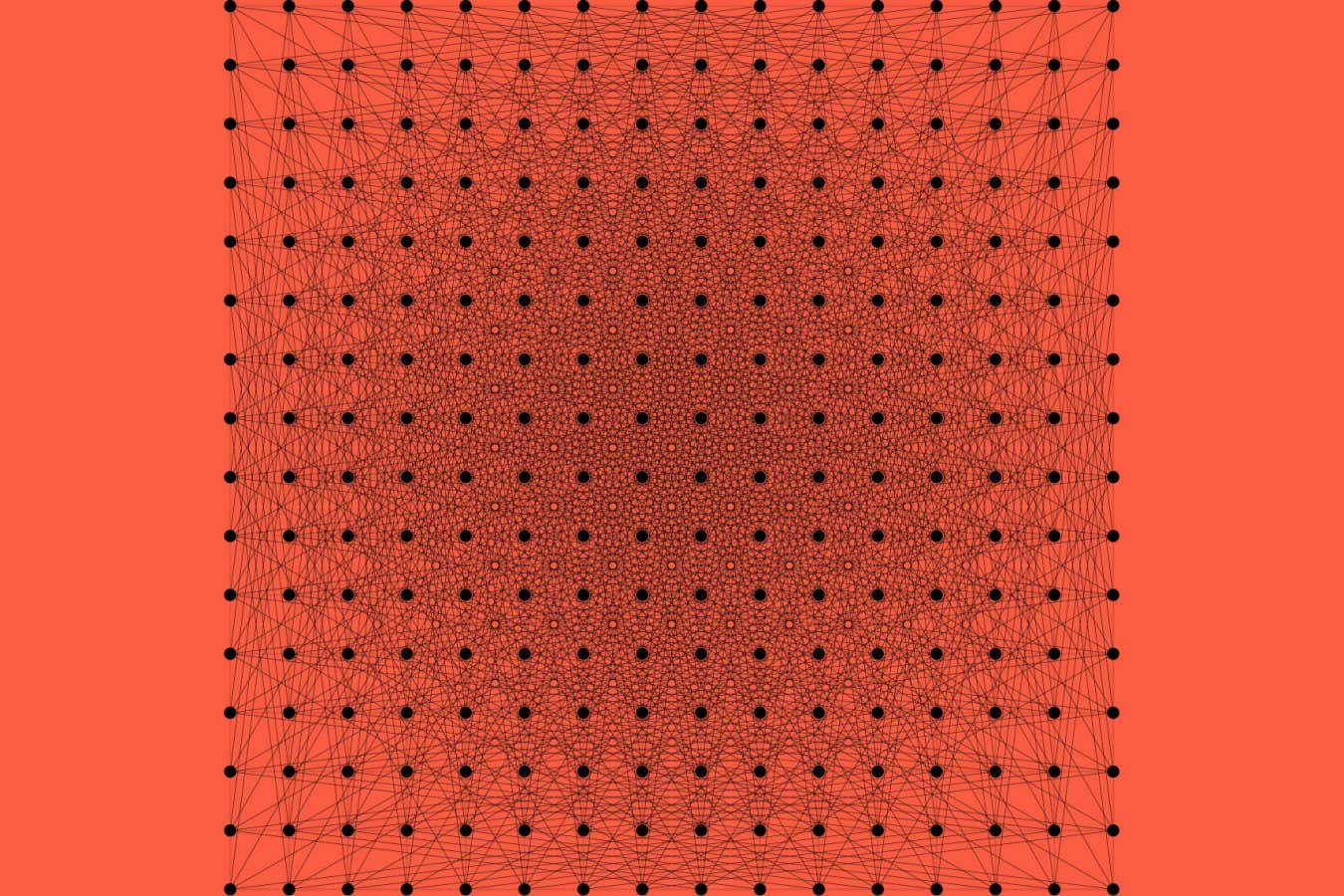
The planar unit distance problem is about how many equal-sized lines you can draw that connect dots on an infinite sheet of paper
Noga Alon et al. 2026, Open AI
An 80-year-old maths conjecture that has eluded the world’s greatest mathematicians has been cracked by an artificial intelligence model built by OpenAI. The result has stunned experts and is being hailed as a seismic moment for AI’s mathematical ability.
“This is a problem that I didn’t expect to see solved in my lifetime,” says Misha Rudnev at the University of Bristol, UK. “It’s absolutely a bomb.”
Tim Gowers at the University of Cambridge wrote that the solution is “a milestone in AI mathematics” in a blog post accompanying the work. “If a human had written the paper and submitted it to the Annals of Mathematics and I had been asked for a quick opinion, I would have recommended acceptance without any hesitation. No previous AI-generated proof has come close to that.”
Twentieth-century mathematician Paul Erdős considered the puzzle, known as the planar unit distance problem, as his “most striking contribution to geometry”, because it was seemingly simple to explain but deeply complex to answer. He asked: if you take an infinite-sized piece of paper and draw a number of dots in a pattern of your choice, what is the maximum number of equal-sized lines you can draw between these dots?
Erdős conjectured that the patterns that yielded the most connections were points arranged in a grid, meaning the maximum number of connections would be only slightly higher than the number of points themselves. Successive attempts to prove that this really is the upper limit, or find a different arrangement of points that might lead to many more connections, yielded only small successes. The most recent improvement to Erdős’s conjecture was more than 40 years ago.
Now, a model from OpenAI has found that Erdős was significantly wrong, and that you can arrange points in less symmetric patterns that can yield a far greater number of pairs.
“My immediate reaction was disbelief,” says Will Sawin at Princeton University. “I thought the way that it was trying to solve it wouldn’t work, but then I looked at it more and I convinced myself that it does work. I pretty quickly became convinced this is the most significant achievement by AI in mathematics so far.”
OpenAI hasn’t said exactly how the model differs from publicly available AIs or how it was trained, but OpenAI researcher Sheryl Hsu has publicly commented that the model is “general purpose” and wasn’t trained “with the goal of doing math research”.
The AI borrowed a technique from algebraic number theory to construct vast lattices in much higher dimensions than the two of a plane. Once it had identified and built these more complex shapes, it then collapsed them down to two dimensions, producing a shadow of the higher-dimensional shapes.
“The counterexample discovered by the AI is complex, and although the ideas to produce it were already in the literature, it certainly takes some ingenuity to put them together,” says Kevin Buzzard at Imperial College London.
While the result is impressive, it is also partly a consequence of the fact that mathematicians didn’t even consider that Erdős’s original conjecture may have been false, says Samuel Mansfield at the University of Manchester, UK. Even if mathematicians did experiment with disproving it, very few geometry specialists would have then been knowledgeable enough in advanced number theory to do so. “This is something that requires you to know a lot about multiple areas,” he says. “In retrospect, it’s maybe not so surprising. This seems to be what an AI would absolutely be good at doing.”
The main appeal of the problem was the “pure intellectual challenge”, says Rudnev, and it may not have any particular ramifications for other outstanding problems, but it has already sparked some further work. After seeing the proof, Sawin used the technique that the AI had discovered to produce a slightly improved, higher number for how many points could be joined together.
“Like many other AI breakthroughs, it did not take humans long at all to internalise, understand and generalise the arguments,” says Buzzard. “One can contrast this with some human breakthroughs which have taken the community months or years to validate.”
Topics:
