

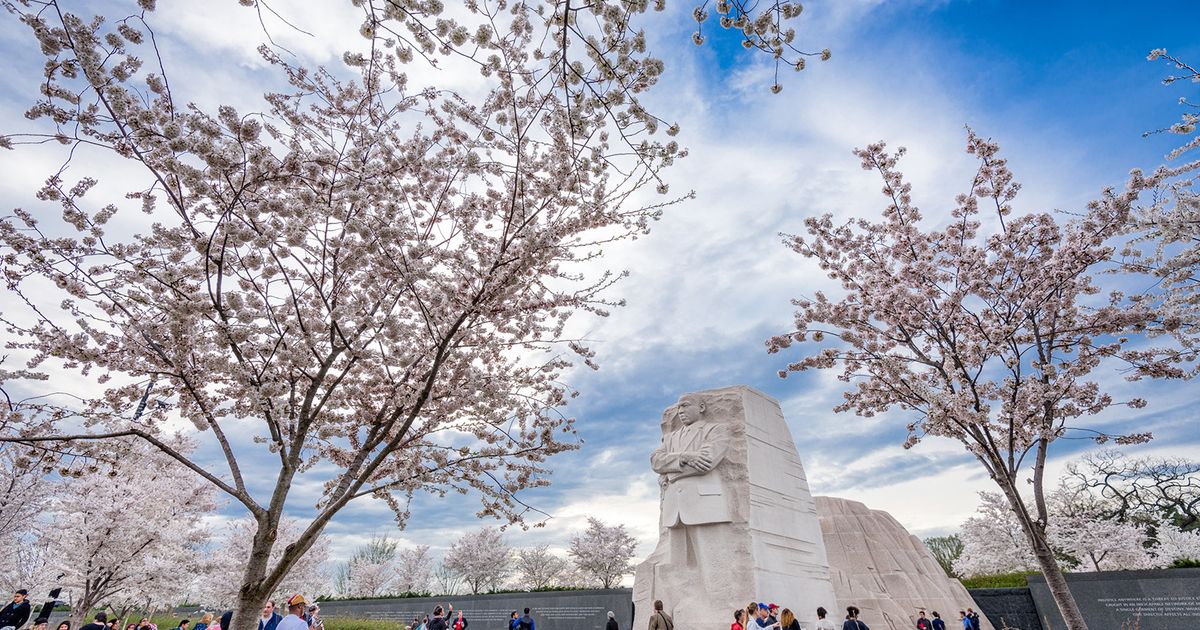
As we honor the Rev. Martin Luther King Jr., it’s fitting to also honor service to others and challenge ourselves to give time and love to our communities. King believed that the central question in life was: “What are you doing for others?”
I was raised by a mother whose life answered that question. She expressed love through service and was guided by an instinct to show up for others. She certified voters during elections, sang for incarcerated people with her choir, volunteered at community events and talked to just about everyone. King said, “You don’t have to have a college degree to serve. You don’t have to make your subject and your verb agree to serve. You don’t have to know about Plato and Aristotle to serve. You don’t have to know the second theory of thermodynamics in physics to serve. You only need a heart full of grace. A soul generated by love.” My mother knew little about Aristotle or thermodynamics, but her love for the people of our town was unconditional.
Inspired by her example, I volunteered to answer crisis calls during my senior year at Gonzaga. I discovered — as so many volunteers do — that helping others was also helping me. I learned the importance of hope from a man perched on the ledge of his apartment building who stopped himself and called us. I learned compassion from the woman, frightened and distraught, whispering into the phone from her basement. I learned how to listen from teenagers alone and uncertain, and maybe most important of all, I learned that I needed to know more about life. Through these conversations, I also came to understand my community more deeply and to see myself as an active participant in it.
Today, along with many other University of Washington faculty members and staff, I get to offer programs that support learning and service for thousands of UW students who are working with local, national and international communities. These students are shaping the experiences of others and shaping themselves.
For example, a geography student, inspired by her college studies and formative years in Sprague, Lincoln County, developed a passion for city planning and now volunteers for her local city council. A business student learned through UW-supported service with Solid Ground that poverty may be solvable through direct service and coalition-building. A student in international studies provided support for a refugee program and decided to join the Peace Corps, marking the beginning of a life lived in service to others and their communities. A nursing student, inspired by the way nursing staff and volunteers surrounded her dying grandmother with compassion and care, arranged her classes to spend her Fridays at the Southeast Seattle Senior Center to offer others the same kind of compassionate care. Whether drawn to urban farming, food insecurity, technology, youth programs or public art, what matters is that students build relationships with others — relationships that endure, and living the reality that service to others moves in both directions.
We hope that every UW student comes to experience service as a formative part of who they are becoming — and encounter it as a place where learning meets responsibility, relationship and belonging.
Asking ourselves King’s essential question — what am I doing for others — and answering it with service to individuals and to our communities, I now understand, is a way of becoming. I see our college students becoming who they are, stepping into their lives as they learn alongside and among their communities. I see students for whom learning, work, service and daily life have become inseparable. I see a generation of civically minded young adults who know how to answer crisis calls and who understand better than I did when I was their age why those calls are made.
The UW’s three campuses again received the Carnegie Foundation’s recognition for its deep partnerships with community organizations and individuals and for its commitment to addressing urgent societal challenges with those partners. We are proud of this honor, and proud of the work our students, faculty and staff are doing to bring into being King’s vision of the “beloved community,” where education serves not only individual success, but collective flourishing.
What am I doing for others? Today is a good day to think about that question.
