

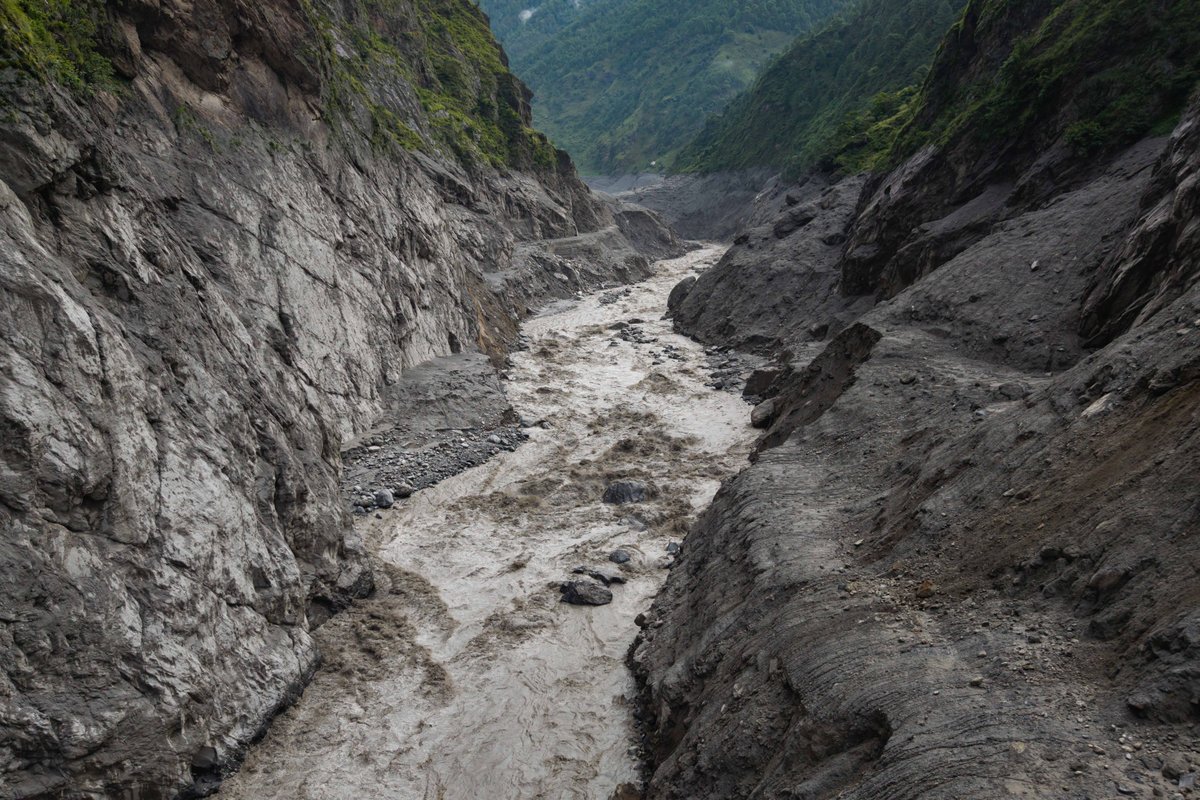
The death toll from the catastrophic floods that swept through parts of Nepal and Tibet last week has risen beyond 1,000 people, while thousands of people remain missing. Among them are hundreds of workers believed to be stuck inside large underground tunnels connected to hydroelectric power plants. As the rescue mission continues, researchers warn that disasters like this could become more common all over the planet as a result of climate change.
Part of what made this disaster so deadly was its suddenness. Experts believe it was likely caused by a large landslide on the mountain Langtang Lirung that included a chunk of glacier. It sent hundreds of millions of tons of ice, rock and other debris hurtling down the slopes to the villages below. The avalanche traveled nearly 100 kilometers (about 62 miles), according to the U.S. Geological Survey.
And while it’s too early to say whether this event was caused by rising global temperatures, the trend is clear: Earth is getting warmer, and that will make disasters like this worse and more common. The rest of the world should be on notice.
On supporting science journalism
If you’re enjoying this article, consider supporting our award-winning journalism by subscribing. By purchasing a subscription you are helping to ensure the future of impactful stories about the discoveries and ideas shaping our world today.
Understanding why climate change is making such events more likely is important. Generally, in high-altitude environments such as mountain ranges, permafrost—basically, frozen soil—holds sediment and rocky material together. When it thaws, it can cause cracks in the rocks that make a violent break more likely.
“It’s essentially preconditioning the glacier and the rock for potential collapse or a landslide,” says Regine Hock, a geoscientist at the University of Oslo.
At the same time, the world’s glaciers are shrinking because of the warming planet. This weakens the ice’s “buttressing” effect on the surrounding slopes, which in turn make those rocks more unstable, Hock says. Excess melted water can also create lubrication, more easily triggering a slip, she says.
What that means is that, in principle, a mountain landslide can happen anywhere that those conditions exist, Hock says. That could be in the Himalayas or in South America or in the Cascade Range in the Pacific Northwest or on the slopes of Alaska. “Wherever you have similar conditions, like warming, destabilizing of the rock, thawing of permafrost and steep slopes, you can have these mass movements,” she says.
But pinpointing the exact risk to any specific village, town or city is difficult. For one, it’s hard to know when a mountain or glacier might crack. Determining that involves having a deep understanding of the land’s features, as well as tracking possible triggers such as earthquakes, says Ben Orlove, an anthropologist who studies climate risks at Columbia University.
The equation also needs to factor in any mitigation efforts—say, early warning systems—to reduce risk and the local conditions where people live. In 2025, for instance, the Tracy Arm landslide in Alaska was so powerful that it produced a tsunami of nearly 500 meters. But because Alaska is so sparsely populated, no one was killed.
There are ways to reduce some of the risks of high-mountain hazards. Local officials can, for instance, work to prevent spills from “glacial lake outburst floods,” lakes formed by melting glaciers. Many of these lakes are not dangerous, says Olivier Gagliardini, a professor at Grenoble Alpes University in France, but if one’s walls are “not strong enough,” they can burst. In France, for example, officials have drained glacial lakes to head off potential flooding, Gagliardini says.
In other cases, evacuation is the only option, Gagliardini adds—that is certainly true for a glacial collapse or landslide on the scale of what happened in the Himalayas.
Subscribe to Support Independent Journalism
Great science journalism requires human expertise, time, effort and creativity. And it costs money. That’s why I and the journalists here at Scientific American hope you’ll join our community.
When you subscribe, you are supporting staff and freelance journalists who are passionate about telling science stories that are true, important and compelling. Our editors and reporters are often experts in their fields, which means they understand the nuances of big discoveries and can untangle the breakthroughs from the hype. With a subscription, you are also supporting rigorous fact-checking to ensure the words we publish are precise and accurate. And you’re supporting original illustrations, graphics and photos that bring you closer to an advanced laboratory, an ice sheet in Antarctica or a space mission in orbit. You’re helping us craft other types of high-quality journalism as well: Our newsletters are carefully written, edited and curated by staffers you have or will come to know and love. Our Science Quickly podcast is based on original reporting, collaboration with editors and scientists and exacting production.
Subscriptions keep this engine running so we can continue to deliver thoughtful, rigorous and independent science journalism to you. In an era of viral misinformation, this work is crucial. If you value what we do, I hope you’ll consider joining us as a subscriber
