

December 30, 2024
4 min read
Auroras May Light Up New Year’s Sky after Solar Outbursts
Will still more auroras ring out 2024, a year marked by the celestial displays?
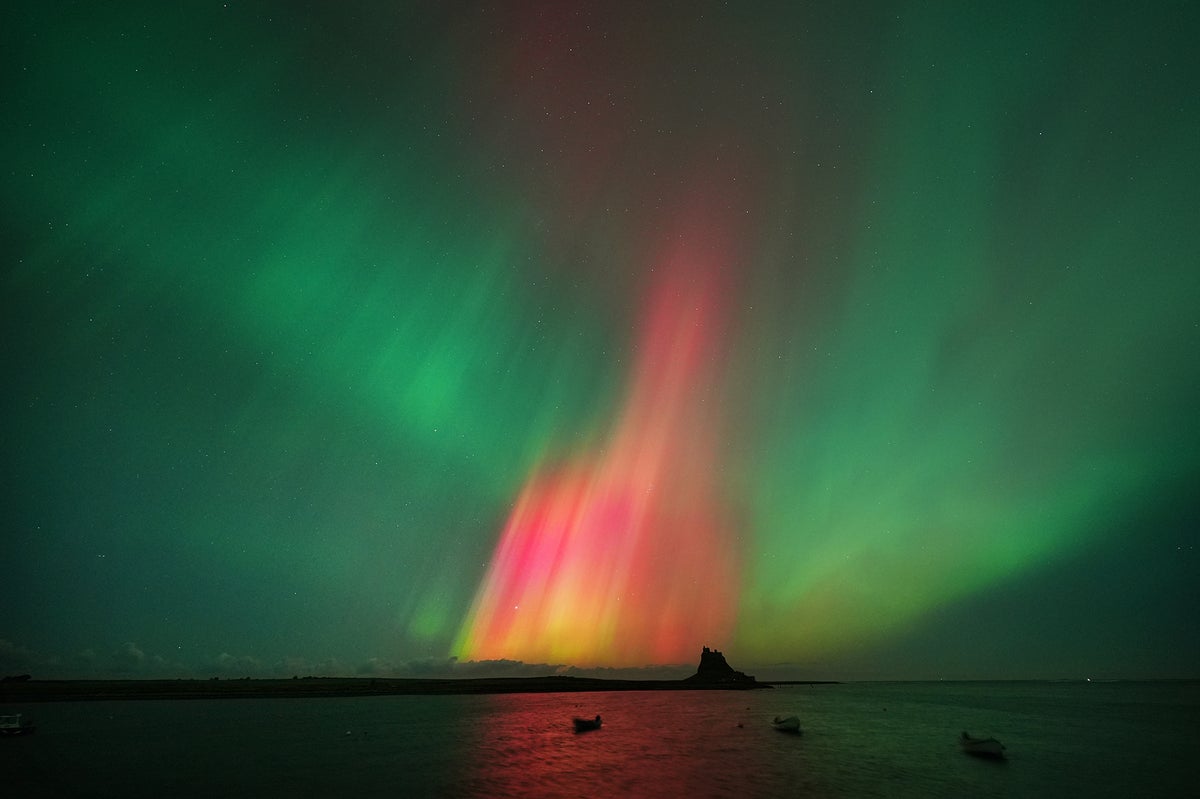
The northern lights seen over Lindisfarne Castle in England on October 10, 2024.
Owen Humphreys/PA Images via Getty Images
The sun is bidding farewell to 2024 with a bang—or rather several bangs. Our star produced three powerful flares on December 29. In addition, two bubbles of material it sent speeding out across space may paint Earth’s skies with northern lights just as many Earthlings mark the turn of the year.
Solar flares are categorized by their peak brightness in x-ray wavelengths, with X-class flares being the fiercest flashes. Our star’s December 29 activity included three such flares, which occurred at 2:18 A.M., 11:14 P.M. and 11:31 P.M. EST, according to a NASA statement. The outbursts represent continuing tumult amid what scientists have identified as the maximum of the sun’s current activity cycle, which also produced stunning auroras as far south as Florida in May and October.
The sun’s 11-year activity cycle is dictated by the magnetic fields that roil our star’s surface. “Our sun is a giant magnet, and so most of the things that happen on the sun are guided by the magnetism,” says Maria Kazachenko, a heliophysicist at the University of Colorado Boulder and the National Solar Observatory.
On supporting science journalism
If you’re enjoying this article, consider supporting our award-winning journalism by subscribing. By purchasing a subscription you are helping to ensure the future of impactful stories about the discoveries and ideas shaping our world today.
Scientists measure the sun’s activity by counting the dark sunspots that mar its surface. Each sunspot is home to a smaller magnetic field—although sunspots themselves are often the size of Earth. Sudden changes in the configuration of a sunspot’s magnetic field, called a magnetic reconnection, can release a huge amount of energy, causing a solar flare. But scientists are still trying to understand what events can trigger magnetic reconnections.
“The major problem with these flares is that we cannot really stick a thermometer or a magnetometer inside of the solar flare,” Kazachenko says. “So it’s very hard to understand what’s going on.”
And magnetic reconnection in one sunspot can trigger the phenomenon in another sunspot—even across a large distance—in what scientists call a sympathetic eruption. “We frequently see flares occurring in groups,” Kazachenko says. The two flares that occurred on Sunday evening represented such a group: they involved sunspots on opposite sides of the sun’s equator that erupted less than 20 minutes apart.
But flares are merely blasts of radiation. Usually for an aurora to occur, the sun must release a bubble of plasma that scientists call a coronal mass ejection (CME), a phenomenon that follows some but not all flares. Whether a CME occurs depends on the details of magnetism at play. During some flares, magnetic fields trap material within the sun. During others, they allow vast blobs of plasma to escape the roiling star. And the more material there is, the better the odds of more spectacular auroras are, Kazachenko says.
In the case of Sunday’s activity, all three major flares produced CMEs. Whether they will produce auroras isn’t yet clear. But the National Oceanic and Atmospheric Administration’s Space Weather Prediction Center has released a geomagnetic storm watch for an event on December 31 and January 1 that, it says, might result in auroras becoming visible over the northern U.S. and into the nation’s lower Midwest.
The uncertainty in the forecast arises from a few factors. Only two CMEs are on paths to potentially strike Earth, and these still may result in glancing blows, complicating predictions about their secondary effects. In addition, Kazachenko says, in order for an aurora to form, the magnetic field of the plasma blob must align opposite to Earth’s own magnetic field. Otherwise the plasma will simply stream by, scarcely perturbing our planet.
The recent activity doesn’t surprise scientists who have been carefully monitoring the sun’s progression through its activity cycle. In an October press conference, experts announced that the sun is officially in the maximum period of that cycle and will remain so for much of 2025.
“We can expect the maximum phase to be on the longer side, roughly three to four years long,” said Lisa Upton, a solar scientist at the Southwest Research Institute, during that briefing. “Currently we’re about two years into the maximum period, so we are anticipating another year or so of maximum phase before we really enter the declining phase.”
Throughout the remainder of solar maximum and beyond, scientists expect more activity and more impacts on Earth. “We anticipate additional solar and geomagnetic storms leading to opportunities to spot aurora over the next several months,” said NASA scientist Kelly Korreck during the same press conference.
And although solar outbursts can harm satellites and astronauts in orbit and even the power grid on Earth, scientists are pleased to see 2024’s activity and that of this solar cycle, which has aligned with the arrival of a massive new solar telescope and two separate spacecraft, all designed to tease apart the mysteries of how the sun works.
“This year has been amazing,” Kazachenko says. “We’re now living through this solar maximum, and now we have this huge suite of instruments that observe the sun in a new way. We’re now living in the golden age of solar multimessenger astronomy.”
