

Rachel Feltman: For Scientific American’s Science Quickly, I’m Rachel Feltman.
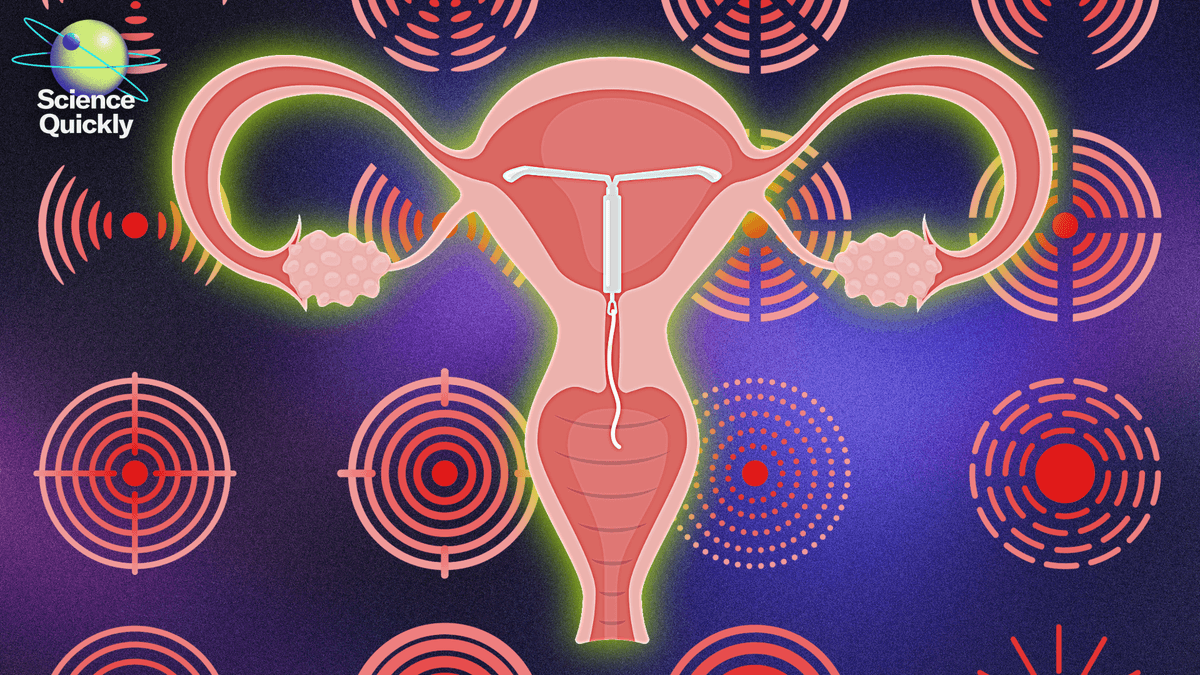
Intrauterine devices, more commonly known as IUDs, are some of the most effective forms of birth control options available. These small, T-shaped devices are placed directly into the uterus by way of the cervix, where they’re more than 99 percent effective at preventing pregnancy for years at a time. And copper IUDs, which rely on copper ions instead of hormones to limit sperm movement and egg fertilization, are also more than 99 percent effective as emergency contraception if placed within five days of unprotected sex.
But while IUDs are a set-it-and-forget-it solution, they do require a visit to the doctor for placement and eventual removal—and that process can be uncomfortable or even quite painful. The Centers for Disease Control and Prevention now recommends that doctors counsel patients on pain medication options before an IUD insertion, but there’s not a lot of data out there about effective treatments. Options offered can include local anesthetic creams or injections directly to the cervix, conscious sedation or even full anesthesia—but there’s no real consensus on which intervention to use or how helpful some of them might be.
On supporting science journalism
If you’re enjoying this article, consider supporting our award-winning journalism by subscribing. By purchasing a subscription you are helping to ensure the future of impactful stories about the discoveries and ideas shaping our world today.
Today’s guest is the author of a recent study on a new method for mitigating the potential pain of IUD insertion. Helena Kopp Kallner is a professor at the Karolinska Institute in Sweden and senior consultant in obstetrics and gynecology at the Danderyd Hospital.
Thank you so much for coming on to chat with us today.
Helena Kopp Kallner: Thank you for having me.
Feltman: So you recently published a study on IUD insertion, but before we get into the research itself, I would love to give our listeners a little bit of context about IUDs. So could you tell us a little bit about what makes them such a great birth control option, but also what, you know, the potential downsides are that might keep some patients from getting them?
Kopp Kallner: So the very big upside with intrauterine contraception or IUDs is that they are user independent. So that means that you don’t have to think about taking something daily, weekly, monthly, or every three months. So it’s a type of fit-and-forget contraception, as we call it. That means that you have it placed, and then you don’t have to think about it. And, for some IUDs now, you can actually use them for up to eight or 10 years.
They’re also very, very effective, so perfect for young and highly fertile women who don’t wanna become pregnant just now. And for the hormonal IUDs, there’s also an upside with, like, reduction in menstrual flow, so you don’t bleed so much, and also reduction in menstrual pain. So those are the major upsides. But then the downside is that they can be painful to have fitted.
Feltman: Hmm. So tell me about, uh, how your new study came about?
Kopp Kallner: Well, actually, this has been quite a long process, as it usually is with clinical trials. But this was actually an idea that I had myself as I was fitting a lot of IUDs for very young women because I see a lot of very young women in my clinic with a lot of menstrual pain, and they are autistic, and they have lots of different issues. And I was just thinking that I needed to find something simple, so just like, “Okay, why don’t I just, like, inject some, local anesthetic through this, like, very, very thin catheter?” And then I was like, “Okay, now I have to do a study,” because I, I felt it worked. But then we started using a lower concentration of the same substance that we have been using now, and we did the pilot trial with around 80 patients. And then we got, like, near significance, and it was so annoying. And then we planned a larger study, so that’s what we have done now, and then we used a higher concentration of the local anesthetic. And it turned out that it, it works.
Feltman: So, prior to you trying this method, what pain relief and mitigation options were available to people getting IUDs inserted?
Kopp Kallner: I think the most common method still worldwide is just the use of anti-inflammatory drugs like ibuprofen and paracetamol that you take before the IUD insertion, although there are so many trials that have shown that this is not effective.
It works fine for pain after the placement or insertion, but not prophylactically. I think the second most common method is probably to use what we call a paracervical block. So that’s an injection with local anesthetic into the tissue with a needle, which is given on both sides of the cervix and then numbs the cervix and the uterus. But it has also been shown in studies that that method in itself is painful. So usually gynecologists and midwives are a bit reluctant to use that method because they feel that in a lot of patients you actually cause more pain with what’s supposed to cure the pain than what actually causes the pain. We only use it for those who really feel they need it or where we really feel like this is going to be painful.
Feltman: Right. Well, and, it’s occurring to me, I’m, unfortunately intimately familiar with why IUD insertion is painful. But, for people listening who have never had an IUD, could you walk us through what the process of insertion actually is, and, and why there is so much opportunity for discomfort and even pain?
Kopp Kallner: Well, I mean, the highest scientific standard of insertion of an IUD is to use, first of all, you use a speculum. That speculum, it visualizes the cervix because the IUD has to be inserted through the cervix into the uterus. So you visualize the cervix, and in some places you also clean the cervix. We don’t do that much in Europe, but in the U.S. it’s usually done, with an antiseptic. And then because the uterus is actually a curved organ, and you’re going to insert something straight into a curved organ, so you have to straighten it out. And, I think a lot of people have a lot of fear of the straightening process because usually that’s done with a so-called tenaculum. And the tenaculum is a very evil-looking kind of instrument with two claws that you, sort of, put onto the cervix. And for some women they don’t feel a thing. It’s not painful. And for others, this is very painful.
And then after that, usually, you use a so-called sound, which is also a, kind of, a straight instrument, and you use that to measure the length of the cervix and the uterus so that you are sure that you put the IUD up into, like, the bottom of the uterus. And that can also be painful. So you put the sound into the uterus, and then after that you do the IUD insertion.
And the IUD insertion has basically three painful parts of it. First of all is when you put the IUD insertion tube through what’s called the inner os. That’s the upper part of the cervix, and that is a very pain-sensitive part of the uterus.
And then, uh, you release the arms of the IUD. So that means that the arms, they’re folded in into the insertion tube, and then when you release the arms, that can also be painful because the IUD suddenly becomes bigger, so it sort of distends the uterine cavity a bit. And that can also be painful.
And then there is the final part of it, and that is when you actually push those arms that you’ve just distended, you push them up into the top of the uterus. Now, all of this, it sounds like it takes a lot of time because I’m, I’m speaking slow. But this is a really fast process. So all in all, from the very start to the very finish, if you have a good provider, this is going to take, like, less than a minute total. But it can be a very painful minute.
Feltman: Right. And it, it seems like for a procedure that’s so common and that potentially causes so much discomfort and frightens people, there aren’t many options, certainly not options that are easy and worthwhile for providers to implement to deal with that pain. Why do you think there’s that gap?
Kopp Kallner: So first of all, I think that the, the pain has largely been ignored because it’s a very short-lasting pain in most instances. And secondly, it’s only until the few last years that we have really been starting to insert a lot of IUDs in women who have not had children before.
And we know that women who have had children, especially who have given birth vaginally, that they have less pain than those who never have. And IUDs have traditionally been used for women who have completed their family. But now we inserted a lot of them in the very young for the obvious reasons that I stated in the beginning, that it’s a very effective method and long-lasting, so it’s very suitable for young women.
And that, of course, has also brought this pain issue more to the attention of providers and women. So I think that there has been a lack of research, and recently there have been a lot of trials investigating different methods for pain relief with IUD insertions, but they have either been found ineffective or painful in themselves.
And there are a lot of methods out there used, and people tell me, like, “No, but you should have been doing this, and you should have been doing that. And I do this, and that works fine for me.” And I’m like, “Yes, but have you done the actual study? How do you know that it actually works? Perhaps it’s just, like, placebo that you’re offering to patients.” And I think women deserve more. Women deserve a method that has actually been proven to be effective in a study so that they know that they’re just not being offered placebo. And if you think that your method is so great then do the study. Show the women that it is effective. That is what I have been doing, and I’m actually very proud of that.
Feltman: Just anecdotally, I feel like people who I know or, you know, who I, I talk to because of my line of work, I think there’s so much fear, there often is so much actual discomfort and pain. People are so used to it being brushed aside that to some extent I think a provider offering anything goes such a long way into making a patient at least feel calmer. But to your point, how much better to have something that’s been empirically proven to actually help you.
Kopp Kallner: Yes.
Feltman: So let’s talk a little bit about the method that you tested. You mentioned that it’s a very small catheter. So just so our listeners understand since that, that might not be a word that they hear a lot in their, their everyday lives. Uh, so there’s no injection that’s being used to apply a local anesthetic. Is that correct?
Kopp Kallner: That is definitely correct. So this is a very, very thin, plastic catheter. And of course, maybe I should have looked up what it is in inches, but it’s 1.3 millimeters wide. So, it’s a very tiny catheter.
Feltman: So small that translating it to be inches would be meaningless. At that small, I think, I think most people in the U.S. would agree millimeters is much more useful.
Kopp Kallner: Oh, great. It’s also, like, extremely soft, so you can completely bend it in either direction. What I usually do is I, I show the catheter to the women when it’s still in its little package. And I say, “See how thin it is,” and then I bend it so that they see that it’s not sharp or anything.
And this little catheter is then attached to a syringe with the 10 milliliters of the mepivacaine then, which is the local anesthetic that we use. And so it just like, it slips into the uterus very nicely actually.
And what happens then is that this fluid, it just, slowly runs out of the cervix, and it forms like a little puddle inside the vagina, and it sort of, like, drenches the cervix in this local anesthetic fluid. And then we apply the tenaculum to that part of the cervix that has been in the puddle, so to speak.
So perhaps it actually numbs the cervix as well. But that, we haven’t really studied so much. We got, in the pilot trial that I spoke about with the lower concentration of the mepivacaine, there we saw that the absolutely most painful part of the whole procedure was the actual placement of the IUD.
So then we actually took away the pain assessment for the tenaculum and the, uh, the sounding because the most painful part was the IUD insertion.
Feltman: Yeah. Well, and speaking of that pain assessment, could you tell us about the results? You know, what kind of improvements did you see? And also what kind of feedback did you get from patients about efficacy?
Kopp Kallner: Yeah, so we measured pain uh, two different ways. First was on what is called the visual analog scale. It’s a 10-centimeters long line. And then the women had the pain scoring sheet, the visual analog scale, this 10 centimeter line in front of them during the IUD insertion.
And then we told them, like, “Okay, now you need to score,” and they scored. And it was like, “Now you need to score,” and they scored. So it was, like, an immediate pain assessment. So it’s not like something, like, “Oh, 10 minutes after I thought like, you know, I experienced this kinda thing I remember.” So it’s a very exact kind of pain assessment. So it’s from the absolute worst pain imaginable—sort of like, what if somebody were to saw off your legs with a really rusty saw and you had no anesthesia—to, like, you wake up in the morning, you’re completely pain free, the sun is shining. You score in between those.
And then we also asked women if the pain was tolerable. What is then tolerable? Well, that is subjective to you. Some people might think, like, “Oh, you know, this sawing off of the leg, well, that might be tolerable.” Very few, of course, feel that. And I think that maybe it’s not like the visual analog pain scale really that matters to the patient. What matters to the patient is that you walk out of there and you thought like, “This was okay.” “This was tolerable.” And what we could see was that we lowered the pain score, uh, in the visual analog scale.
But we also raised the proportion of individuals who thought that the pain was tolerable to 98.3%, I think it was. So that means that the absolute vast majority went out of the room with an okay experience, and I think that is the most important thing. Because what, what I think that we see in social media is we, you know, we see, like, women screaming or posting “This was the absolute worst experience I’ve ever had in my life.” We need to lower the proportion of women who have that just absolutely excruciating, painful, intolerable experience.
Feltman: Well, and is this a method that other practitioners could implement right now? Is there anything stopping a clinician from reading your study and offering this to their patients?
Kopp Kallner: No, I think this is enough. I mean we have, uh, now performed basically three studies with around 600 randomized individuals with this method. I mean, this is the highest level of evidence. It’s been consistent, the findings throughout all these trials.
And there have been no complications. No increased risk of infection has been seen. So I think just go ahead and implement this. And, if we have patients listening to this, I sincerely ask you to ask for this method because I think that doctors are hard to convince to try something new.
But if patients start asking for it, like, “Oh, I want this evidence-based pain relief,” and the doctor goes like, “Oh, what is that?” And they’re like, “Oh, do I have to educate you?” So I think that when we educate women, when we educate our patients, that’s when change happens more rapidly.
Feltman: Yeah. Well, thank you so much, uh, for coming on to talk to us today. This has been really great.
Kopp Kallner: Oh, thank you for having me.
Feltman: That’s all for this week on Science Quickly. We’ll be back on Monday with our usual news roundup.
Science Quickly is produced by me, Rachel Feltman, along with Fonda Mwangi, Allison Rodgers and Jeff DelViscio. This episode was edited by Alex Sugiura. Marielle Issa and Aaron Shattuck fact-check our show. Our theme music was composed by Dominic Smith. Subscribe to Scientific American for more up-to-date and in-depth science news.
For Scientific American, this is Rachel Feltman. Have a great weekend!
