

I am not at the World Cup. I’m going to play the odds here and say that neither are you. Despite the fact that this is apparently the biggest World Cup of all time — more countries represented, more matches played, more fans paying more money for tickets than ever before — almost none of us have been at the World Cup, at least not physically. Like almost everyone who’s been watching (whether casually and fitfully, as in my case, since my country, Ireland, didn’t even qualify for the competition, or with the steadfast commitment and maniacal fervor of so many millions of dedicated spectators), I have been watching it on television.
The number of people who attend the World Cup, large and growing though it may be, is nothing compared with the sheer world-buckling biomass of those who experience it on a screen. According to FIFA’s figures, some 1.5 billion people, nearly a fifth of the population of the planet, watched the last World Cup final, in 2022, and the tournament this year seems on track to exceed that number. So much attention is paid to the business of physically being at the World Cup — the teams that make it there, the fans who travel to support them, the wild and joyful spectacle of multifarious soccer-loving humanity converging on a given place at a given time — that it is easy to overlook the extent to which it is a televised spectacle, perhaps even primarily a televised spectacle.
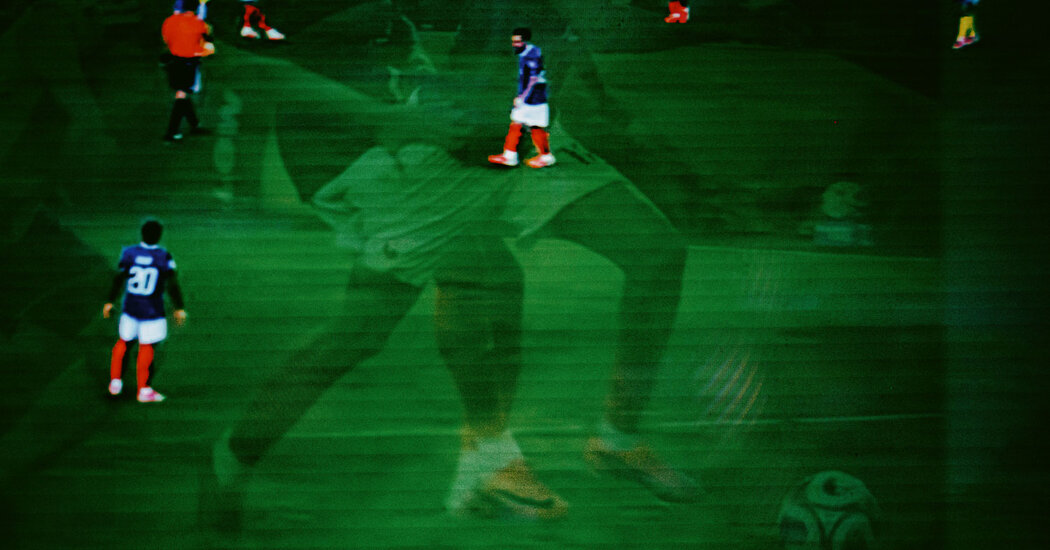
In this spirit, some of the most interesting images to emerge from this World Cup have been created by photographers who are not, in fact, at the World Cup. These photographers are not, that is, standing by the touchline recording the action with their telephoto lenses in the traditional manner, but rather sitting hundreds or even thousands of miles away capturing the flow of images on their television screens. In doing so, they’ve made of those images something new and visually singular — whether it’s by photographing the screen through a bag of water (as the Paris-based photographer Bilal Aouffen has done) or rendering the pixelated image of a player as a dreamy smear that seems to capture more a fleeting and indistinct impression of the goal than the goal itself.
Or take, for instance, the photographs posted to Instagram by the Brazilian artist Gabriel Rolim, whose images are wittily mediated: He uses a modified camera made for the Game Boy to take shots of his television, which he converts into animations that are strange, and strangely delightful, like a pixelated thermographic image of a memory of watching the World Cup. Or the Moroccan photographer Karim Ouakkaha’s beautifully textured shot of the Egyptian goalkeeper Mostafa Shobeir, sitting crestfallen in defeat, the melancholy digital blear of the image making it seem as though he himself is dissolving along with his team’s hopes of progressing.
Jared Soares, a Washington-based artist, snaps photographs of the matches playing on his television, prints them out in monochrome on printer paper and then crumples and flattens the paper before scanning it. The creases give a startling tactile form to his black and white images of players and, especially, fans in moments of public agony and ecstasy.
The oblique angle of approach used by all these artists comes with a history. In the 1960s, the American photographer Lee Friedlander made a series called “The Little Screens,” which depicts hotel rooms with television screens displaying human faces like ghostly apparitions. In the 1970s, as television was becoming more and more luridly omnipresent, the Belgian photographer Harry Gruyaert went further. His series “TV Shots” captured in close-up the distorted, cathodic flare of images on his television set in London. He photographed the televised coverage of the 1972 Munich Olympics, live footage of Apollo flights and broadcasts of the British soap opera “Coronation Street.” In its treatment of the screen itself as a photographic subject, “TV Shots” amounted to a gesture of radical postmodernism.
Besides the fleeting moments of soccer that millions of viewers have been watching, these World Cup photos express something different. In these images, TV screens are not an oppressive, degrading or insinuating presence; they are a means not of erasing or escaping the world but of reaching and being reached by it. Viewed on an Instagram feed on an iPhone, close-up images of television screens appear by comparison to be almost a countercultural utopian space. In a world where everyone experiences his own hyper-individualized flow of images and video and text, minutely optimized for maximum commercial extraction, the World Cup is a rare moment of shared attention.
As the World Cup has gone on, I’ve become increasingly enthusiastic about the competition. I’ve been watching with my 13-year-old son, who out of nowhere seems to have developed an interest in, and surprisingly granular knowledge of, the tournament and its players. I’ve been enjoying the games themselves, but what I’ve been enjoying even more is the almost anachronistic pleasure of watching it on live TV. My 8-year-old daughter has, for her part, been finding it an absurd inconvenience. Why should she have to stop watching cartoons so we could watch a football match? Because it’s happening now, and only now, and we need to watch it not on our phones or on our iPads but on the television, and together.
Deep into the second half of last week’s semifinal between England and Argentina, I texted my friend Rosa, who I knew was watching the match in her house in London. I needed to ask her if she agreed that England’s manager, Thomas Tuchel, looks weirdly like the British pop philosopher Alain de Botton.
She texted back to humor my frivolous observation with assent, and, about three seconds later, Argentina equalized, and the match fell to pieces for England. She texted me photos of her living room full of crestfallen friends, holding their heads in sorrow or staring at the television with grim and futile resolve.
I felt terrible for them all, but I found the photos oddly cheering — not because I’m Irish and retain a petty postcolonial desire to see England and all who sail in her brought low, but because they were all doing the same thing that my family and I were doing in Dublin, and that countless millions of others in countless other places were doing: watching the World Cup. For the nearly six weeks of the tournament, all of us, everywhere, have been watching exactly the same things at exactly the same time — the same angles, the same close-ups, the same agonized or ecstatic replays. We have, all of us, in our own various and yet weirdly identical ways, been at the World Cup.
Mark O’Connell lives in Dublin and is the author, most recently, of “A Thread of Violence.”
Source photographs by Alexis Adrian, Karim Amr, Bilal Aouffen, Ethan Bailey, Casper De Coninck, Pedro Diniz, Mike Francesco Draghici, Hassanein Khazaal, Gabriel Monnet, Karim Ouakkaha, Nazeera Qazzah, Sam Rogers, Gabriel Rolim, Alexandre Simões and Jared Soares.
The Times is committed to publishing a diversity of letters to the editor. We’d like to hear what you think about this or any of our articles. Here are some tips. And here’s our email: letters@nytimes.com.
Follow the New York Times Opinion section on Facebook, Instagram, TikTok, Bluesky, WhatsApp and Threads.
