

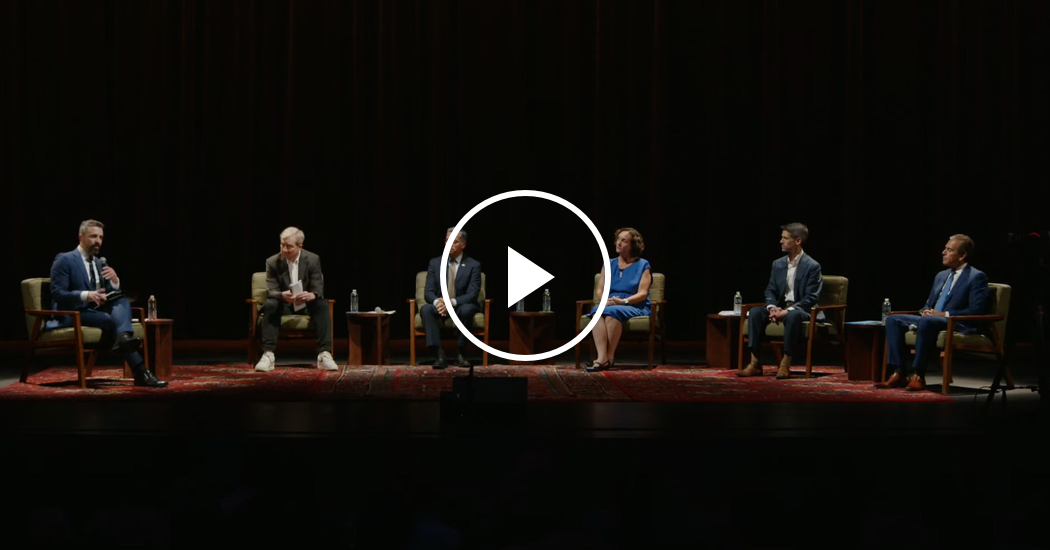
All right Hello, Oakland. All right. Welcome to the beautiful Calvin Simmons theater. We are thrilled you’re here. We are thrilled that all of you are here. The candidates on the stage tonight are, according to the polls, the five top Democratic candidates in this race Tom Steyer, Xavier Becerra, Katie Porter, Matt Mahan and Antonio Villaraigosa. Give them a hand. I should say we invited the top Republicans too. Unfortunately, they could not make it tonight. There have been a lot of debates lately, a lot of debates this week. This is not one of them. What we’re doing here tonight is a forum and on one topic, A topic that deserves 90 minutes of our attention, which is California’s housing crisis. We’re going to have three sections. Each section I’m going to spend about six minutes talking with each candidate in turn. I’ll ask follow-ups if we have time. I want to give people the opportunity to hear all of you thinking through these issues aloud. At the end of that six minutes, a bell will sound like this. That bell slightly breaks my heart. I’m a podcast host. I want to give you all 90 minutes each, but you’re going to get very mad at me if I don’t keep this fair. So we’re going to try to keep it very fair. We are asking candidates not to jump in or interrupt each other. You are free to criticize each other in your answers, but if you do it, that candidate you criticize is going to get a minute to respond and you are not going to get more time. So strategize accordingly. And to the audience, please hold your very much merited applause here until the end. Candidates have not seen the questions here in advance, nor have any of the organizations that are co-hosting the event. With all of that out of the way, let’s get to the reason we’re actually here. Governor Gavin Newsom came into office in 2019 with a promise to build millions more homes. And in the years since, dozens of pro housing laws have passed, some of them written by heroic legislators in this very room. And yet, the number of New homes being built in California is basically the same as when Newsom took office. Housing is a slow and hard problem to solve. But some of these Bills may just take time is true. But we’ve also seen that they will take leadership and courage, that even good laws that we need encounter resistance and headwinds along the way. So all of you want to build more homes. You all have detailed plans to do so. So the question of tonight is what has to happen to convert these good intentions into homes that people can live in. And how do we protect those in need or at risk in the meantime. We’re going to begin by taking on something you all identify as a problem. The very high cost of construction in California. And, Mr. Stier, we’re going to begin with you. A Rand study found that the cost per square foot of constructing an apartment in California is over twice that of constructing it in Texas. Why do you think that is. And what would you do about it. So I know that, in fact, what’s driving that up is the way that we construct the cost of Labor, the cost of materials, and the cost of financing. And for us to drive down the cost per square foot of housing to a place where we can afford to build these houses and people can afford to buy them, we’re going to have to make some real changes in the way we’re going about this. So let’s talk about two of them, which is one about the construction on site. And we are building houses and we are building apartment buildings the way we have been doing it for 100 years. And there is New technology to do this where you basically construct, manufacture the parts of the House off site, the way you’d construct or manufacture a car, and then you assemble it on site. And the estimates that people have both from the real world of having done it, but also projecting what they think they could do, start at percent and they go up from there. And these are real things. And these are companies that are like manufacturing companies. So therefore they need revenues and orders. And the state of California can do that and it can change the building codes. The second thing, in order to drive down the cost of housing is about finance. And the state of California has a number of finance programs. In fact, Buffy Wicks is proposing a $10 billion housing bond, which I think is incredibly important. And I should say, excuse me, excuse me. Hold it. And I should say that the nonprofit community bank that my wife, Kat Taylor, and I started in Oakland, California, has financed 17,000 low income housing units. We need to use finance much more aggressively to drive down the cost of housing. And the third thing I’ll say is this the cities and counties in California do not want to have housing in general. As someone said to me one time, they’d rather have a used car lot than they would a New housing, a New apartment building. The reason is used car lots don’t go to school, use CAR lots, don’t take health care costs. And so a real reason that housing is so expensive, both in terms of the time that it takes to get permits, but also cities and counties will charge very large fees up to 20 percent of the cost of the House, so that they can pre-load the cost of having New inhabitants in their community. I’ve said that I will, on day one, call a special election to close a corporate real estate tax loophole worth over $20 billion to the state of California, so that instead of when we’re talking about a New housing facility in a city or County, it’s not an unfunded liability, an unfunded mandate. It’s a funded mandate. And we can then work with the cities and counties, and they can stop dragging their feet. So we’re going to come back to the city and County question. But I want to jump in on modular for a minute. Modular housing has been promised and hoped for a long time. A lot of politicians have hyped it up. Investors have invested in it and been disappointed. The big companies in the space have often failed. Katerra raised $2 billion in private capital, went bankrupt. Veev failed and tecra failed. Factory OS, which is the biggest one in California, was recently rebranded and recapitalized. So this is pretty central to the way you think about housing. Why do you think it will be different. Why do you think they failed actually. And what have you learned that would make it different now. Well, let me say this. There is a reason they failed. And there’s a reason that most startups fail, Ezra, which is they don’t have revenues and they don’t have orders. And so the question is a does the technology work. B does it drive down costs. And C do they have enough orders so that they’re making money and able to sustain themselves and then to finance themselves into much bigger enterprises. And the answer is the state of California can change the building codes, the state of California can give those orders. And we can actually drive this business so that in fact, not only do they do what they say they can do, but they can get economies of scale going forward to get the kind of size that it needs so that we can really get what they say they can do because the estimates right now are we can drive down the cost per square foot by percent. But I can tell you, because I’ve talked to them, that the people who run these companies see that as a first step, and they can think they can go much further than that. And let me say this. There are 40,000 units in San Francisco, California, that are permitted, that are zoned, that are not being built because they can’t afford to build them to a price that people can afford to buy them. So this is actually the ability to drive down. This cost is an absolutely critical part of building multiples of what we’ve been building for the last four years. And in fact, solving the housing crisis and putting it in a place where working people, working families can afford to buy. So it’s really getting this right is a critical part of the mix. Thank you, Mr. Steyer Mr. Becerra, yesterday you released a comprehensive housing plan. You say in it that it costs too much to build a home in California. You also say in it that you want more union labor in homebuilding and higher wage standards. For Democrats, there’s a pretty wrenching trade off here. An analysis from the Turner Center found that those kinds of standards, notably paying prevailing wage, increase the cost per unit of housing by about $94,000. How do you both cut the cost of housing and increase the wages behind it at the same time. Well, I think the legislature and Assemblymember Wicks took the first measures that we need to get us to that point where we can do is make sure that we are building we’re building with men and women who are skilled, and we’re doing it at a price that we can afford. And so, as we’ve seen, if you do infill housing and you make sure that if you have housing units that will be up to a certain height, up to usually about eight stories, if you’re going to do that, then you have the right to be able, as a developer, to try to get the labor that you need and try to negotiate a good price. If you go beyond that, you’re talking about major construction. Prevailing wage will be the standard. I think that’s a good approach. And then what we do is provide to those that are in the lower height housing, the opportunity to go out and do private actions. If you find that there are violations of Labor laws. But I will tell you this, we should not believe that we have to build homes by making it so. It’s impossible for the Carpenter who builds a home to never be able to afford to buy it. I’m going to make sure that those workers who are building those homes can actually think about buying those homes themselves, and all it takes is for us to work together to make sure we are dropping costs. It’s far more than just labor. There are a lot of things that are involved here, and we would tackle those. So I take that point, but tell me then about how you balance the cost, because what you are describing here, if you begin paying prevailing wage, you begin paying higher wages. You do increase the cost structure. We all want to see higher wages. I take your point very much. The people who build a home should be able to buy a home. There’s nothing to disagree with in that, but you have to cut the cost of construction somewhere. You got financing, you’ve got labor, you’ve got materials. If you are increasing a cost driver, what are you decreasing and by how much. Well, if we can get rid of the Trump taxes, the tariffs that are now being found illegal, that would help us reduce the cost of building materials if we could stop going to war in foreign cost of construction. California was high before Donald Trump. It was high, but not as high as it is now, and we could lower those costs. Transportation of building materials is very expensive, and so let’s not disregard that. We need Washington, DC to be helping us. But to your point and remember, again, labor costs for most homes that are going to be built will not be based on simply the highest rates that you have in the large mega projects. The legislation that was passed by assembly member Wicks provided different ways to do this, which would make the labor cost Affordable for developers. We also have to deal with financing. We have to have a stable source of financing, a source of financing. We can’t just do it one time. I think the measure that assembly member Wix is going to try to put on the ballot is good. I think the measure that former assembly speaker what that measure is just for people not following 10,000, $10 million, billion dollars, excuse me of bonding, financing so that you could start building Affordable housing. The 40,000 units that Tom mentioned that are ready to go, except the financing, that $10 billion would be readily available to get those shovel ready projects up and running, which helps give confidence to the California families that are looking to get into a place. But what is bringing the cost of construction down here. I’m hearing I’m hearing New bond programs, but the cost of construction is too high. That’s what your plan says. What brings it down. So one you go after the red tape. So we try to streamline. And again, the legislation that the legislature passed over this last year helps reduce some of the red tape that you have at the state level. We have to tack it at the local level because of the high fees that are imposed. You have to also make sure that they aren’t trying to use their ordinances to try to prevent us from being able to build. Remember that most homes, most housing that’s built today is reserved for single family homes. Very little construction is done with apartments and condominiums. Very little to buy other than single family homes. We’re never going to reach the number we need if we continue to only build single family homes, and that’s why the legislation that allows us to really build out, do the infill where we know we have transportation will give us an opportunity to increase greater amounts of housing at Affordable rates for people who need to either buy or rent. And I think that if we do that and come up with a stable source of funding into the future, so it’s not just a one time housing bond that people can count on, developers will begin to have confidence that we are looking to give them a predictable means of being able to finance these projects and have them pencil out. Thank you, Mr. Becerra Mr. Porter, you’ve often said on the trail here that time is money. Something I hear from developers to the Rand study I mentioned found that it takes about 27 months to complete a multifamily housing project in Texas, 37 months to complete it in Colorado, and 49 months in California. Why does it take so long here. And what would you do about it. So first, I love that you’re talking about this Rand study, because this is the second time that we’ve had a housing event where we were asked essentially what makes construction costs higher. And I think some people still haven’t read the study because what the study I have read the study. What the study point. And we got asked about it before and nobody read it and doesn’t seem like they have since the study is very, very clear that the speed is the driver. Now, that’s not to say there aren’t a lot of things that were mentioned that contribute to the speed. But if Colorado, if we could be 22 months faster, which is what Colorado does, which does care about the environment. And does have good worker standards, then the estimates are we could take 10 or even percent off the price. And that was market rate. So yes, we need more housing, but we also need that more housing is a tool to less expensive housing. And so I think it’s really important to think about all the different tools in your toolkit. I strongly support the pending legislation that would create one uniform statewide permit, making it easier for everyone to have the same permit, easier for the state to monitor those denials. I also think it’s a really good idea to limit how many last second add-ons can come. So I think right now you ought to have to. If you’re a city and you get a permit, you should have 30 days. That’s the proposal in the legislature. You could argue it could be 45 or 60 to say, this is what the fees are going to be. This is your contribution for sewer. This is your contribution for school and then you cannot do what we see now, which is just a little bit more and a little bit more and a little bit more which is a little bit more delay and then a little bit more cost until pretty soon the project is unaffordable. So those are just a couple of ideas. I also do think there are innovations in architectural design, particularly for multifamily, that could be really helpful, especially smaller multifamily where we’re seeing things that are four units have to apply the same standards essentially as something that’s 400 units. So that also adds to the time unnecessarily, without providing much benefit of those smaller unit projects, which we need a lot of. Yes, we need all of the big units too, but we’ve got a lot of different geographies in California. They’re going to solve this problem different ways, but they all need to do it much faster because time is money. There’s a difficult irony, you see, not only in that study, but it comes up again and again in my own housing reporting. There is no form of housing that Democrats feel more strongly about support more unanimously than Affordable housing. Affordable housing costs more to construct per square foot than market rate housing does. When you look at that same study that we are hyping up here on the stage. What you see is that it costs about twice per it costs twice as much to construct a square foot of market rate housing in California, as in Texas, four times as much to do a square foot of Affordable housing as market rate housing in Texas. Now that Affordable housing is being built partly on the public dime. Why is it so much more expensive here to do Affordable housing than market rate. What do you do about it. This is not a surprise because look, Affordable housing projects face more delays. They face more obstacles. They face more community resistance. They face more restrictions on zoning. People don’t necessarily want them in a lot of our communities. And so the other piece of this is that land becomes more expensive. Every time you have uncertainty about whether something is going to happen, the costs go up. The other issue is that Affordable housing developers are piecing together financing from seven different pools of money that are all designed to make a contribution. And you just as soon get the seventh thing and you’re ready to go, and then the seventh one expires, or you lose that funding, or someone changes the term of a program. So one consolidated bigger pot of money, which is more similar to what market rates are using. They’re going to Wall Street. They’re getting the money and they’re using it. One consolidated part of pot of money would help. The other thing is the state should be putting land up for Affordable housing. That is one of the major factors. It’s one of the hardest ones to solve. You can actually solve labor by not going backwards on housing in labor policy, which the other candidates both have. I think we ought to be trying to drive down the cost of construction, but the land is a tricky piece. The state should contribute land for Affordable housing. You say the other candidates are going backwards on labor. What do you mean. So I have not. I have said that I do not think today or now is the time to do prevailing wage in residential. And when we were in front of the labor fed, I was the only candidate. I don’t believe you were in front of the labor fed. So I just want to make it clear. But those of us who are in front of the labor fed, I was the only one who said, I’m not doing skilled and trained in full today for residential housing because it’s going to drive up the cost. And I took the heat from labor. I stood up to labor and Lorena Gonzalez, got it was right there. And I am not scared of anybody because I’ve got three teenagers that I do not want living on my couch. And you all seem very lovely, but I don’t want you living on my couch or a street corner or in someone’s attic. I want you to all have housing where you can flourish, and so you cannot. There is a pathway to keep building that workforce. There is a big need, a huge need to enforce labor violations and abusive labor practices, which unions have often been very helpful at doing. You could also do that through actually having government oversight of wage violations and workforce violations. And that would be my approach. Thank you, Mr. Porter. Mayor Mahan San Jose has been able to approve over 20,000 New homes for construction, most of which did not get built because the economics didn’t work out. What could Sacramento do to get those 20,000 homes built. Well, thanks for doing this, Ezra. There’s no more important issue. I just want to say good Evening to everyone. It’s great to be in Oakland. Thank you all for coming out and being pro housing. This issue is very personal for me. I grew up in a house remembering. My parents argue about how we were going to pay the mortgage, and we were lucky to have a mortgage. My sisters have since moved out of state because they couldn’t afford the cost of living here. So you asked about the state and first let me as I come around to what we can do across the board, let me just share what we’ve done in San Jose, because I came into this problem of we’ve approved 22,000 homes and they’re not getting built. So we’re saying yes, and we’re celebrating the beautiful rendering. And it’s in the paper and everybody’s excited except the neighbors who say we don’t want it, and it doesn’t matter because we don’t break ground. And if you look at the Rand study, it’s time. And it’s fees are the two big levers we have control over. And the state can impose upon cities some standards and requirements and caps that can hold us accountable. Now, we didn’t wait for that in San Jose. In the last two years, we have moved our multifamily housing approvals in our downtown, all of our planned growth areas along all of our transit corridors to what’s called a ministerial approval, meaning it’s essentially by right. It doesn’t go to the planning commission, doesn’t come to the city Council. It’s just a weekly hearing in the planning Department, and you get told to go. It actually exempts CEQA. So you’re building by. If you conform with what we’ve zoned and we’ve zoned for dense multifamily housing in these areas. We have dramatically reduced the timeline for building. So I am deep in this right now as a mayor of a big city. We just had a 560 unit project get approved in no time. Came in, got the approval. They’re ready to go. So that’s speed. Now the state can impose those standards and set deadlines and use its ability to basically impose effectively, a builder’s remedy by right and say, if you don’t meet these turnaround times, city, or County, the developer is going to by law, have the right to build a conforming project on fees we have accumulated. I mean, I can tell you in my city over 10 pages worth of fees that look good on paper. It’s to mitigate every imaginable. It’s traffic and park fees and Affordable housing fees. And they all sound good on their own. They’re all justifiable. And they’re well intended. But you stack them up and they’re adding percent to 20 percent to the cost of housing. We had a really tough conversation on our city Council. I came to our Council and said, we’ve got to cut the one time fees in order to get the housing in the ground. And the good news is, if we build the housing, we make up the revenue over time. We have more property taxes, more sales taxes, more workers, more jobs, more dynamism. We eventually, in the long run, are better off. But it’s a tough trade off to make because you get yelled at by the park advocates, by the Affordable housing advocates, by every other advocate you can imagine. We had a Council Member literally lose his seat not long ago in San Jose, and our last mayor lose his Council majority over a fee reduction because it was framed as a giveaway to developers. But there are still a number of big of big projects that have not been able to go forward because the economics aren’t working for you. So what could you do as governor to make it work for cities like San Jose. So to finish the point, wait as we cut the fees by over 2/3 and 2000 homes got under construction last year. Another 2000 are securing financing as we speak, and we’ll break ground. And what the state can do is cap local fees. A lot of these fees are not really fees. We allow these bogus nexus studies that employ a cottage industry of consultants. No offense to any of the consultants in the room that the Nexus is pretty loose. Nobody’s getting $65,000 worth of value out of the neighborhood park. I’m sorry. I love our parks, but I think what we ought to do is cap fees at a much lower level at top down policy, and require that a city that wants to impose a higher fee actually produced to the state a feasibility study that shows that the project can still pencil. Because this is the problem. We don’t control interest rates, we don’t control the cost of timber, but timelines at the local level. And all these fees are completely levers within our control. And we’ve made excuses for far too long, and it’s blocked tens of thousands of units in our cities. Thank you, Mr. Mahan Mr. Villaraigosa, your campaign site defends prop 13, California’s cap on property taxes. You talk about holding the line on property taxes. Prop 13 pushes cities to raise fees on New housing, because they aren’t collecting enough in property taxes to pay the Bills. It pushes them to prefer retail and commercial building over residential building. It pushes against homeowner selling because it sells to lose what is effectively a tax break. I know prop 13 is popular. It’s easy for me to sit here and talk about it, but you say you’re willing to do the unpopular things to fix the housing crisis. Why isn’t prop 13 reform one of them. First of all, I didn’t vote for prop 13. I’m on record opposing prop 13. Since 1978. Look it up. Am I misreading your campaign site. Well, I do believe that we need to hold property taxes down. But let me explain. First of all, Tom Steyer is right. What he was talking about is called the fiscalization of land use. And because of Prop 13, we have a situation where we reward a small mall strip mall more than we would housing. So many cities push back against it. So with respect I’m saying with the laws we have today hold the line on property taxes, but I think we need to fix the whole broken tax system along the lines think long. Think long is said that what we have today when we pass prop 13 commercial properties, were paying percent of the freight. Homeowners were paying 40. Now it’s the other way around. We property can’t move. People can. It’s why I’ve opposed the billionaire tax, because I said they’re just going to leave. But I do believe we need to fix prop 13, but fix the whole broken tax system. But within the laws that we have today. Ezra yes. Hold the line on property taxes. So walk me through how you would fix that tax system. Well beg pardon. Walk me through how you would fix that tax system. How do we fix it Yeah as you’re saying want to do it more comprehensively than prop 13 reform. We need to fix prop 13. I just told you, we went from percent commercial to now to now 40. Sorry today we said back then homeowners were paying 40. Commercial was paying percent. Now it’s the other way around. We got to change that. That’s one. Two I do believe that we have to address the fact that people that bought a home before 1978 don’t have to pay the same taxes that people who buy a house today do. And that’s not fair either. We want to keep those costs down, but we have to address the fact that my generation was benefited by the greatest generation that made sacrifices so we could buy a home. And by the way, I bought a home. At 25 years old. I was working on a nonprofit. Today, young families can’t buy that because the average down payment is 140 to $160,000. But fixing the broken tax system, we got to address the fact we don’t have a service tax. Almost most states do. We got to fix the upper income tax there. Those people are leaving, and we’ve got to address the fact that we over rely. I’m the only person on this stage that’s actually been the Speaker of the California State Assembly. I had to balance two budgets with a surplus, and I did both times. The fact is, we can do that in times of good times and bad times. We can’t because the people at the top are paying the vast majority of the taxes. So you think long has put a proposal to spread them across the economy so that we’re not over reliant on the upper income tax so that we can tax more and incentivize cities to build housing, not strip malls. So it sounds like you want to move the line on property taxes. You think the system is not working as it currently stands, the system’s not working. And how then does that give you some movement on fees. We’ve heard a couple of the candidates on stage talk about the various fees that are layered on, in part because of the way property taxes work. How do you approach those when Matt and I are on the stage. We tend to agree a lot because he’s right. Impact fees are killing us about 150. Can you describe what impact fees are for people. Who are there. All kinds of reasons. He mentioned that parking fees, all the fees that every group says, all good things, by the way, and your book, the essence of your book is that Democrats don’t build anymore because we’re looking for perfect, and perfect doesn’t exist. That’s what happens when you have the kind of experience that two of us do. At the end of the day, I built more market rate workforce, Affordable, and homeless housing in eight years in the middle of a recession than they did in the. In the 12 years before me, the Downtown skyline went from 20,000 people to 60,000. I’m the first person in the United States of America mayor to do a transit oriented development districts so that we’re building housing along transit districts. So what Buffy Wicks and Bob Hershberger are here are doing. These are the things that we need to do to drive down costs, to build housing, and to make sure that young people can buy a home again. Thank you, Mr. Villaraigosa. I want to talk a bit about one of the difficult fights that a lot of housing projects have run into, which is the conflict with cities and counties. And, Mr. Becerra, you were state attorney general when California began suing cities over housing. You sued Huntington Beach. You led the San Mateo case that expanded the housing Accountability Act zone of authority. Governor Newsom is now threatened lawsuits against 15 more cities and counties for dragging their feet or opposing state housing law. Do these lawsuits work to build more housing in Huntington Beach. It’s been just years of legal wrangling, not New build. And if they don’t, what enforcement tools would you want to use or create as governor to align cities with the state. Ezra, you have to use every tool you have, and certainly litigation is one you hate to have to go there. You would hope that you would have cooperation between state and local government. Local governments have, for any number of reasons, decided they want to be able to control what happens when it comes to housing in their jurisdiction. And they do have tools, zoning laws. We talk about these fees that they try to collect to help with infrastructure. But what I would say is we have to have an agreement, a state local government agreement, that there has to be a clear path on what the state of California will do when it comes to housing. Every local government must then fall in place to make sure they’re doing their fair share. The lawsuit against Huntington Beach was because Huntington Beach had its own housing element plan. It itself had made it clear that they needed to build several hundred units of New housing, and then they reneged. And so when we sued them, we said, it’s in your own plan. You’re just not willing to do it. The reason we won is because they were violating the law. The case against San Mateo County was simply to make it clear that the state has a role when it comes to housing, because while we all are Californians and we’re Angelenos or oaklanders or whatever else, we all have to be able to live and work and survive in California. So the state of California has a role to play. I defended the law that said that every jurisdiction is accountable to meet its housing responsibility. And we prevailed in court and found that law was constitutional, which set the foundation for us to now be able to push and see the legislation that has now become law. That’s going to let us build more. But has that law given access to the kinds of penalties that are needed to make it work. I mean, the Huntington Beach case is interesting because the state in Huntington Beach have gone back and forth. There was elections in honey beach that led to more opposition, and to my knowledge, it has not led to the housing being built, that there is some absence of sanction that is sufficient to make the cities that don’t want to do it agree with the state. Two issues, Ezra. And this I say, as the former chief and law enforcement officer for the state of California. The difficulty with enforcement is sometimes the penalties, the fines are never enough. It’s almost a cost of doing business to violate the law. You’re willing to pay the cost of the fines to not have to go in that direction. The second problem is, of course, it takes forever. And so I take when I’ve been attorney general or when I was Secretary of Health and Human Services, on the health care side, the approach I took when there’s a law in place that requires you to do something, I would first give you leash. I’d say, I’m going to give you incentives to do what you’re supposed to do under the law. At some point, though, those centers go down and at some point we cross over and now becomes penalties and the penalties grow. The longer it takes you to conform to what the law says, you have to do incentive to come forward. And if they don’t, then start penalizing them for not coming forward. Let me pick up on the incentives. One of the lines I thought was interesting in your plan is quote. We will use a carrot approach as well. Cities meeting their obligations should be first in line for state resources. Which state resources. Well, we do have some funding that would be available right now in existing housing and community development agency funding, but it’s running out. We do need to have a funding source. The initiatives that are on the ballot to create bonding authority would help us have some of that funding that we would need, but we would have to certainly make sure we’re generating the source of funding. The legislature does provide the state with some money. It’s not nearly enough, but there is an opportunity to make it clear. The funding that the state has will first and foremost be allocated to those who are conforming to their state law obligations, those who aren’t. The money that you could have gotten is going to those who are actually fulfilling their housing requirements. And let me pick up the question from the other side. So you have cities, and again, I’ll use this example. We say we don’t want to do this. The representatives you’re dealing with there are elected on a platform of not doing this. Why is it the state’s prerogative to tell them what to do. Well, the state same reason kids have to eat their broccoli. I mean, we all have to. We have to live by rules. I guarantee you, everyone would love to be able to cross through an intersection and not have to worry about the red light, but we have rules. I live in New York. Nobody worries about the red light. Thank God This is California. Look, we’re a society that believes that we must. And we teach our kids to follow rules. And if you’re a city and you see the housing crisis and you’re not following the rules, then get ready, because I’m going to enforce, I will use the powers of the state, working with the attorney general, working with our housing and community development agencies, and with those who are willing to push the envelope to say, I’m going to give you a reason to do this building. I’m going to give you an incentive. I’ll put you in the front of the line. But at some point, you’re going to pay the price because we need to build. Mayor Mahan, building on that, we do see repeatedly this dynamic where big housing bill is passed in Sacramento. Then cities and counties find ways to delay or evade them. You’re a mayor right now. You’re also running for governor. How would you handle this tension between local control and state goals differently than Governor Newsom has. Well, I think actually, I think Governor Newsom has been a champion for housing. And while he and I have disagreed publicly on some other policy areas, I think he’s been bolder on housing than other past governors we’ve had. And I give him a lot of credit for that. I mean, my philosophy is that we should use our housing element process and the arena targets to tell cities and counties what is expected of them, the policies, the programs and the zoning and the space they need to create for housing and the ability to approve it quickly. I talked about capping fees, and we should give local control up to the point where they lose the privilege of having that local control. I can tell you from experience, we were on the receiving end of this. We had a number of critiques of a housing element that started under my predecessor and then around the time I came into office. You describe what a housing element is. This is a policy document that we as a city and counties as well, have to submit to the state to basically show that we have zoned to create room for New housing, and that we have programs and policies at the local level that will in fact, enable that housing to get built. And we had some critiques of our plan, and it was a slow back and forth, a slow process for getting it passed. And many other cities in the state, we did not meet one of the deadlines for approval. And the state has an accountability mechanism that I would suggest is much more effective. It’s not fun to be on the receiving end of it, but it’s much more effective than lawsuits, which is what’s called builder’s remedy. And I think that the lawsuit should be the last resort here. I feel very strongly that our next governor cannot bring a lawyer’s mindset to this problem. It is a market failure. It is a process failure. It’s the cost stack. It’s the efficiency. It’s innovation like modular. But in this case, when cities fail to meet permitting deadlines, when they try to use fees and local building codes to block housing, when they don’t deliver on actually enabling housing to get built, I think the state should override and create by right mechanisms for developers to move ahead projects whether or not the city likes it. I think that’s an accountability mechanism that’s more effective, frankly, because what we see with these lawsuits is they drag on for years, they get appealed, and eventually maybe the court tells the locality, go back and update your policies, update your general plan, update your housing element or whatever it is. And we’re not actually seeing housing get built. Huntington Beach is not building more housing to your point, San Diego, I think, was sued. I think when Mr. Bashara was the AG and one of the projects with 2000 units still hasn’t gotten built. So I think the legal path is not particularly effective if we actually want to build housing. Let me ask you about the other side of this question, which is persuasion. And the relationship between the state and the cities. Obviously, it is better if there is alignment rather than you have to go to builders remedies or litigation. So do you think there are ways to bring cities along. I mean, do you think there are. You’re obviously very pro housing mayor, but you presumably know other mayors and you have seen these fights up close. Are there things the governor could do or things that you would do as governor that would you think could lead to more cohesion between the state goals and the cities preferences Yeah, I think we’re going to need we’ve talked a touched on financing tools. And as you all probably during the Great Recession, redevelopment went away. Went away in California. And I think that what redevelopment offered was this tax increment financing, meaning you could project future property tax increases, the increment, and then pull that value forward and bond against it to make local upgrades. And I think we need to revisit having that tool in a limited fashion. I think there are some cities and counties got into trouble and racked up big debts, and so there need to be guardrails. But that is a way for cities to build the infrastructure that they need without having to put all of that incremental cost on each New project up front. And I think it’s a mechanism that could be used to unlock more Affordable housing, more of the horizontal upgrades that would enable cities and counties to see the fiscal benefits of building housing faster Mr. Becerra, you mentioned there over the question of whether or not the litigation is effective. You have one minute to expand on that. And I believe we didn’t identify the project specifically, but this was a project in the San Diego County area that was in the hills in wildfire, wildfire, risky areas. It was a pretty large development, several thousand units. It had one route for egress. And we went to the developer and we went to the County and said, this is a safety hazard. This is something that could lead to the loss of life if indeed we have a wildfire. This was when I was AG between 2018, 2017 and 2021, way before Palisades and Altadena. And we simply said to them, if you’re going to build that many housing units and people are going to be living up there and there’s a wildfire that hits. You better have a way for these folks to be able to save their lives. Having one route of egress was not going to do it. So we said to them, if you’re not going to take care of this, guess what. We’re going to have to Sue you. We tried we tried not to do the litigation. But sometimes, Matt, it does help to have someone who knows how to enforce the law Mr. Villaraigosa, you were mayor of Angeles, a city very close to my heart as a UCLA graduate, and I grew up an hour South. There you go. La has not exactly been a model of pro-housing policy of late. Mayor Karen Bass signed Ed one, which expedited Affordable housing, then started rolling it back because of local opposition when it seemed to work almost too well passed measure Ula, a transfer tax on the sale of properties over $5 million, which seems to have cut the development of multifamily properties. SB 79, which increases housing density around transit, passed in Sacramento and. City Council passed a rezoning to slow it down. What would you do as governor to make Angeles an engine of housing progress again. Well, as I said, and I’ll say it again, I built more market rate workforce, Affordable homeless housing in eight years in the middle of a recession than in the 12 years before me. The downtown skyline changed from 20,000 to 60,000 people. I agree. Look, I’m opposed to the EULA. The Ula is a transfer tax. Everybody what it says, it sounds good. They call it the mansion tax. It says that homes over 5 million. You have to have a 5 percent transfer tax. You can’t buy a mansion in La number one for 5 million. But number two, it doesn’t just impact a single family dwellings. It impacts multi-family dwellings. It impacts commercial. Speaking of Rand and UCLA, my Alma mater, they did a study and that study showed that we’ve had an 84 percent drop in construction since the EULA. And let me be clear, as I understand it, I had more cranes than anybody in that eight year period of time for housing, the airport, community, colleges, schools. Today we just opened up the first leg of something I said 20 years ago. I said, dream with me, we’ll be build a subway to the sea. And we built it. And by the way, abundance, when we were talking in the green room or whatever, that was one of the things I told you. Fair enough. I was doing abundance. In 2012, I went to 10, I went to Obama, and I said, reward. Cities and counties that are putting up their own money, allow us to access low cost loans to build transit. And then I said, put Nepa and CEQA together to cut time because you said it. What drives up cost is time or impact fees are our SQL. Do you know that under SQL you don’t need. It’s supposedly the California Environmental Quality Act. You don’t need to Sue an environmental reasons Nepa you do. You can Sue from Richmond, California. I mean, Richmond, Virginia, for a project in Richmond, California. Yes you can. It’s broken. I’ve been taking it on for 20 years. Nationally and lately that with Buffy and some of these people, I love what they’re doing. Because this is what we have to do to build. Well, let me ask you about the politics of Los Angeles, because I do take the legislators there, the mayors there as responding to local demands. I remember speaking to Mayor Garcetti at one point, and there was pressure after Angeles passed measure h-h-h. Well, they got the money to build, but a lot of places didn’t want it built where they were. And so there is a push here, even in a city where housing is very expensive. So that city as well as anybody. Like, how would you persuade both the mayor of Los Angeles and the people of it that the things you want to do are good for La. There’s a lot of agreement here. Javier said something about using a carrot and a stick. I agree. That’s what I did. I love using carrots. I love going into neighborhoods, talking about the need to build the housing or homeless facility or wherever it is. I love working with them and compromising with them. But in the end, I understood one thing. If you want to be popular, get a dog. Yes You’ve not met my other jobs where you got to make tough calls. I made those tough calls. That’s how crime went down 48 percent It was the most violent big city in America when I got there. That’s how graduation rates went up percent. I rocked the Apple cart and I made the tough calls. And that’s what you have to do when you’re a governor. We passed all these laws, but we got to implement them. And I agree with you, that Gavin has, without question been a housing governor. We’ve passed the laws, but now we need the leadership to actually implement them, which is why I’ve said we need an Accountability Act, housing production accountability board within the housing Department to make sure they’re meeting not just their housing element, but actually building the housing that they say that’s in that element. Thank you, Mr. Villaraigosa Mr. Steyer, I’ve broadly been asking questions in this section about how to manage opposition. Coming from parts of the system in California is a very complex system. The governor does not control of all the candidates on the stage. You have the least experience dealing with California’s many, many layers of government, overlapping authorities, stakeholders. You’ve never held public office before. It’s a relationship based system. Many people I’ve talked to who like your ideas, are worried you’ll get overwhelmed by the system. It overwhelms even people who know it very well. What’s your answer to them. Well, I have two things to say. One, Ezra, you should know is easier. You should know that for the last 11 years, we’ve had 20 people in Sacramento working on legislation and being part of this system for the whole time, to trying to put together coalitions and work for progressive policies. Second of all, I’ve run three ballot initiatives in the state of California, all of which have required a coalition of legislators, of unions, of interest groups, including many times, chambers of Commerce, including, in the case of getting a tobacco tax, getting the people in the medical associations. But let me say this to listening on this stage, we’re talking a lot about how we’re going to incent cities and counties. You’re talking about, in my mind, two different things. One is how are we going to organize the agencies within the state government. How are we going to relate to the cities and counties around the state of California. And those are two separate questions. The first one, the governor’s step of bringing all of the housing into one place, is a good first step, but not nearly enough because a large part about the problems in timing and cost of housing have to do with multiple overlapping agencies who have different goals and conflicting goals. So that is a good first step. But in terms of the cities and counties, there’s been a sense on this stage that they’re doing something wrong, that it’s basically NIMBYism. They don’t want to do it and therefore they obstruct. And what I was trying to say the first time is this there is an element of that, of course, but there’s also the element that they can’t afford to do this, that they are getting. Every housing development is an unfunded mandate, and I’m the only person on this stage who’s saying I’ll pass a proposition to bring over $20 billion to the cities and counties. So it’s no longer an unfunded mandate. And to a large extent, when you’re asking how do you get along with people, a lot of it is about relationships. And I’m sure that we would have in my administration, and I have particular people in mind who have long relationships here and would be part of what I would think of an office of intergovernmental affairs. But the other question is this when you talk about carrots and sticks got to have some carrots. And I’m talking about $22 billion worth of carrots. So two things on that carrot. So something like that. On that carrot. On that carrot. There is a very similar proposal on the ballot a few years ago. It failed. $22 billion is also higher than most estimates of how much money that would bring in. So if you put this prop 13 reform or the closing of what you call the Trump tax loophole on the ballot, and you support it. And as often happens with well-meaning ballot measures to increase taxes, it fails. Then what happens to the rest of the plans when the money isn’t there. So let me say this. Say this, Ezra, as because you’ve done your research, I’ve done this three times and three times people have asked me questions where this was a much tougher proposition than the one that is split. You mean ballot measures. And I’ve done it. When you think about ballot measures, it’s a question of is there funded opposition. And I’ve done it against oil companies that are as funded in opposition as you’re ever going to get. And people told me we were crazy to do it and we got percent of the vote. We did it. The tobacco companies were the legislature had failed for 20 years to do it, and we got over percent of the vote. And we also beat the out-of-state companies who weren’t paying fair state income tax. So in answer to your question, I’ve done it three times in the state of California. In one, I’ve done it three times outside the state of California. In one, I look at this and I say, this is a question is, can we convince the people of California that this is something necessary, that the money is absolutely necessary and that it’s just. And in both of these cases, I believe that to be true. And I’m overwhelmingly confident that we can do it because the truth of the matter is what everybody’s talking about here when we’re talking about doing redevelopment, which is what Matt said, which I think is a good idea, that’s $1 billion a year, not enough. We’re talking about we need to build a lot of houses, and we need the cities and counties to come along with us. Basically, we need to fund them to be able to do it. And then you’re asking, what’s your stick. And Javier was saying, well, we can Sue them. And he did say it was the last resort. But the truth of the matter is that doesn’t get it done in the time frame. Money is actually how we’re going to get this done, because the answer is going to be you do it. You get the money, you don’t do it. You don’t get the money. You do more than your share. You get more than your share. This is a real. We need the ability. You’re talking about relationship. I’m talking about incentive. How do we actually incent people. Everyone’s assuming these guys are doing something wrong and there is NIMBYism. But the truth is, when I’ve talked to mayors, they’ve said, I don’t want to do this because I can’t afford to do this. And if you bring the money, I’ll be behind you all the way MS Porter, you and I both lived a couple blocks away from each other in Irvine, California. Irvine is an unusual city, a master planned community. The Irvine company assembled the land in the 19th century and held it and then shaped it in this way. That would be almost impossible today. And I say almost because somebody is trying to do something similar right now, which is a California forever project. This tech billionaire, excuse me, this tech billionaire backed effort to build a New master planned city of 400,000, in Solano County in Solano County. I’m sorry. On land assembled somewhat like Irvine was. There’s been a lot of local opposition. The way that land was acquired was unusual and secretive. I have two questions for you here. As governor, what would you think of California forever. What would be your relationship to that project. And more broadly, what do you think of the kind of master planning projects that led to Irvine Yeah, so I’ve actually asked to meet with the California forever people because the first thing is you got to listen. You got to find out. You got to dig in the details, you got to read the study, you got to ask the hard questions. And I think they might be scared. I’m bringing a whiteboard. And so they keep not responding. But I’m really coming in a place of wanting to understand it. So look, I think some of that is NIMBYism. And I would just say to those on the stage who don’t think there’s very much NIMBYism, I invite you to visit Huntington Beach for yourself because I used to represent Huntington Beach and a lot of those cities in Orange County, as are very anti housing now. Irvine interestingly, is not one of them. They are still building. We are adding people from when you live there to when I live there, the population has doubled or tripled. And that is because they control enough of the factors that they don’t get gobsmacked with all of these additive things. And so there is something to having that kind of bigger reach around all of the factors. But let me give you another example of where this doesn’t work. And this is where I thought you were going with California forever, which is to home ranch. Now, this is a really interesting are you familiar. This is a really interesting example. This was one of the largest, I think it’s still today the largest contiguous private landholding in California. Pretty pretty amazing. And it’s outside of Los Angeles. They have been trying to develop. And I went and I visited and I saw it. They have been trying to develop housing there, work force priced housing for 30 some years, and they own the land like there’s not anybody to permit them. They just keep getting sued. They got sued on CEQA. They resolved 30, 29 of the 33 objections, and then they went to court and they lost on one of them. And do you know what happened back to 0 on all 33 objections. So, yes, there’s something to saying. You can get your arms around it, but we have to do a lot of other tools. One thing I do think about master planning is that it can be a way to deal with some of that impact fees, because Irvine, as in any given strip mall in Irvine, if you’re standing there and you’ve just walked into one store and you walk out and you think, shoot, I need to go get that other thing, Irvine company Big Brother will have put that thing across the parking lot in the strip mall. It’s actually scary. And it’s not for everybody. It is really not for everybody. But I think the fact that I live in and am raising my family in a very different model of housing and living in a place like Orange County, which has got everything from the worst NIMBY in the state to some of the fastest growing pro housing cities in the state, is a really good perspective as governor. I mean, I said the other day to someone well, they’re like, well, you’re not really from a big thing in California, some people. And I said, well, Orange County is the sixth most populous County. And they said, in California, no, in the United States, people. San Diego County is the fifth most populous County in the United States, and they’re making some progress on housing there. So, yes, you’re absolutely right. I think there are limits to what you can expect from master planning. But I do think innovation in housing is important. And at its core, if you take them at their word, which is where I would start, might not be where I’d end, but it’s where I’d start. The conversation with California forever. What they’re saying is let us innovate. Let us show people what a different model of living and working and recreating can look like. And I think we need imagination about what housing could be so that we’re not just fighting about 40 story apartment buildings and single family. There are so many other permutations of housing, long term leases, which is something Europe has that we don’t have that. I campaigned on this in my Senate race. I’m campaigning on it now. We need more housing innovation. And at its heart, that’s what I think some of these projects offer. We’re going to take a quick commercial break now. We’ll be right back. All right. Come back everybody. Welcome back. No no more fun crosstalk. We’re back to housing Mr. Becerra, as Secretary of HHS, you oversaw one of the federal agencies most directly involved in homelessness policy. The Biden administration largely embraced housing first as the dominant federal framework. California spent something like $24 billion on homelessness from 2018 to 2023, mostly within that framework. And the unsheltered population has continued to grow. What went wrong. We didn’t focus on outcomes. The accountability wasn’t there. $24 billion was there, but the outcomes didn’t result. We didn’t see that people were moved off the street fast enough. We didn’t provide the services they needed. To me, the homelessness crisis is as much a mental health crisis as it is someone needing a place of shelter, and we didn’t provide the types of resources to make sure we could stand people up and make sure they wouldn’t go back to the streets. I also believe that we have to do far more to prevent people from ever becoming homeless. I don’t have control of the streets of Los Angeles, of Oakland or the counties as governor. What I can control is the monies that we send and try to demand accountability. But the most important thing, I believe, and this is where I will focus as governor, is trying to help that person that is on the very edge of losing their housing, whether it’s their home or their apartment that they’re renting, because there are people who under some circumstances, you lose your job unexpectedly, you’re trying to get back to work, and it’s taking you a little longer. You used up your savings. You’re on the verge now of losing your apartment that you’re renting. You have a medical emergency. You break your piggy bank open, you use it all up. It’s not enough. You still have a big bill. All of a sudden you have to make a decision. Do you pay the bill or do you stay in your home. And I believe those are the folks that if we provided more support and I would create a stabilizing fund that would be there to help those Californians who are in a home make sure they don’t lose their home. It will cost us far less to invest in someone maintaining their housing than trying to pull them off the street, get them to stand up, provide them the services, get them to temporary shelter, and then help them get re-employed. And so let’s invest in prevention before we start talking about just trying to pick people off the street. Excuse me. Hold it till the end. You mentioned that seeing you mentioned seeing much of homelessness as a mental publichealthquestion@jhu.edu. One of the difficult questions within that conversation is the role of coercion. Is the role of coercion. What do you do when people are on the street having mental health problems and they don’t want to go in for treatment, they don’t want to go into a home. What would your approach to that be. First, I think we have to give everyone an opportunity to have an out. And when I established the 988 program, and I hope some of you are familiar with it, it’s like 911, but for mental health crisis and suicide prevention. And if you dial 988 or actually text or chat, you’ll get someone who’ll help you. Not as a police officer, but as someone who can provide you services. We do that. We have a dedicated line for veterans who are hurting. We had, we had, but this administration took it away, aligned for LGBTQ who wanted to be able to speak to somebody who would understand their concern. We have to give people an out, an opportunity. But what happens too often is we don’t do that and then we don’t do. The second thing is to make sure that we tell folks, we are your keeper. I am my brother and my sister’s keeper. We will not let you languish in the streets. And if you keep saying no and it’s clear that you need help, then it’s really our responsibility as civilized people to make sure we provide our brother or sister some assistance. And so I think we have to get to that point. We don’t let people make that decision when it’s clear they’re not making the right decisions for themselves. When you say that you want to see. Hold up, hold the applause. When you say that you want to see more accountability in the homelessness programs. That’s not a New thing to hear from leaders. It’s not like Governor Newsom doesn’t want accountability and homelessness policies that he puts forward. When I’ve talked to mayors of major cities, they talk about this. So very specifically, what would you do that has not already been done. Very similar to the carrot and stick approach, which I use, by the way, at HHS, we had to help doctors switch from paper record keeping prescriptions, their medical records to digital to finally join the electronic world. A lot of folks said we can’t afford it. And so what we did was we scaled it. We said, look, we’re going to give you incentives to change your practice into one that can function electronically. And we’re going to give incentive. But at some point it’s going to become penalty if you don’t join the real world. We would do the same thing. There’s a locality you’re not. You have programs, but they’re not resulting in success. Then we have to terminate those programs or stop the funding. I will then scale those programs that are working. I’ll take the money from the programs that aren’t working, and I’ll scale those programs that are working. And that’s what you have to do is you have to carrot stick. But I will use the stick at the end of the day, because taxpayers are paying for folks to be pulled off the street Mr. Steyer, you said the most compassionate thing we can do is revive the interim housing to get people where they want to be. That’s not a New strategy, building interim housing from shelters to other approaches. And it tends to run into two problems. One is that communities often don’t want it, and they fight it very, very hard, much harder than they fight a normal apartment building or something like that. Another is that many unsheltered people refuse to go into it. These are often very, very restrictive spaces. You can’t bring a partner, you can’t bring your pets. So how do you solve those problems that have made interim housing not the answer that many people hoped it would be. Well, let me take a step back, Ezra, because I agree with Javier that keeping people off the street is the first thing because no one gets well on the street. The street itself. Being homeless is an incredibly stressful, vulnerable and dangerous condition. And so when you think about the mental health issues of homeless people, only one in seven people who becomes homeless has a mental health problem. But virtually everyone who stays on the street for a long time develops one. So I agree with what Javier was saying, which is we need to keep people off the street because it is much cheaper. And he was talking about it from the standpoint of money, but it’s also much cheaper from the standpoint of mental health. And so that is the first thing. The second thing that I’ve said is we need to get people off the street as fast as possible before the dangers and vulnerability on the street multiplies the problems that those people have when they originally become homeless. And the reason that I’ve said emergency interim housing, and I would dispute exactly how you characterized it, is this the strategy that the state of California has right now is shelters and permanent assisted housing. People hate going into shelters because they actually think they’re dangerous. They have no privacy. They’re not allowed to bring their pets. And it’s something many, many people on the street would prefer to be on the street than to be in a shelter. The difference about emergency interim housing is you actually have privacy. You have a room with a key. You are allowed to bring your pet. You don’t have to be clean. There is shared food and laundry services and there’s wraparound services. And what I believe is true is that the majority, not percent of the people on the street are willing to go into emergency interim housing to the tune of somewhere around percent. And so, in fact, when we look at the strategy we’ve had, which is shelters and permanent assisted housing, it has failed. And those permanent assisted housing, as you said, in terms of the cost of low income housing, it costs somewhere between $750,000 and a million a key. So what I’m talking about is something that is much cheaper, much faster that people much, much more than the strategies that we’re employing now. And in fact, deal with the biggest issue we have, which is being on the street itself is incredibly dangerous and causes multiple problems. So my actual goal is to keep people off the street, get people off the street for their sake, to be compassionate. And also because look, SB 79, Buffy Wicks bill, which I strongly supported and continue to support is about building densely around public transportation for that to happen and for people to want to live there, we need safe, fun cities, walkable cities where kids can walk. And it’s absolutely critical that they feel safe walking down that street and that in fact, that’s the kind of fun community Californians want. Let me ask you about interim housing, not even as an emergency question. You read American history and you’ve got Abraham Lincoln in boarding houses all across his travels as a lawyer. You used to have a lot of housing that worked more, almost like college dorms do today. You had a lot of housing where people would come in and there were shared bathrooms. There was a shared kitchen. It was a lot of people in a single home, and we functionally zoned a lot of that out of existence. And so things that were very, very, very low cost housing that exist in between what we think of as a home or an apartment now and the street no longer exists because we made them illegal. Should we make them legal. Should interim housing be more than an emergency measure. Look, I actually think that’s where we’re flexibility in housing is how I would describe what you’re saying. And so the obvious thing right now is ADUs, additional dwelling units. It’s a flexible way of sticking a New unit in your backyard. Originally it was for your a family member. But now it’s very much as something you can rent out. That’s additional housing for your community. So to a very large extent, emergency interim housing flexible. It’s honestly, to me, it sounds pretty. I hate to say it, but it sounds like a college dorm. And so to a very large extent, it is taking away from a very rigid sense of what housing is supposed to look like, somehow that our existing system is supporting, without taking into account that we’re in a New world, we’re going to build tiny little houses, we’re going to build ADUs. But what is critical from my standpoint, is that we get a lot of units that we get these get people off the street for their own sake, that we are actually compassionate about it, but also that we’re building a society that people look great. Cities are a lot of fun. We need to make sure that our cities are great cities MS Porter, before people become homeless, they are housed, and what tends to happen is that they have an income shock or a health crisis, or something happens where they can no longer pay their rent and they’re evicted. Over half of California renter households spend at least 30 percent of their income on housing, puts them in danger of that kind of thing happening. We’ve talked a lot here about increasing the supply of housing to reduce costs. In the best case, that takes time. So what is a policy that you want to see to help people afford the home they already live in. In a time of stress or strain, whether they’re an owner or a renter, how do we help people not fall out of the housing situation they’re in now. So a lot of my career, all of my career before I ran for office was about this exact question. Studying families who fell into bankruptcy or were facing eviction or foreclosure. That was my life’s work. That’s how I got to know Elizabeth Warren. Studying these families, talking to them, researching them. And it’s the things you mentioned job loss, income loss. It’s medical debt or sickness that leads to the loss of income. It’s family breakup, changing the family structure. These are the same drivers of bankruptcy that are the drivers of foreclosure and eviction. So there’s some really good research on this. This is not something that we don’t know what to do about but we have not had the willingness from our leaders to scale it up. So the very most effective way to keep someone in their home or in their apartment is to give them direct cash assistance. Period that is the very most effective way. Everything else is complicated and an expensive and slow. So let me give you an example. Somebody scrapes up their rent because they got evicted. And then they can’t afford any food. They can’t afford their bus fare. They’re late to work. They lose their job. Scraping up the rent didn’t do any good. So there’s really good research on this. The audacious foundation just funded a huge project here in California to do pilots all around the country. The average cost of this kind of cash foreclosure or eviction prevention is $6,000 a family. That’s the median cost. Compare that to a million or $800,000 a unit. So long before we get to the interim housing, which I think is right, we should keep doing that. And thanks to Mayor Mahan, got the chance to see some of that. And I’ve seen it in a few other cities since. But we’ve got to stop. We’ve got to put the shovel down on homelessness. We’re just make the problem keeps getting worse. And so I think that those kinds of programs really work. And California should not have 97 different programs with 52 different forms and 99 fill in the blank questions. We just need to give people a handful of money for a very short period. And most people are not permanently homeless. They become permanently homeless because they lose the housing they have. So if they could stay put for just a little while until they get better, or they find that New job, or they get back together with their partner, whatever it is, they will never find themselves in that situation in the first place. Let me ask you about that. And by the way, I did a lot of this when I worked on the statewide foreclosure prevention eviction prevention program with Kamala Harris. This was a big part of what we asked the banks to do was they had cheated people into these loans. They were cheating them on the way out. My research exposed that. But a big part of what we said to the banks is give them cash so that they can figure out then whether they’re going to be able to keep this house or they’re going to need to make a transition, give them 10 grand and 20 grand. In that case, the banks were wrongdoers so we could ask for big amounts, but give them that money to make that housing transition. Let me ask you about that fractured nature of California’s homelessness and income support and rent support programs. I remember I wish you could ask Chad Bianco about this. I remember talking to someone who had run homelessness prevention in La, and I remember her saying to me, look, everybody thinks I have a billion to spend. I wish I had $1 billion and you would let me spend it. There’s a billion and I can’t spend it because it’s coming in so many sources, and it’s audited in so many ways. And I hear this again and again and again from public servants that if you would let me do my job, I could do it. But instead I spend all my time managing these overlapping authorities and these different people I report to. So how do you actually unify some of these authorities and give the people we have tasked with these incredibly moral, important, difficult jobs the authority to do them. So, I mean, the state can think about doing some of this in our own programs. So replacing 5 and six different programs designed to help you meet your basic needs with something called Cal need or Cal necessity. It’s one program. It’s one chunk of money. And you trust families to figure out what they need to do to stay afloat. And by the way, poor people, low income people are really, really good at juggling money because they have to be to exist. And the opposite, the opposite perception that we can’t trust people with cash, we can’t give low income people cash is racist, it’s sexist and it’s wrong, and it costs us a fortune. So you could take that same approach. So broadly, let me just say I drive a minivan. You might know the license plate is oversight. So I’ve thought a lot about this. We do oversight backwards in our state and in most government agencies. It’s burying people. It’s death by 1,000 paper cuts, but they still bleed out. You are much better. Crushing and I’m really crushing cheaters and trusting most people to do it right in the first place. And that would be my approach. Mayor Mahan, you have in San Jose done quite a lot in flexible housing to try to help with homelessness. And so I wanted to ask you open ended question here. What have you seen work better than you thought. That should scale statewide, that if you were governor, you would really put resources behind it. And what have you tried or what does the state support that you have not found is effective, and you would like to somewhat move away from it. That’s a great question. And, I’m actually going to start not on interim housing because I think Katie’s description of prevention was right on, and we have partnered with our County and a local nonprofit called destination home who this is the model we created, arguably the nation’s leading prevention model. And Notre Dame University studied it and showed that up to I think the longitudinal data was maybe three or four years. By the time they did the study, over 92 percent of households who were helped with one timeout rental assistance paired. By the way, the one thing I would just add is the importance of the case management really supporting someone in helping them bridge past the job loss, the health issue, the unexpected debt that came along, the cars that broke down, whatever it is really, over 92 percent remain housed and don’t need ongoing public subsidy. It’s incredible. So it is very cost effective. And we’ve reduced inflow by percent as related to those who are coming off of our streets. We’re getting to a point where with enough supply of interim housing, we can get to functional 0. Unsheltered homelessness, which has been my biggest focus, has been to say you started as 0 with well, where did all the money go. Effectively tens of billions of dollars. And I think we made a mistake politically in trying to convince voters that if they invested in something we need, which is the development of New Affordable housing, that they would suddenly see all the tent encampments disappear. And it’s not either or. But the truth is, one solution is very slow and expensive and only so scalable, frankly, at least with that mechanism. And as the tent encampments persisted, I think we lost a lot of public support for the approach. And so what has worked in San Jose. And I’ve stood in room after room. We have built 23 interim housing sites, and I’ve seen rooms with hundreds of angry neighbors, red in the face, shouting and saying, we are going to recall you. And my commitment to them has been, we’re going to make your neighborhood better, not worse off. And this is, I think, the details matter. What we’ve been able to demonstrate to residents around those 23 sites. And we’re not perfect. I’m sure if I say this, someone’s going to tweet at me with a photo of something that’s gone wrong. So I’m just going to acknowledge that up front. But what we’ve done is we’ve been really radically pragmatic. When we buy that old motel that’s rundown and we convert it into transitional housing, or we buy those modular units, some of which are now stacked and built at 300,000 a unit, and you could live in them long term. They’re very nice, some of which are literally just tiny sleeping cabins. We made a commitment to the neighbors in a radius around that site that there’s going to be a local preference. If you’re homeless in that area, you get first dibs on that housing. Number two. After a period of time of outreach and moving people in a smaller radius, we’re going to create and enforce a no encampment zone, because with the early sites, what didn’t work was allowing people to still choose to camp a block away from that interim site, and it completely visually undermines that trust and belief that we’re making progress. Not everybody loves the idea of a no encampment zone, but that’s how we got community buy in and what we’ve seen. And this was the case I made, but we had to prove out and it took. I want to thank my colleagues and others down in San Jose for having the courage to do this. We were finally able to show people, and they felt that when we built interim housing and got people stabilized indoors and connected to case management. Calls for service for crime 911 for blight 311 plummeted, which actually makes perfect sense. Common sense. You get people stabilized indoors and not in an unmanaged tent encampment with noise and fires and drug use and all the challenges and everybody’s quality of life is better. But I will say, the thing that we’ve done that has not worked super well is as we have tried to throw local public dollars at building New Affordable housing, you pointed it out. Our cost to build is 30 percent higher than the private market. Frankly, if I could go back, I would have encouraged us to buy the older housing stock that’s $300,000 a unit rather than build New at a million a unit. When the private marketplace could have built, if we had just incentivized them at $600,000 a unit. So I think we should be buying and preserving the older stock, buying down affordability. Let’s do funded inclusionary requirements and buy down affordability on New market rate units, but not subsidize at the least efficient with no cost controls or innovation. I just I don’t think it’s scalable. And I think we lose public trust when we just keep throwing money in an inefficient way at the problem Mr. Villaraigosa. Antonio is fine. I’m going to. I’m going to maintain formality here. The New York Times’ is a hostile guy to have to follow. The tenant Protection Act is going to expire during the next governor’s term. That law caps annual rent increases to 5 percent plus inflation. Some tenants have seen the rents jump by nearly percent per year, all in a recent bill to cap rent at 5 percent a year failed in the legislature. There was a lot of lobbying in both directions on that. Rent caps are a tough issue. Both sides make good points on this. What did you say. Rent caps. Rent caps. What is your view on them, particularly in a place like I mean we’re in the Bay Area. You have all this new AI money sending prices skyrocketing and a lot of people do not work in AI. They’re not part of that. So how do you think about the Tenant Protection Act. And how should the. The annual rent increase caps be decided as a temporary situation. I’m for it. They passed that temporary protection rental Protection Act because people were starving. They were going on the streets. We had COVID. All of those things came to play at the same time. But I think you look at any study you’ve been in, the job that I’ve had over the years. And one thing is clear we need supply. If you want to bring down rents over the long term need supply. So that’s why I always say you need market rate. You need workforce, you need Affordable and you need homeless housing. I want to speak to something that you raised though, and you pooh poohed and that is that when some of this started, it was in the middle of a recession and Jerry got rid of redevelopment. Redevelopment was a tool. Tax increment financing was a tool for us for economic development and for housing, and particularly for the Affordable housing. But one of the things I want to say about this conversation, because I’ve heard you speak to the others, we spent $24 billion at the state level. And the fact is, homelessness went up the allow. The legislative analyst did an analysis. Only two programs worked a program that we’re all for rental assistance help these people when they have lose a job. Cars broke down whatever it is from going homeless in the first place, and homekey, which is temporary housing. But right now, the average unit. And this is where getting back to your book abundance. This is where the Democrats get it wrong. I really appreciate the teamwork here. We’re looking for perfect everybody. The average unit in La for permanent supportive housing is $850,000. Your kids can’t afford that. We can build tiny homes. We’re doing it in San Jose. We’re doing it in La for 100,000. The fact is, what we’re doing is we’re looking for perfection. And it doesn’t exist in Santa Monica. It’s 1.2 million. That’s what the average unit is. That doesn’t work. So I loved your point. And I had forgotten boarding houses because before my time. At the end of the day, we should have on all of the above approach. That’s what happens when you’re practical. I tell people I came out of the Civil Rights movement. I was a labor leader for 25 years before I got elected. I am unabashedly a progressive, but after being a big City Mayor for eight years, the one thing I know the only way we’re going to deal with this is on all of the above solution. Let me speak about something we haven’t spoken about yet. Democrats love to talk about Ronald Reagan made this problem worse because he got rid of mental hospitals. We Democrats have been in office for 28 years. Why don’t we build mental facilities. We did the care courts and there’s no accountability at the County level to start to use the care courts to make sure when parents want parents who love their kids or a spouse who loves their partner wants to put them in an institution, it’s almost impossible. And One Flew over the Cuckoo’s Nest was one example. Crazy but the other example is that there are too many that nobody goes to lock mental facilities. So part of the problem is that we have to understand there are too many people on the street. And you’re right. I’ve been with hope of the mission. And let me tell you something. A lot of these people that are on drugs are mentally ill now. They weren’t when they first got homeless, but after being homeless and threatened to be raped and beaten up and no food and everything else, yes, they start getting on drugs and they have mental illnesses and a drug problem, so we have to have those services. But if we keep on doing what we’ve been doing, just saying only this works or that works, we’re never going to get deal with this problem. And what I say is this what is compassionate, humane or progressive about people living in their poop about people, getting beat up at night and stabbed. There is nothing progressive about that. Nothing thank you, Mr. Villaraigosa. That is our final question. So I’m going to end with a variant of what I always do on the show, which is what is one book you’d recommend to Californians. And we’ll go in order of the room here Mr. Steyer, we’ll begin with you. The book I recommend. You got to use your mic. The book that I’m recommending is called the hour of the predator. And it’s a statement. It’s a nonfiction book about how the power in our society and around the world is changing, and it is an absolute plea for us to preserve our democracy Mr. Becerra, let me give you something uplifting after this conversation. There is a book called reign of gold by Victor Villasenor, which is all about how if you just put your mind to it, you can lift up your family and have success. It’s the American dream. In this book and it’s a rain of gold. I love that book MS Porter, I read for fun. So I would tell you that I think the banger book of the year that really, really encapsulates, encapsulates in a fascinating, mind bending way, all of the frustration and rage that women and gender stereotypes put onto us and that we have to navigate is yesteryear, which is a fiction book. It just came out. It’s a 36 hour stay up all night. Don’t do your campaign work because you’re reading it. Banger of a book. And it’s a debut novel, which I also think is important to support New authors and New voices. Yesteryear much more fun. Mayor Mahan all right, so in this audience, this is totally unoriginal. But the truth is I just read why nothing works. I think you just interviewed Mark dunkleman. I literally just read it. It’s on my nightstand. And it was great. It got me thinking about this mix of top down, more centralized, get stuff done approach versus also that bottom up individual kind of liberties and using the law as a tool. And it really made me think a little more critically about whether or not we have the right mix in California right now. I think the answer is kind of no. And Mr. Villaraigosa, ours was the Shining Future. Your colleague David Leonhardt wrote it about a year and a half, almost two years ago. It’s a book that is critical of Democrats, among other things, and what it says. We forgot to be the party of working people. We forgot to fight for an economy that’s not working for enough people. We forgot that issues like affordability are front and center of what people care about. They care about all the other things we stand for. And I always have, but they care about they can’t eat, pay rent, pay for gas or buy a home. And so I love that book because it’s reminding us about another time when you had a GI Bill, when you helped people buy homes, when we were doing things to make the economy work for all of us. Please join me in thanking the candidates here for a wonderful conversation.
