

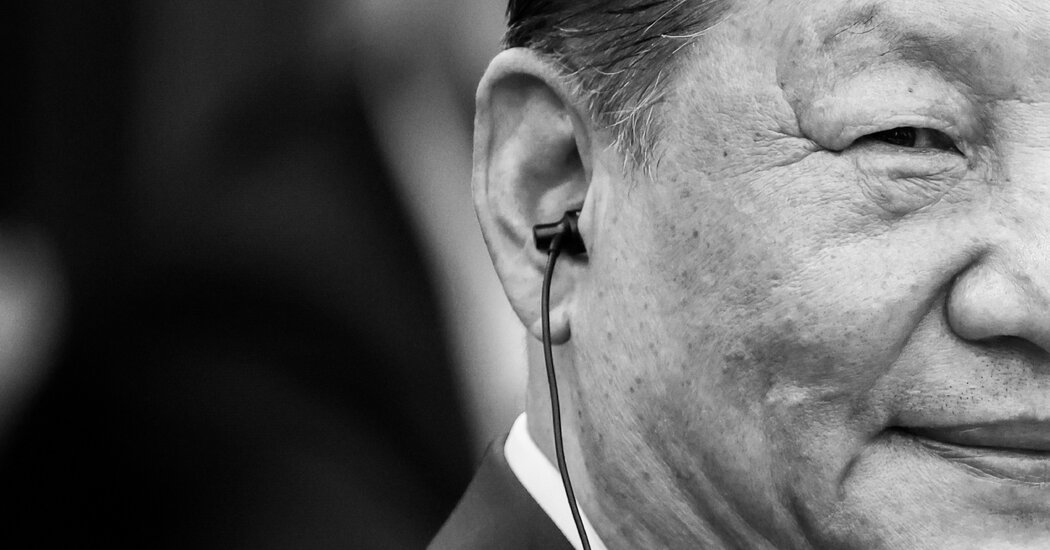
President Xi Jinping of China is believed to have ordered his armed forces to be prepared to invade Taiwan by 2027, if necessary, raising the specter of a catastrophic military conflict in the next few years that would almost inevitably draw in the United States.
But an ongoing purge by Mr. Xi of his top military ranks casts doubt on that deadline and, in the longer term, whether he can trust his generals to successfully wage war.
Over the past two years, two defense ministers and a host of senior People’s Liberation Army officers have been removed from their positions, including top leaders of the Rocket Force, which controls China’s nuclear weapons.
Heads continue to roll, including, according to recent reports, one of the highest-profile ousters yet: Gen. He Weidong, the country’s second-ranking officer, who reported directly to Mr. Xi and has been deeply involved in planning for a theoretical Taiwan invasion.
It is impossible to say for sure whether such dismissals are related to corruption — a stubborn and serious problem in the People’s Liberation Army — to ideological differences or to other reasons. But the tumult raises serious questions about the competence and reliability of Mr. Xi’s military commanders. This is likely to weaken his appetite for war, offering Taiwan and the United States time to strengthen their defenses.
There is no question that China’s military has come a long way. Once antiquated, it is now the world’s largest armed force and rivals the United States in air, naval and missile power. China’s military has been rehearsing an invasion or blockade of Taiwan for years — including exercises in early April — and is working out some of the challenges of transporting tens of thousands of troops across the Taiwan Strait.
But hardware and logistics alone don’t ensure victory. Military effectiveness depends heavily on battlefield leadership — experienced commanders able to make tough calls, quickly, in the fog of war. China has not fought a war since 1979, and today’s generation of Chinese officers, unlike their American and Russian counterparts, has no battlefield experience, a fact that Mr. Xi himself has lamented.
The deeper problem — underscored by the internal turmoil — is that Mr. Xi and the Chinese Communist Party may not even have a solid grip on their army.
Unlike the U.S. military, whose personnel swear an oath to the Constitution and are supposed to be apolitical, the People’s Liberation Army is the Chinese Communist Party’s army. Its officers swear allegiance to the party — of which they are members — and take their orders from Mr. Xi as head of the party and chairman of its powerful Central Military Commission. In theory, they should be under firm party control, but that’s not the case.
The People’s Liberation Army, with its combined army, navy and air forces, occupies a powerful position in China. This was immortalized by Mao Zedong, who said, “Political power grows out of the barrel of a gun.” The army’s status resulted in party leaders granting it a high degree of autonomy to ensure generals remained loyal, essentially allowing it to police itself.
As Chinese military spending soared over the years, so did opportunities for corruption. Party leaders, some of whom were themselves accused of being corrupt, often looked the other way. But after Mr. Xi took power in 2012, he began an anti-graft campaign throughout the party that rooted out corrupt or potentially disloyal senior military officers. He also undertook the largest restructuring of the armed forces since Mao.
The long-running purge indicates he’s still struggling to assert control.
Most of the recent dismissals appear related to corruption. But like his predecessors, Mr. Xi needs the military’s backing to maintain his grip on power and can go only so far in attacking its culture of graft. Illustrating the intractability of the problem, those brought down in the past two years have been his own appointees.
Corruption undercuts military preparedness in important ways. It can fuel the rise of officers more skilled at receiving kickbacks than at commanding troops and lead to the purchase of subpar equipment. A report released last year by the U.S. Department of Defense suggested that corruption in China’s Rocket Force might have been so severe that some missile silos required repairs.
Perhaps more important, the wave of dismissals may mean that Mr. Xi cannot fully trust what his military advisers tell him about China’s readiness for war. General He’s case, in particular, raises doubts regarding Taiwan, a self-ruled island that China claims as its own territory. As a former chief of the Eastern Theater Command, General He was responsible for planning a potential invasion of Taiwan until Mr. Xi elevated him in 2022 to vice chairman of the military commission, where he was the Chinese leader’s top adviser on a Taiwan campaign.
All of this adds to another key problem common in the armies of autocratic countries: political interference. Chinese officers and soldiers spend substantial amounts of time on political indoctrination, including studying Mr. Xi’s speeches. Ever-present political commissars make sure the party’s orders are followed, which can slow down decision making and inhibit individual initiative. In democratic countries, by contrast, officers have more freedom to make their own decisions and learn from their mistakes.
None of this means Taipei or Washington can afford to be complacent. China’s huge army would fight if ordered to, even if not fully ready, especially if China perceives Taiwan moving toward outright independence.
But Mr. Xi is probably not spoiling for a fight. The disastrous invasion of Ukraine by President Vladimir Putin of Russia showed the world that military might alone does not ensure victory over a smaller foe that is dug in and determined. Win or lose, a war with Taiwan could devastate China’s economy — which already faces slowing growth and hefty U.S. trade tariffs — and a military failure could threaten Mr. Xi’s hold on power.
Taiwan should use this time to radically increase spending on weapons that are especially useful in repelling an invasion, such as anti-ship cruise missiles, sea mines and drones. The United States should deploy more long-range missiles and other weaponry to the region to deter a Chinese attack against the island. It also could capitalize on American military ingenuity by devising innovative ways to thwart an invasion that exploit Chinese commanders’ inexperience and inability to quickly respond to unforeseen situations.
The greatest risk today is that the fear and tension stoked by aggressive Chinese behavior and language lead to a miscalculation and war. China’s threats will continue. But leaders in Taiwan and the United States must avoid overreacting and recognize that for the foreseeable future, Mr. Xi will be reluctant to send a scandal-plagued military into battle.
Phillip C. Saunders is the director of the China Center at the Institute for National Strategic Studies at National Defense University in Washington, D.C. Joel Wuthnow is a senior research fellow at the institute. They are the authors of “China’s Quest for Military Supremacy.”
The Times is committed to publishing a diversity of letters to the editor. We’d like to hear what you think about this or any of our articles. Here are some tips. And here’s our email: letters@nytimes.com.
Follow The New York Times Opinion section on Facebook, Instagram, TikTok, Bluesky, WhatsApp and Threads.
