

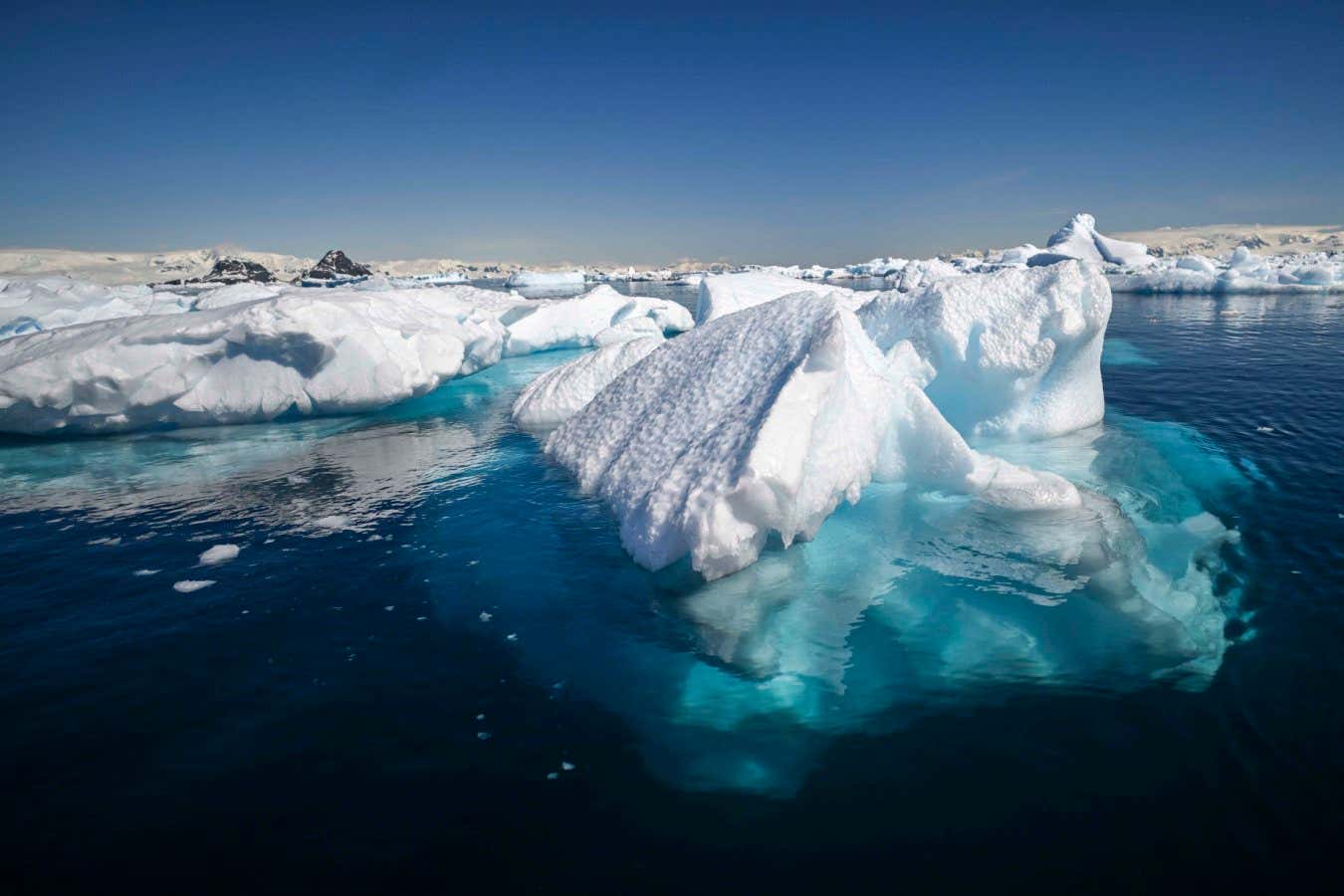
Melting ice in Antarctica could have an impact on ocean currents
JUAN BARRETO/AFP via Getty Images
While the melting of the Greenland ice sheet is expected to slow or even collapse the Atlantic Ocean current that keeps Europe warm, meltwater from West Antarctica could preserve this vital current.
But it won’t be enough to prevent major changes in the climate. The Atlantic Meridional Overturning Circulation (AMOC) would still decline by 60 per cent, and its full recovery would take 3000 years.
“I would tend to say, don’t be so quick to say that the AMOC is going to collapse,” says Sacha Sinet at Utrecht University in the Netherlands. “But the things I show here do not change much what will happen for the next century. Probably you will not be alive to tell if the AMOC was stabilised or not by West Antarctica.”
The AMOC is a system of currents that brings warm surface water from the tropics towards northern Europe, where it cools and sinks before flowing south to Antarctica. The current carries 1.2 petawatts of heat – equivalent to the energy generated by 1 million power plants – that keeps Europe much warmer than Labrador or Siberia at the same latitude. But light, fresh meltwater from Greenland’s ice is expected to hinder the sinking of salty, dense AMOC water, slowing down the current.
If the AMOC collapsed, winter cold snaps could reach almost -50°C (-58°F) in northern Europe. This week, Iceland declared AMOC shutdown an “existential” security threat. Sea levels would also be higher along the US east coast, and Africa could suffer more severe droughts.
Recent research concluded that even if we reach net zero by 2075 and then start removing CO2 from the atmosphere, the risk of eventual AMOC collapse could still be 25 per cent. One study predicted a shutdown within decades, while another said Antarctic winds would keep the AMOC going in a weakened state.
Meanwhile, the melting of the West Antarctic ice sheet has been accelerating in recent decades, and some research suggests that it is likely to collapse completely. But the effect this will have on the AMOC is unclear.
According to simulations by Sinet and his colleagues, the timing of the melting is key. If a centuries-long pulse of Antarctic meltwater arrives at the same time as massive melt from Greenland, it will only speed up AMOC shutdown.
If the Antarctic water arrives about 1000 years before the peak of Greenland’s melting, however, the AMOC would weaken for several hundred years, but then recover over the next 3000 years. While the AMOC eventually recovered in all scenarios, this early Antarctic melt prevented its total collapse and sped up its revival.
This may be because as light, fresh meltwater pools around Greenland, the sinking of dense, salty AMOC water shifts southward, and the current later regains strength as meltwater tapers off from Antarctica.
Although it’s unlikely that West Antarctica would melt so early while Greenland would melt so late, these findings reveal a greater connection between the AMOC and Antarctic melt, says Louise Sime at the British Antarctic Survey.
“I don’t think we knew until this study that there was this possibility that changes in Antarctica could potentially change so much the impacts of Greenland ice sheet melt [on the AMOC],” she says.
However, the connection should now be investigated with more complex models, as this study didn’t include possible feedback effects like changing wind patterns, which could expand Antarctic sea ice, she adds.
Even if drastic West Antarctic melt prevented AMOC collapse, it would still cause as much as 3 metres of sea level rise, flooding coastal cities.
“Unfortunately it is not a consolation if one catastrophe might perhaps reduce the risk of another catastrophe,” says Stefan Rahmstorf at the University of Potsdam, Germany.
Topics:
