

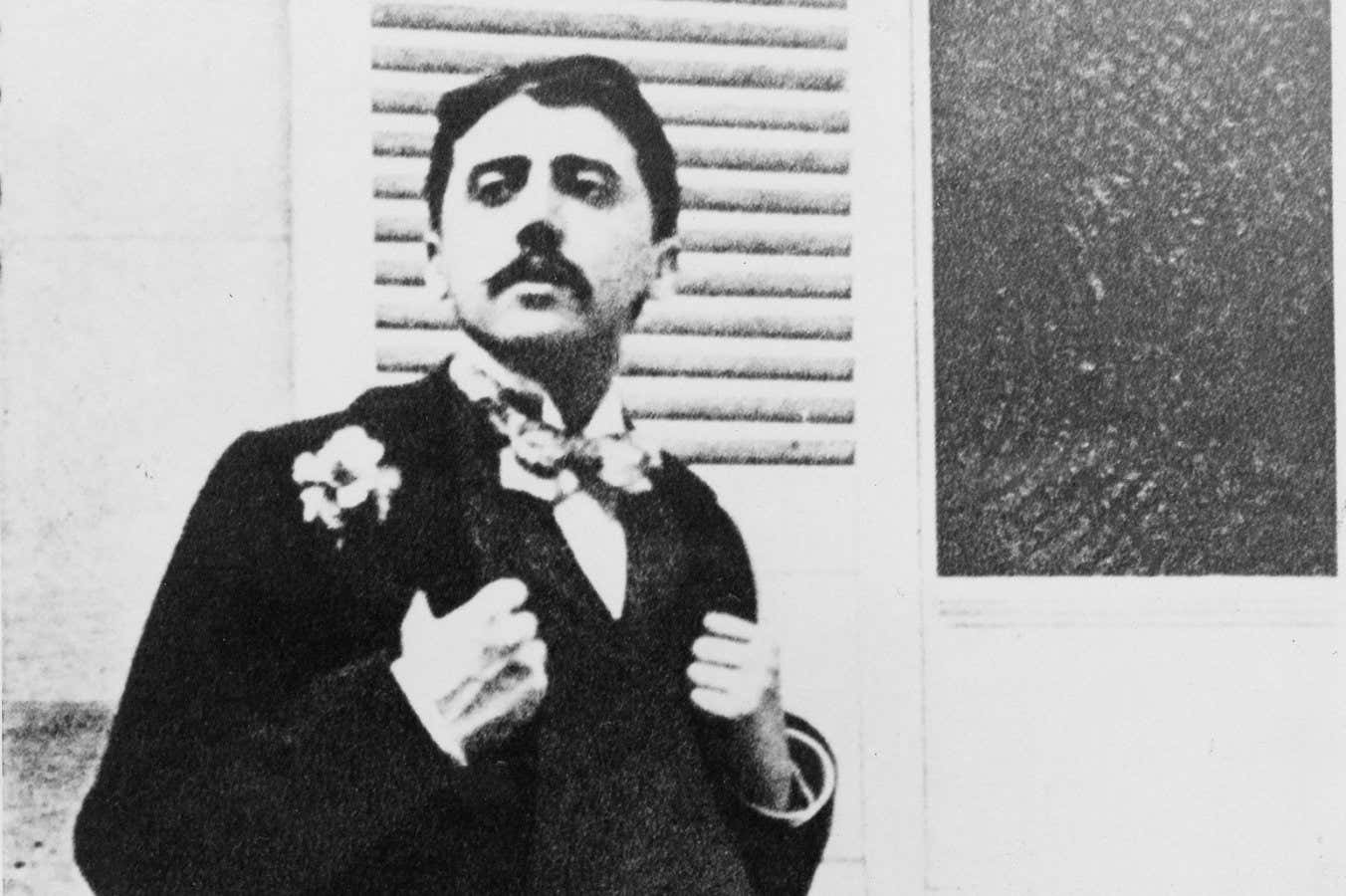
Marcel Proust, photographed in 1905
Photo 12 / Alamy
Dawn had crept serenely over the city. The shadows draped over the avenues were slowly receding to usher in a beautiful, bright morning. It was June, and the few early risers on their way to set up market stalls were basking in the quiet, pale radiance of the new day, some small comfort when the enemy was only fifty miles away. Many who could afford to had already fled the metropolis, but most of the inhabitants clung to the belief that the defensive line would hold, as it had for nearly four years. There was still hope.
On Boulevard Haussmann, a few cars headed eastwards but otherwise the street was quiet, with most of its inhabitants still to awaken. The occupant of the second-floor apartment at number 102, though, had been up for some time – all night, in fact. The shutters of his windows were tightly drawn, as they had been for months. His green bedside lamp was the only source of light in the gloomy bedroom. Crammed full of dark furniture with books piled high on the desk, and the heady vapours of stramonium for his asthma engulfing the chamber with pungent fumes, the room held an air of oppressive confinement. Its cork-lined walls, especially installed to isolate the occupant from the sounds of the street and the rest of the building, added to the sense of claustrophobia most of his visitors must have felt.
Sitting up in bed in his ornate Japanese housecoat and propped up on two large pillows, he would at this time of the day normally be working feverishly on his manuscript, which he had been writing diligently by hand in black leather notebooks over the last twelve years. But this morning was different. He had been gripped by an overwhelming fear. One side of his face, he was sure, was drooping. When he had spoken to his housekeeper, Céleste, on the previous evening he was convinced that his utterances had been slurred, his speech somehow garbled. He must be on the verge of suffering a major stroke, he concluded, just as both his mother and father had been afflicted. There could be no other explanation. It was in the family blood. And hadn’t his beloved mother, Jeanne, been left with a terrible infirmity? Her stroke had robbed her of language: she had become aphasic, unable to talk to her precious sons.
So it was that in the summer of 1918, as the Germans were launching their final offensives of the First World War with the aim of reaching Paris, that the great novelist Marcel Proust sat in his blue satin sheets contemplating with dread the possibility of a brain disorder, one that would deprive him of his most cherished ability: to communicate. Now in his late forties, he was highly familiar with aphasia. Not only had his mother suffered from it but, before his own stroke, his father Dr Adrien Proust had written an entire book on the topic.
The younger Marcel had also made the acquaintance of many of the most accomplished neurologists in the city. At that time, Paris was considered to be the leading centre for brain disorders in the world, with several of its pioneering experts having made landmark contributions to the subject. These included developing an understanding of disorders of language after stroke, which can impair not only the ability to speak, but also to read and write. Without these faculties, where would Proust be?
Such was the dread of his impending aphasia that morning in June 1918 that he made an appointment to see the celebrated neurologist, Joseph Babinski, whose consulting chambers were located just ten minutes away at number 170 on the same boulevard. As Proust recalled the encounter, Babinski had no knowledge of him. ‘Do you have a job?’ Babinski had apparently asked.
Proust’s objective that day was to get Babinski to perform a trepanation: to make a hole in his skull. So great was his fear that he was convinced that such a radical course of action was necessary to prevent a stroke from progressing. Babinski, ever the professional, examined Proust and reassured him that there was no evidence that he was suffering a stroke and gently declined to perform the surgical procedure. Goodness knows what might have happened to Proust’s great novel if he had. Marcel Proust never did experience a stroke, although the anxiety of being struck down by one continued to plague him intermittently for the rest of his short life. Even when, a few years later, he was dying from pneumonia, it was Babinski who was called for.
Proust’s concerns about suffering from a condition that affects the brain are not unique. Although any one of us can develop an illness that affects our bodies, what many of us fear the most is a disorder that affects our brains. Why? Because neurological conditions can make people become so very different. Some may not be able to communicate, as Proust had feared. Others might lose their memory or suffer from distorted perceptions or hallucinations. Some may become socially inappropriate, lacking in empathy, or be rude and aggressive. Others might become very impulsive or disinhibited, gambling away large amounts of money or developing new addictions. Some might suffer from pathological apathy, becoming withdrawn and lacking motivation to interact with other people.
Understandably, alterations in behaviour or personality like these can be extremely upsetting and frightening to people who develop them and to their families. But they also reveal a lot about you and me. By observing what happens when a particular brain function is lost, we can learn a great deal about our normal selves, how cognitive functions contribute to create who we are (our personal identities), as well as how they shape our social identities – the part of our selves that derives from our relationships to others.
For someone like Marcel Proust, loss of language would have been calamitous. Not only would he lose the ability to write but, perhaps just as importantly, he would no longer have the same presence within his social circle. The social identity that he had worked so hard to craft would effectively dissolve. Proust had spent years cultivating relationships with some of the loftiest members of French society. He had an inordinate preoccupation with his relationship to people of influence. For a man who was gay and from a Jewish background (on his mother’s side), he had deftly managed to navigate the complexities of Parisian prejudice and snobbery with enormous success.
Through observation and emulation, he had become an insider in a world where few would have thought he belonged or would have any sway. Indeed, some commentators have concluded that Proust was a highly effective manipulator, a man who was unwilling to relinquish his own influence over others in his orbit, even when he spent days on end writing in his sombre bedroom. Without language, though, the circles that he had worked so hard to be part of would no longer be accessible. He wouldn’t ‘belong’.
This is an extract from Masud Husain’s Our Brains, Our Selves (Canongate Books), winner of the Royal Society Trivedi Science Book Prize and the latest pick for the New Scientist Book Club. Sign up and read along with us here.
Topics:
