

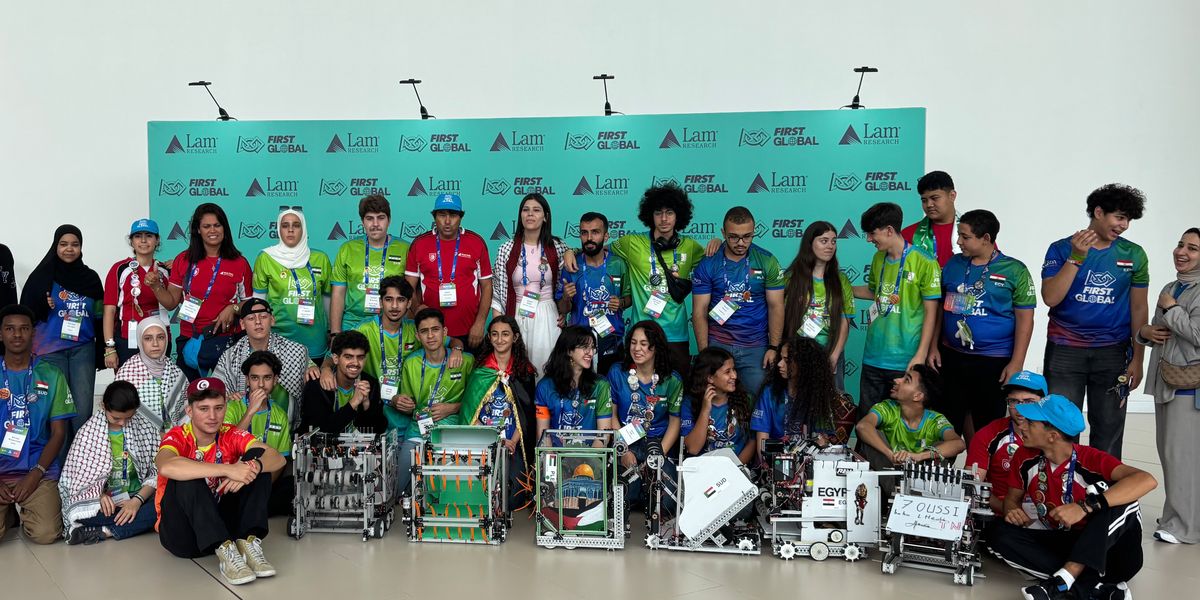
Aspiring engineers from 191 countries gathered in Panama City in October to compete in the FIRST Global Robotics Challenge. The annual contest aims to foster problem-solving, cooperation, and inspire the next generation of engineers through three challenges that are inspired by a different theme every year. Teams of students from 14 to 18 years old from around the world compete in the three day event, remotely operating their robots to complete the challenges. This year’s topic was “Eco-equilibrium,” emphasizing the importance of preserving ecosystems and protecting vulnerable species.
Turning Robotics Into a Sport
Each team competed in a series of ranking matches at the event. The matches consisted of several simultaneous goals, lasting two minutes and 30 seconds. First students guided their robots in gathering “biodiversity units” (multicolored balls) and delivering them to their humans. Next the robots removed “barriers” (larger, grey balls) from containers and disposed of them in a set area. Then team members threw the biodiversity units into the now-cleared containers to score points. At the end of the match, each robot was tasked with climbing a 1.5 meter rope. The team with the most points won the match.
To promote collaboration, each match had two groups, which consisted of three individual teams and their robots, competing for victory. Each team controlled its own robot, but had to work together with the other robots in the group to complete the tasks. If all six robots managed to climb the rope at the end of the match, each team’s scores were multiplied by 1.5.
The top 24 teams were split into six “alliances” of four individual teams each to compete in the playoffs. The highest-scoring alliance was crowned the winner. This year’s winning teams were Cameroon, Mexico, Panama, and Venezuela. Each student received a gold medal.
It may have been hard to tell it was a competition at first glance. When all six robots successfully climbed the rope at the end of the match, students across teams were hugging each other, clapping, and cheering.
“It’s not about winning, it’s not about losing, it’s about learning from others,” says Clyde Snyders, a member of the South Africa team. His sentiment was echoed throughout the event.
Making It Into the Competition
Before the main event, countries all over the world run qualifying events where thousands of students show off their robotics skills for a chance to make it to the final competition. Each country chooses its team differently. Some pick the top-scoring team to compete, while others pick students from different teams to create a new one.
Even after qualifying, for some students, physically getting to the competition isn’t straightforward. This year Team Jamaica faced challenges after Hurricane Melissa struck the country on 28 October, one day before the competition began. It was the strongest storm that has ever hit Jamaica, killing 32 people and leaving billions of dollars in infrastructure repairs. Because of the damage, the Jamaican team faced repeatedly cancelled flights and other travel delays. They almost didn’t make it, but FIRST Global organizers covered the costs of their travel. The students arrived on the second day, just in time to participate in enough matches to avoid being disqualified.
Team Jamaica arrived late due to Hurricane Melissa, but they remained positive. Kohava Mendelsohn
“We are so happy to be here,” says Joelle Wright, the team captain. “To be able to engage in new activities, to compete, and to be able to showcase our hard work.” Team Jamaica won a bronze medal.
Working Together to Fix and Improve Robots
Throughout the competition, it was a regular occurrence to see students from different teams huddled together, debugging problems, sharing tips, and learning together.
Students were constantly fixing their robots and adding new features at the event’s robot hospital. There, teams could request spare parts, get help from volunteers, and access the tools they need.
Volunteering in the robot hospital is demanding, but rewarding, says Janet Kapito, an electrical engineer and the operations manager at Robotics Foundation Malawi in Blantyre. She participated in the FIRST Global Challenge when she was a student.
“[The volunteers] get to see different perspectives and understand how people think differently,” she says. It’s rewarding to watch students solve problems on their own, she adds.
The hospital was home to many high-stress situations, especially on the first day of the competition. The Ecuadorian team’s robot was delayed in transit. So, using the robot hospital’s parts, the students built a new robot to compete with.
Tanzanian team members were hard at work repairing their robot, which was having issues with the mechanism that allowed it to climb up the rope.
Collaboration played a key role in the hospital. When the South African team’s robot was having mechanical problems, the students weren’t fixing it alone—several teams, including Venezuela, Slovenia, and India, came to help.
“It was truly inspirational, and such a great effort in bringing teams from over 190 countries to come and collaborate,” says Joseph Wei, director of IEEE Region 6, who was in attendance at the event.
The Importance of Mentoring Future Engineers
Behind every team were mentors and coaches who provided students with guidance and experience. Many of them were past participants who are invested in teaching the next generation of engineers.
But the robots are designed and built by the students, says Rob Haake, a mentor for Team United States. He tried to stay as hands-off as possible in the engineering of the robot, he says, “so if you asked me to turn on the robot, I don’t even know how to do it.”
Haake is the COO of window and door manufacturing company Weiland, Inc., in Norfolk, Neb. His passion is to teach kids the skills they need to build things. It’s important to teach students how to think critically and solve problems while also developing technical skills, he says, because those students are the future tech leaders.
One major issue he sees is the lack of team mentors. If you’re an engineer, he says, “the best way to help [FIRST Global] grow is to call your local schools to ask if they have a robotics team, and if not, how you can help create one.
“The answer may be a monetary donation or, more importantly, your time,” he says. The students you mentor may one day represent their country at a FIRST Robotics Challenge.
From Your Site Articles
Related Articles Around the Web
