

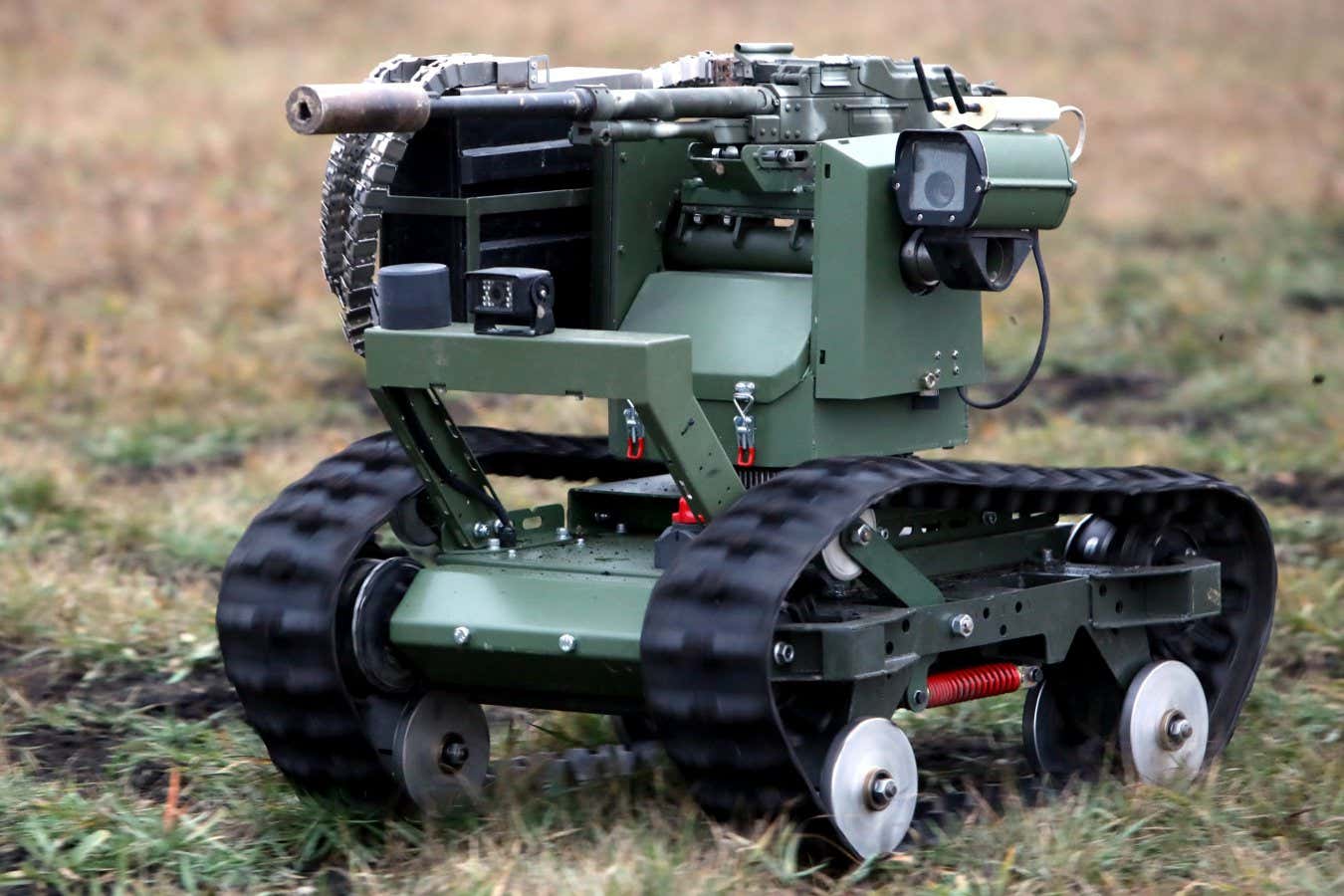
Ukraine’s “Legit” unmanned ground vehicle
OLEKSANDR KLYMENKO/Ukrinform/NurPhoto/Getty Images
There’s a received piece of wisdom among militaries around the world that whatever new technologies appear, in the end, foot soldiers are what matters. As British Army officer Field Marshal Archibald Wavell put it shortly after the second world war: “All battles and all wars are won in the end by the infantryman.” This may now finally be changing.
Robots in battle are about to reach a critical point for Ukraine. In May, it began the mass production of Legit, a low-cost robot capable of carrying a machine gun. This comes after announcing plans to replace a third of its infantry with uncrewed ground vehicles (UGVs) in one sector, despite their limitations.
“Even imperfect systems become valuable if they absorb risk instead of soldiers,” says Oleksandra Molloy at the University of New South Wales in Australia.
The most important proving ground for Ukraine’s robots will be the front line. It is there where casualties are most likely and where substituting machines for people is most vital. Yet, the front is only thinly populated with soldiers watching over ditches and minefields. The real intelligence gathering is done by drones, with one Ukrainian soldier reportedly saying that the observers are only there because “old generals” demand boots on the ground.
So could robots hold the line alone? Mykola Zinkevych, a commander in the Ukrainian military, says they already have. He says that a quad bike-sized UGV, driven by a remote operator at around 6 kilometres per hour, occupied a front-line position for 45 days, fighting off Russian troops solo.
There were no soldiers in the fighting position, and the DevDroid returned at intervals for handlers to change batteries and refill magazines. UGVs had previously been used mainly to transport supplies, but increasingly they are fitted with remote-controlled machine-gun turrets.
The next challenge for UGVs is offensive attacks, but these are harder because of mobility difficulties. In 2024, the Ukrainian military carried out the first ever robot-only assault. Even after careful surveys to avoid obstacles, two of the machines got stuck. Nevertheless, the assault was successful in taking the Russian position.
Ukraine has continued small-scale UGV operations since, allowing the military to develop specific robot tactics. One unit estimates that robot assaults have saved it hundreds of casualties.
“Everyone must understand: this is about saving lives,” said Ukrainian President Volodymyr Zelensky in April, as he announced plans to ramp up UGV production to 50,000 UGVs in 2026, up from around half that figure last year.
There is no particular technological breakthrough that has led to this moment. UGVs are relatively simple robots and are controlled by a remote human operator. The US deployed, but did not use, similar armed robots in Iraq in 2007. But Ukraine has a particular pressure to test robots as its army is so outnumbered by Russian soldiers. For this same reason, Russia has experimented less with automation.
The costs are modest. The Legit costs only around $11,400, in part because it uses components originally designed for Hoverboards, the motorised two-wheeled scooters. Cheap, expendable machines can be readily sacrificed in suicide attacks, or to defend a position to the last bullet, so that human lives need not be risked.
“The battlefield rarely rewards elegance,” says Molloy. “It rewards survivability, redundancy, low cost and mass.”
Ukraine’s Commander of the Third Army Corps Andriy Biletskyi says that he hopes robots will make up 80 per cent of the Ukrainian fighting force in the near future.
Current wheeled and tracked UGVs are not suited to urban terrain or going inside buildings, but this could be set to change. The US military is experimenting with humanoid robots for “breaching operations”, using explosives to blast a way into buildings. Current humanoid robots are clumsy, but various makers, including Elon Musk’s Tesla, believe that agile, AI-enabled humanoids could be mass-produced within two years.
“UGVs do not actually replace army manpower; they displace, reallocate and up-skill it,” says Molloy.
But there is a clear upgrade path to AI-powered machines operating without human control, which would be more efficient – and ethically challenging.
The success of Ukraine’s UGVs is not guaranteed, and many will argue that trench warfare is an easy environment for robots compared with other types of conflict. But the coming of robot soldiers in Ukraine could mark a permanent change in the face of war.
Topics:
