

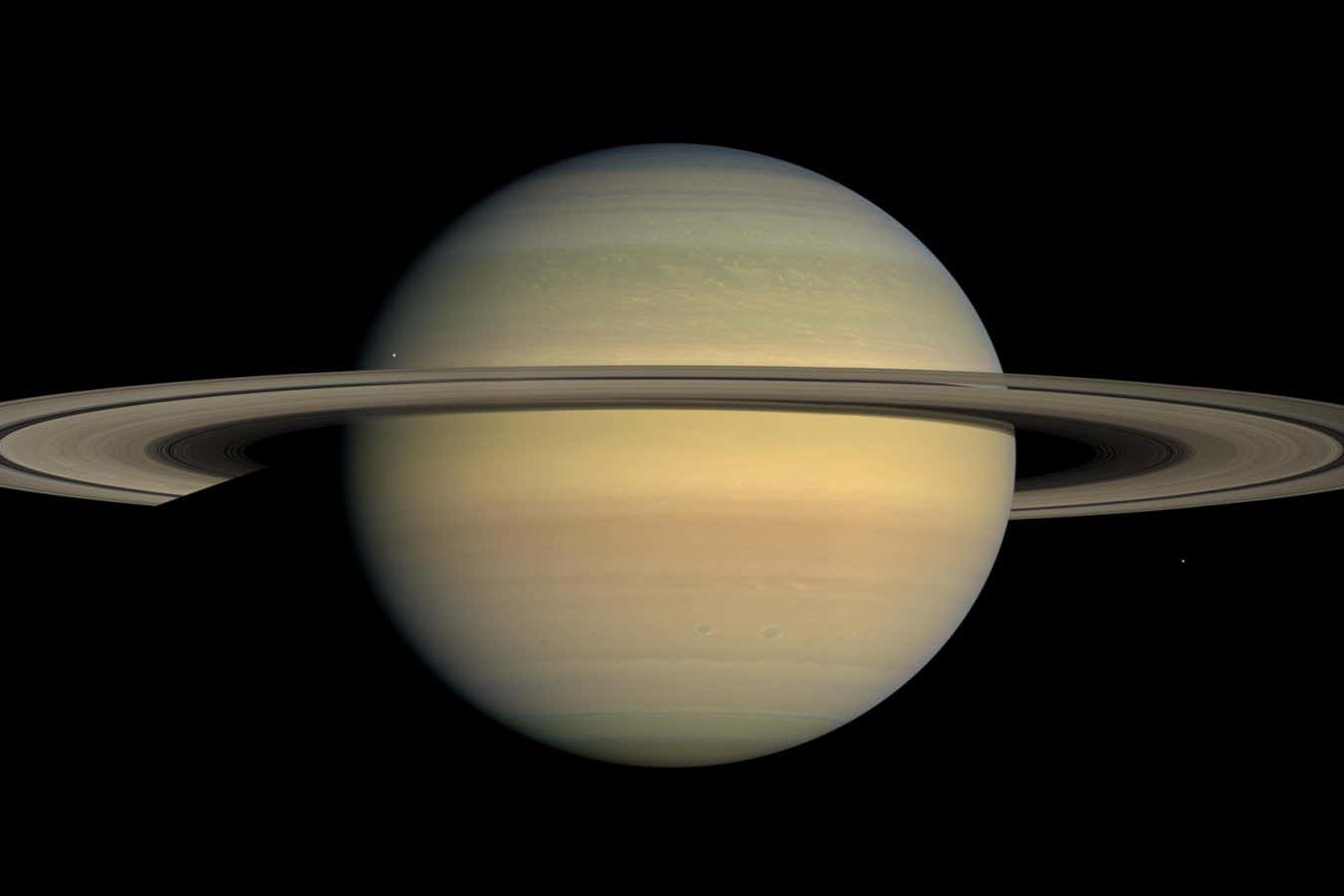
Saturn now has a total of 274 moons
NASA/JPL/Space Science Institute
A further 128 moons have been discovered orbiting Saturn, bringing the planet’s total to 274 – more than there are around all the other planets in our solar system combined. But as advances in telescope technology allow us to spot progressively smaller planetary objects, astronomers face a problem: how tiny can a moon be before it is just a rock?
Edward Ashton at Academia Sinica in Taipei, Taiwan, and his colleagues found the new moons with the Canada-France-Hawaii Telescope, revealing dozens that have previously evaded astronomers. They took hours of images of Saturn, adjusted them for the planet’s movement through the sky and stacked them on top of each other to reveal objects that would otherwise be too dim to see.
All the new moons are between 2 and 4 kilometres in diameter and are likely to have been formed hundreds of millions or even billions of years ago in collisions between larger moons, says Ashton.
“These are small little rocks floating in space, so some people might not find it quite an achievement,” says Ashton. “But I think it’s important to have a catalogue of all the objects in the solar system.”

The dot at the centre of this image is one of the new “fuzzy blob” moons of Saturn
Edward Ashton et al. (2025)
Despite the wealth of data gathered by his team, these latest moons still only appear as “fuzzy blobs”, says Ashton. There are more powerful telescopes that could potentially resolve the moons in more detail, although many have smaller fields of view, which would mean taking many more images, he says.
The newly discovered moons have been recognised by the International Astronomical Union (IAU), and Ashton and his team will now get the right to name them. Ashton, who is Canadian, says he has approached a representative from Canada’s Indigenous peoples for suggestions, but is also mulling the idea of some kind of public naming contest.
Could there be more moons out there? Scientists have spent decades scanning the area around Saturn with increasingly powerful telescopes, which has paid off in recent years. In 2019, 20 new moons were found, and Ashton and his colleagues had already discovered 62 in 2023, separate from the 128 they most recently found. Ultimately, it is likely that further discoveries will require advances in telescope technology, says Ashton, who believes there are easily thousands of moons in orbit around Saturn, even discounting the smaller, rocky debris found in the planet’s rings.
Mike Alexandersen at the Minor Planet Center, which logs planetary bodies for the IAU, says there are likely to be many more moons yet to be found in our solar system as improvements to telescopes allow them to see smaller objects. He says decisions will have to be made about what does and doesn’t count as a moon.
“I do know that the IAU decided that, due to the number of moons that are likely to exist, they’re not going to prioritise naming anything that’s smaller than 1 kilometre. But that’s not the same as them not recognising it as a moon,” says Alexandersen. “They’ll probably only name it if a spacecraft goes to visit it.”
He suggested that the cutoff between what is a moon and what is just a rock particle that makes up part of a planetary ring is probably going to be somewhere between 1 kilometre and 1 metre in diameter. “In the end, it probably won’t be my decision, it’ll be the IAU, which will make up some cutoff which will be more or less controversial – just like the cut for what’s a planet or not. And it’s most likely going to be relatively arbitrary,” says Alexandersen.
Elizabeth Day at Imperial College London says that, one day, there may even be commercial reasons for having accurate maps of the solar system. “We might want to extract resources from asteroids and moons in the solar system, so having a great understanding of what is where is important for that,” says Day.
Topics:
