

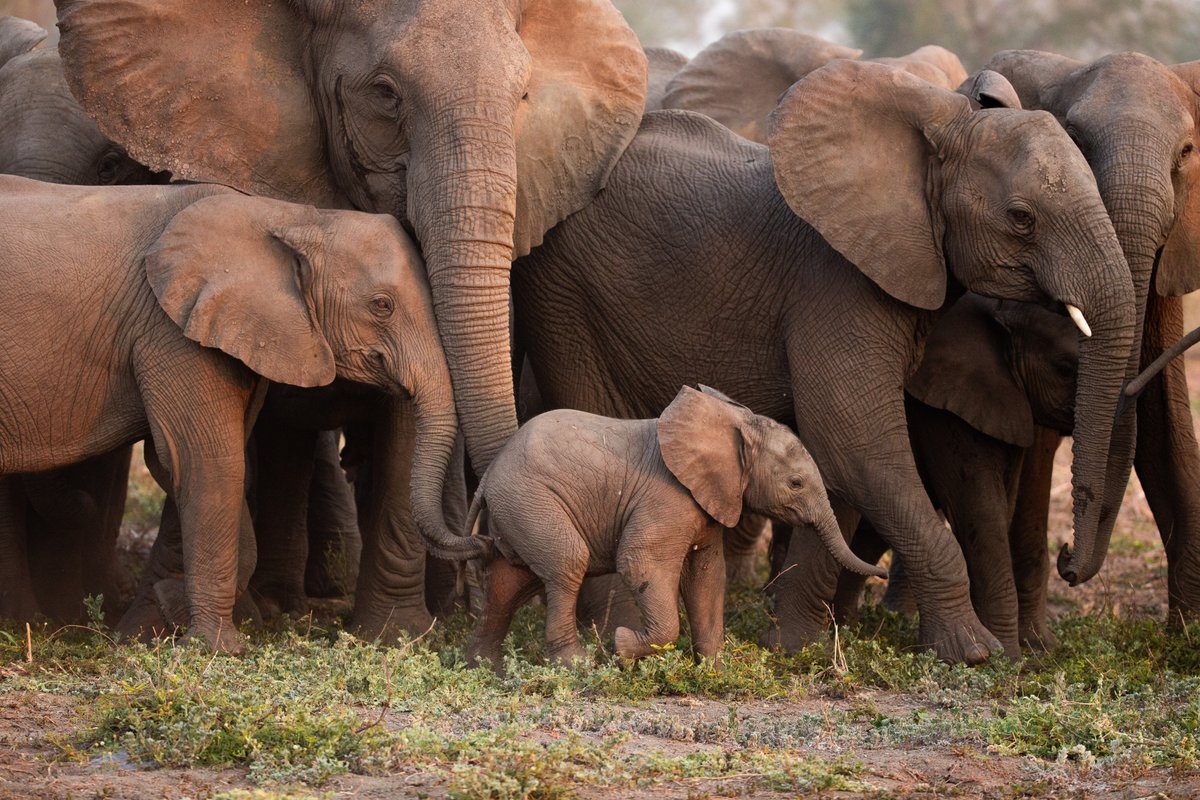
In February 2020 behavioral ecologist Mickey Pardo witnessed the aftermath of an elephant birth. In Kenya’s Samburu National Reserve, he watched as a female African elephant named Matisse called to her newborn with repeated “rumbles”—a kind of deep vocalization he describes as like “an idling truck engine.” Pardo watched as another adult elephant, likely Matisse’s sister, rumbled from a distance before the family came together, uniting with another series of rumbles, as if saying hello.
“It was just really … fascinating to see this whole sequence,” recalls Pardo, a senior scientist at the research organization ElephantVoices. What these calls might mean, exactly, has long been a mystery. But a new study published on Thursday in Scientific Reports helps to shed some light.
On supporting science journalism
If you’re enjoying this article, consider supporting our award-winning journalism by subscribing. By purchasing a subscription you are helping to ensure the future of impactful stories about the discoveries and ideas shaping our world today.
In the study, Pardo and a team of scientists used machine learning to analyze hundreds of rumble recordings from a separate population of African elephants in Amboseli National Park, also in Kenya.
The analysis homes in on several kinds of elephant rumbles: “coo” rumbles to calves, “contact” rumbles made from a distance, “let’s-go” rumbles before group movements, “cadenced” rumbles during rest or meals and two different “greeting” rumbles.
In many cases, the recordings captured overlapping calls, a jumble of rumbles the researchers refer to as “choruses.” To be clear, these calls are not at all like elephants’ iconic trumpet sound. They are low and almost like a growl or thunder.
The researchers used the algorithm to predict the elephants’ behavior based on each recording. It wasn’t entirely accurate, but it did predict behaviors better than chance—suggesting that elephant vocalizations during similar situations may have similar acoustic properties.
“It is pretty exciting that we’re able to train a model to look at an entire chorus and have some interpretation of exactly what’s going on,” says Sara Keen, a study co-author and a senior research scientist at the nonprofit Earth Species Project.
In some cases, different rumbles became progressively similar, a pattern the researchers describe as “vocal convergence.” Scientists have observed this phenomenon in other chatty animals, including parrots and dolphins. Humans, too, are known to mirror one another’s language patterns.
Interestingly, converging appeared “only in the situations where they [the elephants] seem to be coordinating group behavior action,” Keen says. It’s possible that this convergence could indicate agreement, but that theory needs further testing to confirm, she adds.
“This study emphasizes how vital it is to pair new computational analyses with real behavioral observations in the wild,” says Arik Kershenbaum, a zoologist at the University of Cambridge, who was not involved in the study.
Keen hopes scientists may be able to use similar methods to analyze other animal calls, too, such as for orcas and crows. Many other species are known to perform a kind of “chorusing,” she says, which may make good candidates for future research.
“Animals communicate to influence each other’s behavior, and so you can’t just study the sounds in isolation,” Kershenbaum explains. “But when you combine a rich behavioral dataset with powerful machine learning algorithms, that’s when we can start to get answers to questions like ‘What are the animals saying?’”
Subscribe to Support Independent Journalism
Great science journalism requires human expertise, time, effort and creativity. And it costs money. That’s why I and the journalists here at Scientific American hope you’ll join our community.
When you subscribe, you are supporting staff and freelance journalists who are passionate about telling science stories that are true, important and compelling. Our editors and reporters are often experts in their fields, which means they understand the nuances of big discoveries and can untangle the breakthroughs from the hype. With a subscription, you are also supporting rigorous fact-checking to ensure the words we publish are precise and accurate. And you’re supporting original illustrations, graphics and photos that bring you closer to an advanced laboratory, an ice sheet in Antarctica or a space mission in orbit. You’re helping us craft other types of high-quality journalism as well: Our newsletters are carefully written, edited and curated by staffers you have or will come to know and love. Our Science Quickly podcast is based on original reporting, collaboration with editors and scientists and exacting production.
Subscriptions keep this engine running so we can continue to deliver thoughtful, rigorous and independent science journalism to you. In an era of viral misinformation, this work is crucial. If you value what we do, I hope you’ll consider joining us as a subscriber
