

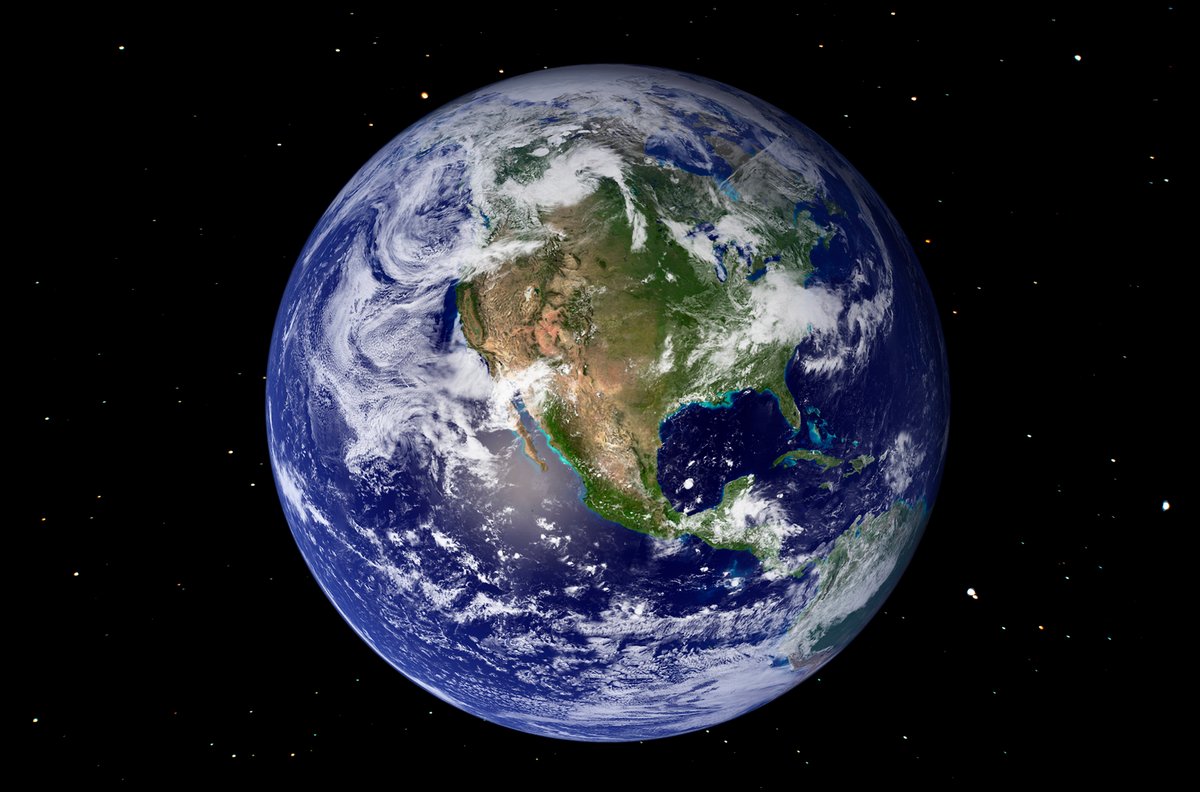
Several times since the age of dinosaurs, the solid part of our planet has rolled over, drowning some continents and lifting others out of the sea.
Our planet is slightly squished, with more mass at the equator. But the movement of Earth’s mantle and rocky crust can make some areas denser than others and throw off the planet’s balance. As a result, these solid outer layers can tilt and slide around the planet’s liquid inner core beneath as the planet works to redistribute its mass. This phenomenon is called true polar wander because it moves the planet’s actual rather than magnetic poles.
Incredibly, a new Science study finds this massive upheaval has happened to our planet at least four times in the past 320 million years. And it’s still ongoing.
On supporting science journalism
If you’re enjoying this article, consider supporting our award-winning journalism by subscribing. By purchasing a subscription you are helping to ensure the future of impactful stories about the discoveries and ideas shaping our world today.
“Based on satellite measurements, we know that this is happening today, at about 10 centimeters a year, mainly because of melting ice caps,” says Mathew Domeier, a geoscientist at the University of Oslo and lead author of the study.
What scientists didn’t know was whether true polar wander is a slow, steady process that’s always going on or happens in short, rapid bursts. The best evidence scientists had for the phenomenon was from magnetic signals recorded in ancient rocks, but those are sparse and inconclusive. So instead Domeier’s team looked at clues hidden in ancient floods.
Earth’s spin makes both the planet’s rock and water bulge at the equator. When the solid Earth tips out of alignment, it is driven through the watery bulge, and parts of the rock poke out of the water while others get drowned. It looks like sea-level change, but that’s not the case at all, Domeier says: The water stays put while the continents move. Two opposing quarters of the globe flood, while the other two dry out, forming a unique four-leaf-clover pattern.
The team analyzed maps showing where continents lay underwater or dry at 10-million-year time points. The four-leaf-clover pattern appears around 200, 150 and 100 million years ago, and again between 30 and 20 million years ago. The findings, Domeier says, “took me quite by surprise.”
“The particularly elegant aspect of this study is the independent test it provides” for the existing magnetic data, says Giovanni Muttoni, a geologist at the University of Milan, who wasn’t involved in the new research. The strongest signal found, from 150 to 140 million years ago, he notes, matches a period for which magnetic data had already hinted at rapid wander.
“During true polar wander, continents can move rapidly across the climate belts even though their positions relative to one another change much less,” Muttoni says. This rapid movement could reshape ocean currents, upend ecosystems and perhaps even nudge Earth’s magnetic field.
What exactly triggers rapid true polar wander events and how far the poles move during them remains unknown. “Trying to understand why these events happened at these times would be the next logical step,” Domeier says.
Subscribe to Support Independent Journalism
Great science journalism requires human expertise, time, effort and creativity. And it costs money. That’s why I and the journalists here at Scientific American hope you’ll join our community.
When you subscribe, you are supporting staff and freelance journalists who are passionate about telling science stories that are true, important and compelling. Our editors and reporters are often experts in their fields, which means they understand the nuances of big discoveries and can untangle the breakthroughs from the hype. With a subscription, you are also supporting rigorous fact-checking to ensure the words we publish are precise and accurate. And you’re supporting original illustrations, graphics and photos that bring you closer to an advanced laboratory, an ice sheet in Antarctica or a space mission in orbit. You’re helping us craft other types of high-quality journalism as well: Our newsletters are carefully written, edited and curated by staffers you have or will come to know and love. Our Science Quickly podcast is based on original reporting, collaboration with editors and scientists and exacting production.
Subscriptions keep this engine running so we can continue to deliver thoughtful, rigorous and independent science journalism to you. In an era of viral misinformation, this work is crucial. If you value what we do, I hope you’ll consider joining us as a subscriber
