

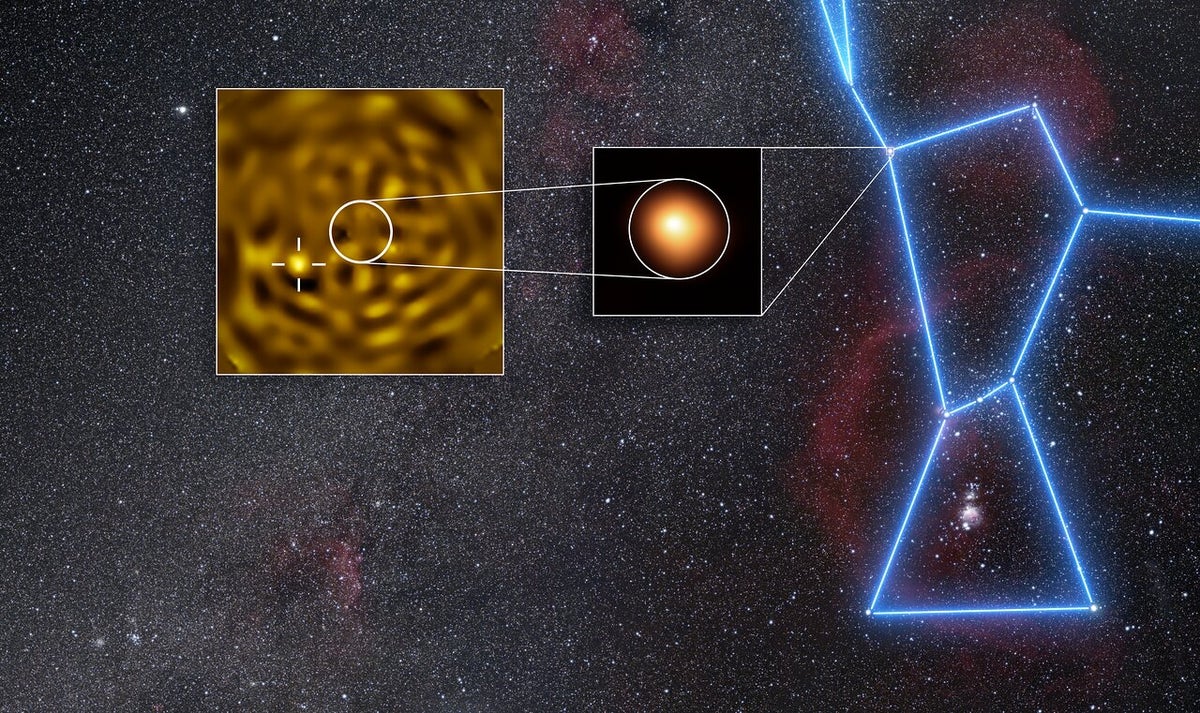
Betelgeuse, Betelgeuse, Betelgeuse: somewhat like summoning the homophonically named movie character, astronomers had hoped that repeated studies of this iconic red supergiant star would reveal its long-suspected stellar companion. Now, after years of theoretical predictions and observational hints, proof of its existence has apparently arrived.
Betelgeuse is one of the most conspicuous stars in the heavens above. You’ve almost certainly noticed it, even if not by name, as the gleaming red dot marking the right “shoulder” of the constellation of Orion. It’s famed among astronomers, too, as one of the largest visible stars in the night sky—if it were to replace our own sun, Betelgeuse would engulf all the surrounding planets as far as Mars. But despite the star being so well known, there’s much still to learn about it. Researchers don’t yet know, for instance, just how far away it is; more recent studies place it in the ballpark of 600 light-years from earth, give or take 50-odd light-years.
Speculations about a smaller companion star of Betelgeuse have been around for nearly a century, but any actual evidence for its reality has come only relatively recently. In a January preprint paper that was subsequently published in February, for instance, scientists announced that years of observations from the Hubble Space Telescope showed what could be the possible second star passing in front of Betelgeuse once every six years.
On supporting science journalism
If you’re enjoying this article, consider supporting our award-winning journalism by subscribing. By purchasing a subscription you are helping to ensure the future of impactful stories about the discoveries and ideas shaping our world today.
To settle the issue once and for all, a team of researchers went looking for the companion using an instrument called SPHERE/ZIMPOL on the European Southern Observatory’s Very Large Telescope in Chile. SPHERE/ZIMPOL is custom-built for high-contrast imaging, the sort of capability that is required for teasing out the meager light of an exoplanet (or a small stellar companion) against the dazzling brilliance of a far larger and brighter star. But even this mighty instrument couldn’t easily cut through Betelgeuse’s overpowering glare; that’s why the team chose to look in December 2024—a time when earlier work had predicted the hypothesized companion wouldn’t be obscured by Betelgeuse itself and would be near its maximum separation from the red supergiant in the sky. After months of painstaking data processing, the companion—formally known as Betelgeuse B—swam into view on the researchers’ computer monitors as a faint blip of light.
Their results, reported in the journal Astronomy & Astrophysics, constitute a “gorgeous detection,” says study co-author Andrea Dupree, an astronomer and associate director of the Center for Astrophysics | Harvard & Smithsonian. “I mean, it’s really there!” Besides offering a mere existence proof, she adds, the study provides new details about the companion, which “seems to be about three solar masses”—much heavier than previous, more piecemeal estimates had guessed.
In astronomy, however, seeing isn’t always believing; clouds of orbiting dust or far-distant background galaxies could masquerade as a planetary point of light around a star. But in this case, there are other reasons to be convinced that Betelgeuse B is genuine, says Meridith Joyce, an astronomer at the University of Wyoming, who was not part of this latest study.
“I trust it for a number of reasons,” she says, pointing out that the findings are consistent with several other papers released in recent years. Even the one discrepancy she found was minor: Joyce says her work suggested the companion’s mass would be smaller than what was imaged. She notes, however, that her calculations were based on a library of data from other stars that is, by its nature, imperfect.
“The models we were using to make those sort of mass estimates were pretty sparsely sampled,” she says.
One of Betelgeuse’s most notorious mysteries is its strange habit of brightening and dimming. In 2019 this fading was so pronounced—a phenomenon known as Betelgeuse’s Great Dimming—that some observers thought it might be experiencing the death throes that precede a star exploding in a supernova. By the next year, the star’s luminosity had returned to normal. That dimming and rebrightening was likely the result of a coronal mass ejection—a huge expulsion of stellar material—and was unrelated to Betelgeuse B, Dupree says.
The paper that was published in February, which Dupree worked on, offered an observational hint of Betelgeuse B. In it, she and her co-authors used relatively small and inexpensive telescopes to discern a ripple in the larger star’s atmosphere that we now know is obviously the wake raised by Betelgeuse B’s gravitational pull. With the smaller star now confirmed, Dupree hopes to use the same method to monitor other massive stars for hidden companions. Taking a more complete census of such systems, she says, could help astronomers better understand the vagaries of star formation and the finer details of how supergiants live and die.
For now, however, despite their relative certainty, the authors of the new study are calling for further observations to shore up their result. If subsequent studies show the point of light orbiting around the star and periodically disappearing behind it as expected, their discovery will be undeniable. “We’ll see,” Dupree says.
It’s Time to Stand Up for Science
If you enjoyed this article, I’d like to ask for your support. Scientific American has served as an advocate for science and industry for 180 years, and right now may be the most critical moment in that two-century history.
I’ve been a Scientific American subscriber since I was 12 years old, and it helped shape the way I look at the world. SciAm always educates and delights me, and inspires a sense of awe for our vast, beautiful universe. I hope it does that for you, too.
If you subscribe to Scientific American, you help ensure that our coverage is centered on meaningful research and discovery; that we have the resources to report on the decisions that threaten labs across the U.S.; and that we support both budding and working scientists at a time when the value of science itself too often goes unrecognized.
In return, you get essential news, captivating podcasts, brilliant infographics, can’t-miss newsletters, must-watch videos, challenging games, and the science world’s best writing and reporting. You can even gift someone a subscription.
There has never been a more important time for us to stand up and show why science matters. I hope you’ll support us in that mission.
