

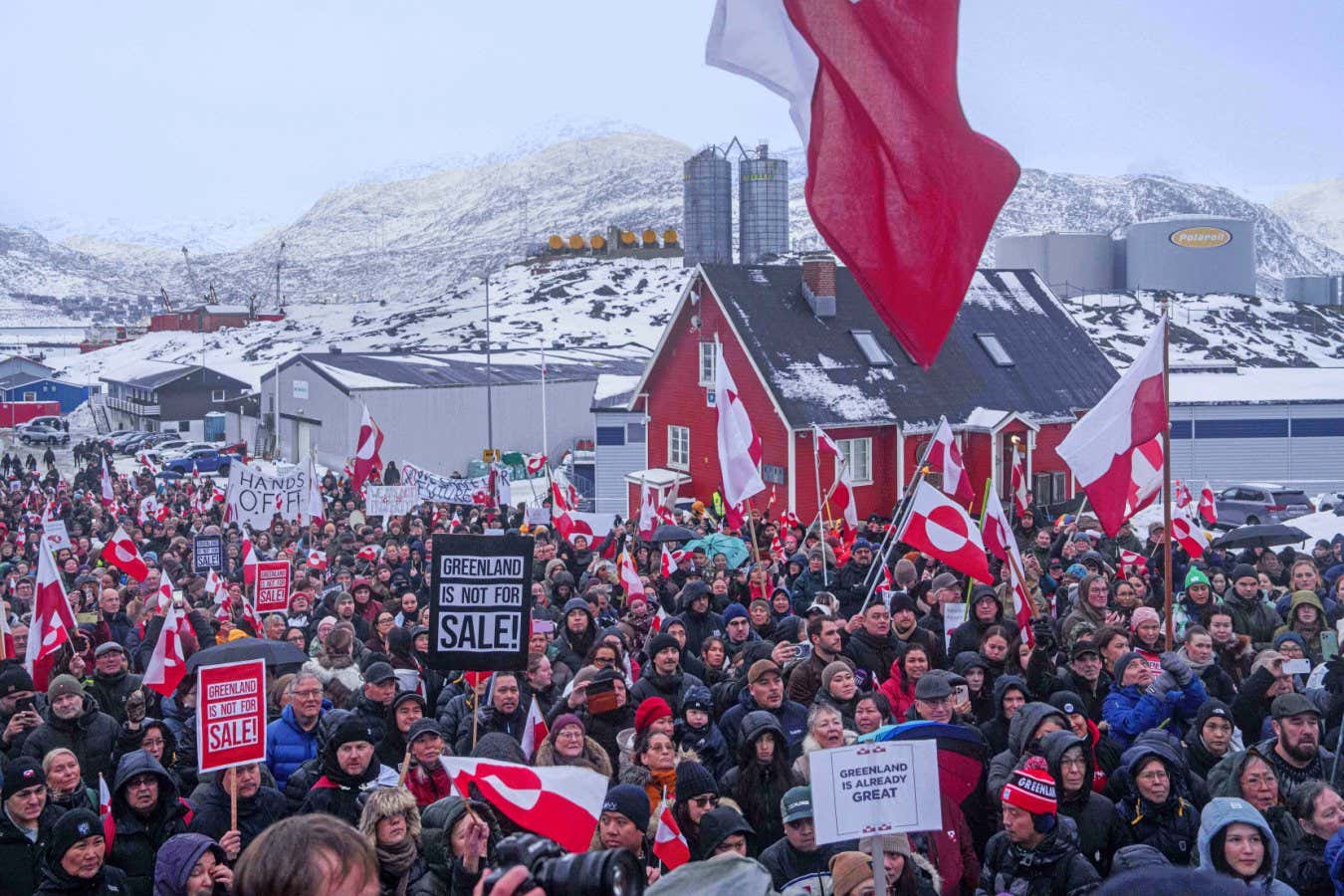
A protest at the US consulate in Nuuk, Greenland, on 17 January
Evgeniy Maloletka/AP/Alamy
With US President Donald Trump continuing to demand that Greenland be placed under his country’s control, European nations are pursuing a range of responses, from stepping up their military presence on the Danish-owned territory to imposing economic sanctions on the US. The extraordinary threat to world order also has Europeans wondering whether it is time to wean themselves off the global dominance of US technology – but is that even possible?
Individuals who want to boycott US tech are in for a difficult time. For example, if you ditch your iPhone in favour of a South Korean-made Samsung, you will still be engaged in the Android ecosystem, which is linked to the US-based Google. Some Chinese phone manufacturers like Huawei have developed their own operating systems, but this would involve swapping one geopolitical giant for another.
And it’s not just hardware. The major social networks, from Facebook and Instagram to Snapchat and X, are based in the US, as are video streaming services like Netflix, Disney+ and Amazon Prime Video. Even the rare platform not run from the US, TikTok, is being drawn into its control, thanks to a Trump-backed deal. Perhaps the only major non-US platform that people use daily is Spotify, which was founded in Sweden.
Europe does have some alternatives for major tech products: for instance, French firms have developed a search engine called Qwant and a ChatGPT replacement called Mistral. For smartphones, your options are more limited and far outside the mainstream: Liberux Nexx is a Spanish smartphone running the Linux operating system, while German company Volla sells a phone running its own operating system. Neither is commonly used. But beyond the individual, can governments and companies do anything to move away from US tech dominance – and should they?
“It’s crazy that almost all of Europe’s public services run on US platforms like Microsoft or Google,” says Tommaso Valletti at Imperial College London, UK. The current arguments over the future of Greenland ought to clarify thoughts, he says. “You obviously cannot replace that overnight, but that’s exactly why Europe must start building alternatives.
Some European countries were already considering their options before the latest Greenland crisis. In November, key figures at a summit in Berlin agreed on seven points to reduce dependency on non-European tech firms, while bolstering the region’s companies. One initiative, known as EuroStack, argues Europe should “buy, sell and fund” homegrown cloud computing, artificial intelligence and connectivity services, in part because just 1 per cent of the European Commission’s own cloud stack – the hardware and software underlying its digital services – currently runs on a homegrown provider.
Advocates say building a sovereign digital stack will be costly – potentially running into the trillions of euros – but is essential to avoid a future in which a hostile US administration could effectively flip a digital kill switch on European infrastructure. Simply basing our tech choices on costs and the past open market, without considering other aspects like national security, is “becoming increasingly naïve”, says Kristina Irion at the University of Amsterdam.
Change will be difficult, though, given many corporate and public sector IT systems rely on companies like Microsoft and Google for their day-to-day operations, says Chloe Teevan at the European Centre for Development Policy Management, a think tank in the Netherlands. “People are already in their ecosystems, so offering an alternative that is attractive to people is not simple, and the policies of the past 20 years have not helped with that,” she says.
Building up major infrastructure takes time, too, especially in a fragmented, slow-moving market like Europe. Because of that, some European decision-makers may wonder whether cutting ties is worth the effort, given Trump should be out of office by 2029. “I actually think nothing will be fast enough to really make any impact,” says Irion.
But that doesn’t mean it shouldn’t happen, in large part because, setting aside politics, relying on companies in other countries in such a geopolitically turbulent world isn’t the smartest idea, says Teevan.
“It’s not going to be easy, but doing nothing is abdication,” says Valletti. “Starting now is the only way to have real options in the future.”
Topics:
