

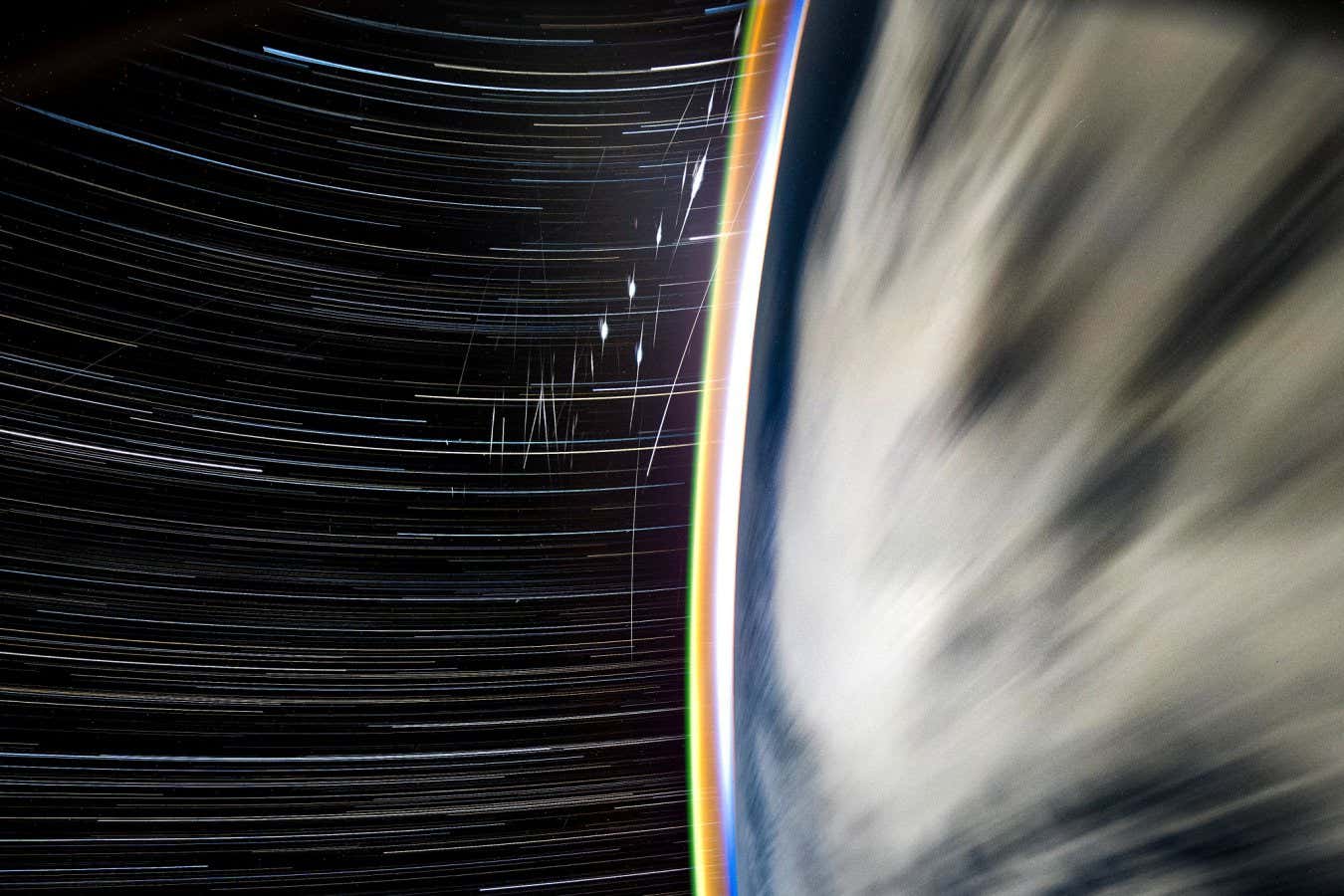
Starlink satellite trails, as seen from space
Don Pettit/NASA
The number of satellites in orbit is growing at a tremendous rate, but we don’t yet have a good understanding of how susceptible they are to solar storms – and that problem is only going to get worse.
Since May 2019, SpaceX has launched more than 10,000 satellites into its Starlink space internet mega constellation, although about 1000 of these have re-entered Earth’s atmosphere at a current rate of one or two a day. The satellites are deployed in a giant mesh around the planet, encompassing pretty much the entire globe. This means a solar storm and its accompanying geomagnetic storm, when our planet’s magnetic field fluctuates in response to charged particles and magnetic fields from the sun, is likely to influence at least some of the satellites, no matter when it occurs.
To investigate the effects of such storms on Starlink, Eunju Kang at the University of California, Irvine, and her colleagues looked at public satellite-tracking data taken during a solar storm in May 2024.
They found that at the peak of the storm, Starlink satellites that were on the side of Earth facing the sun experienced a drop in altitude up to half a kilometre – a small dip in their 550-kilometre orbits, but still significant, as the atmosphere was affected by incoming solar radiation, creating drag on the spacecraft.
Satellites in other regions were greatly affected too, such as those near Earth’s poles, where our planet’s magnetic field funnels more charged particles from the sun, and those over a region of South America called the South Atlantic Anomaly where, for unknown reasons, the planet’s magnetic field is weaker and so the atmosphere is more susceptible to solar activity.
This created an unusual effect in the constellation, according to the data the team had, says Kang. “If one satellite loses its altitude, the neighbouring satellite would also have to compensate,” she says, using its on-board ion thrusters to automatically match the affected satellite because the satellites communicate with each other by line-of-sight lasers to maintain the network, creating an undulating effect as other satellites in the chain followed suit. “It’s kind of like waves,” says team member Sangeetha Abdu Jyothi, also at the University of California, Irvine.
That could pose problems for other satellites trying to navigate around the Starlink constellation to avoid a collision. “When we have less predictability of trajectories, it can increase the risk of collisions,” says Abdu Jyothi.
Other public data is also shedding light on the impact of solar storms. Some Starlink customers use an online service called RIPE Atlas to share the status of their connection. Using this data, Kang and her team found that network outages were reported during the May 2024 solar storm, as the satellites were disrupted. “There was an immediate spike in packet loss,” says Kang, where data doesn’t reach its intended destination.
The research highlights the issues that constellations like Starlink – plus developing constellations like Amazon’s Project Kuiper and several efforts in China – will face from solar activity, not just in terms of communications but also in avoiding large changes in position that could cause a collision with other satellites.
In February 2022, a powerful solar storm knocked about 40 just-launched Starlink satellites back into the atmosphere, where they burned up. Earlier this year, other research showed that increased solar activity was speeding up the demise of some Starlink satellites.
The solar storm in May 2024 was about three times weaker than the largest solar storm on record, the Carrington Event of 1859. A storm of this record size is likely to hit Earth again at some point, with potentially big problems for mega-constellation operators. “With a very large storm, it will be much worse,” says Abdu Jyothi. “But we don’t know how much worse.”
For now, we hopefully have some time to prepare. The May 2024 storm struck during the peak of the sun’s activity, which operates on a 22-year cycle. A powerful storm can theoretically strike at any moment, but might start to become more likely in the 2040s, when the star’s activity peaks again. By then, there will probably be tens of thousands more, if not hundreds of thousands more, satellites in orbit, compared with the roughly 13,000 in orbit today. “The problem goes up the more satellites you have,” says Scott Shambaugh, founder of Leonid Space, a US company that tracks the impact of space weather on satellites.
“When a solar storm hits, we don’t yet have great predictive models of how that’s going to influence drag on a shorter timescale,” says Shambaugh. “That means for the next hours to days, your satellites are not going to be where you think they’re going to be.”
Mathew Owens at the University of Reading, UK, says one particularly poorly understood area is substorms, small variations in our atmosphere caused by heating from solar activity, which can disproportionately affect satellites in different orbits. “A geomagnetic storm is made up of many, many substorms,” he says, but “predicting those is incredibly difficult”.
Constellations like Starlink are giving a unique window into this activity, essentially acting as a giant research network of probes in Earth orbit. “These satellites are probably the first data probes that we have about how local atmospheric drag variations happen,” says Abdu Jyothi.
Topics:
