

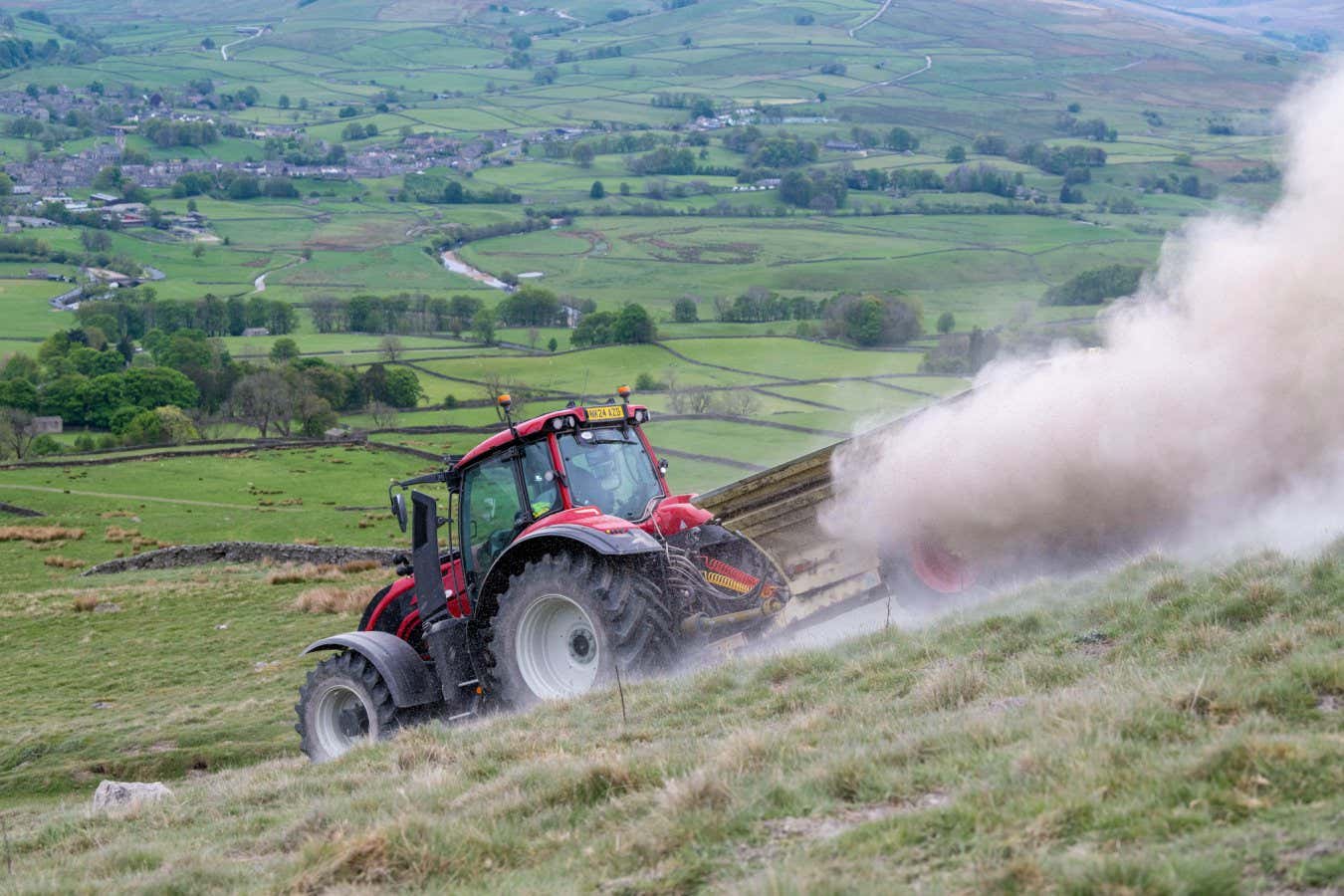
Farmers spread lime on pastures to improve the quality of the soil
Wayne HUTCHINSON/Alamy
The centuries-old practice of spreading crushed limestone on farmland can improve crop yields by making soil less acidic. This custom is typically considered a source of greenhouse gas emissions, but new findings suggest “liming” may actually help remove large amounts of carbon dioxide from the atmosphere.
“Liming can be a carbon source or a carbon sink. Empirical measurements suggest this is a pretty efficient carbon sink,” says Noah Planavsky at Yale University. This could offer new motivation to spread more limestone on the world’s farms – but liming won’t have this effect everywhere.
Currently, most of the millions of tonnes of crushed limestone farmers spread on fields each year are counted as a source of emissions. That is because, as the alkaline rock dissolves in the acidic soil, much of its carbon is released as CO2. But this accounting is incomplete, says Tim Jesper Suhrhoff, also at Yale.
For example, soils today are very acidic due to the intensive use of fertilisers, as well as pollution from burning fossil fuels. As a result, even without crushed limestone present, other alkaline minerals found in soil will dissolve and release carbon. “Those CO2 emissions are going to occur no matter if you are putting lime into the system or not”, so added acidity, rather than liming, is to blame, says Suhrhoff.
To provide a more accurate picture of this practice’s emissions, argues Suhrhoff, researchers must compare how much CO2 is released from and taken up by the soil in scenarios with and without liming.
As an example of this approach, Suhrhoff, Planavsky and their colleagues looked at the Mississippi river basin, which collects runoff from most of the agricultural land in the US. They calculated the net carbon effect of all of the liming carried out between 1900 and 2015 in this region.
The researchers used geochemical models, as well as data on how interventions like fertiliser and liming change soil acidity, to estimate emissions from soil. They also compared their modelling results with direct measurements of alkalinity in the Mississippi, since limestone creates alkalinity when it reacts with carbon dioxide.
Using their new approach, the researchers found liming in this region – rather than generating hundreds of millions of tonnes of emissions – actually removed about 300 to 400 million tonnes of CO2, compared to a scenario where no liming was done. Suhrhoff presented the work at the Goldschmidt Conference on geochemistry in Prague, Czech Republic on 10 July.
Liming could also be paired with the growing practice of spreading crushed volcanic rocks on farms – called enhanced rock weathering – to remove even more CO2 from the atmosphere, says Planavsky.
Wolfram Buss at the Australian National University says liming can act as a carbon sink, but what worked in the Mississippi river basin won’t necessarily work everywhere. “There are risks associated with lime application that can make it a net carbon dioxide source in other systems, given strong acidification of agricultural soils,” he says.
The next steps are to identify those places where liming is most needed. “It opens up the possibility that we can incentivise something that will be good for crop yields and will potentially give us billions of tonnes of carbon dioxide removal,” says Planavsky. Such financial incentives could be particularly helpful for low-income farmers who can’t afford to do the optimal amount of liming for their crops.
Topics:
