

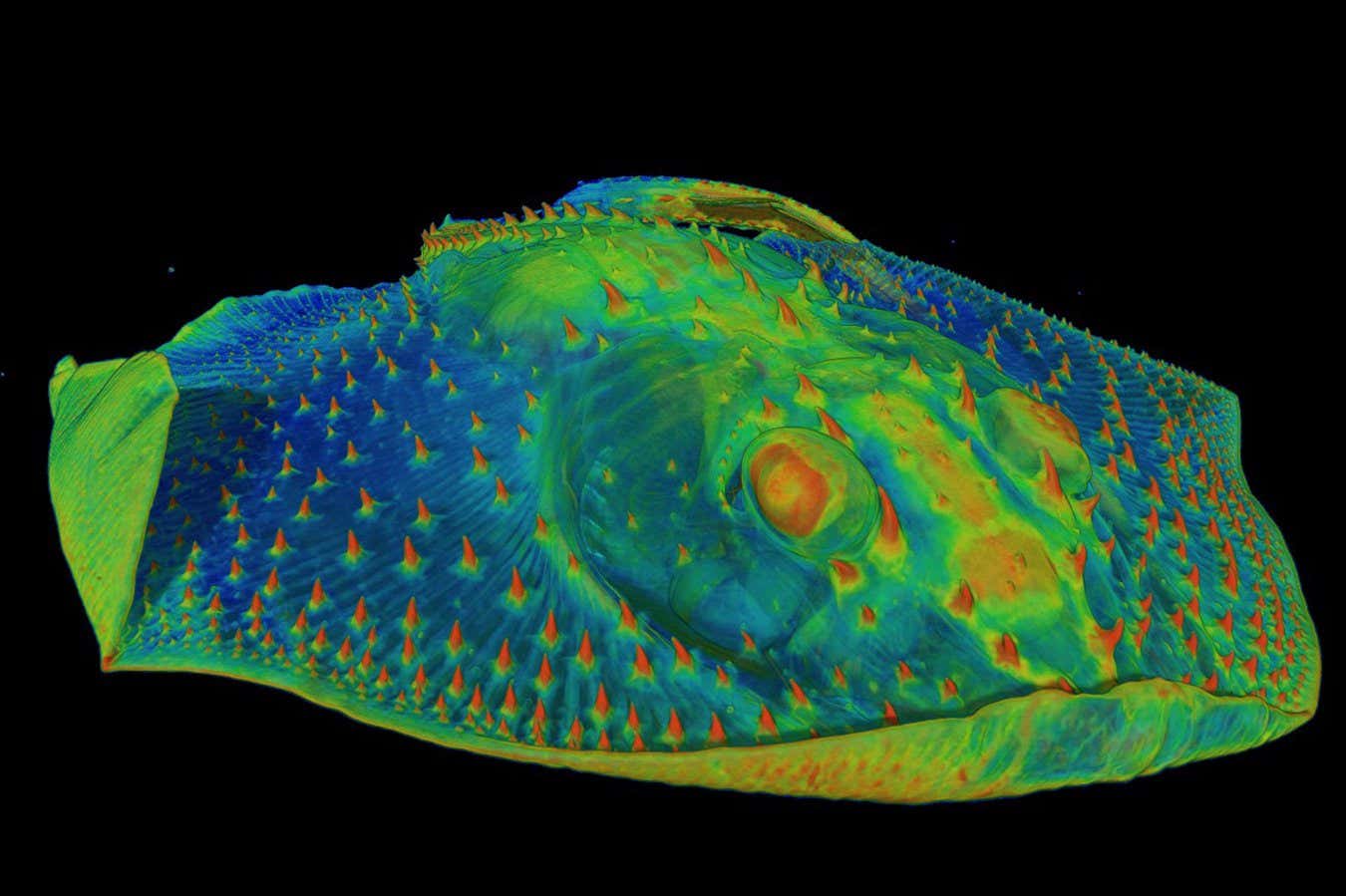
CT scan of the front of a skate, showing the hard, tooth-like denticles (orange) on its skin
Yara Haridy
Teeth first evolved as sensory organs, not for chewing, according to a new analysis of animal fossils. The first tooth-like structures seem to have been sensitive nodules on the skin of early fish that could detect changes in the surrounding water.
The finding supports a long-standing idea that teeth first evolved outside the mouth, says Yara Haridy at the University of Chicago.
While there was some evidence to back this up, there was an obvious question. “What good is having all these teeth on the outside?” says Haridy. One possibility was that they served as defensive armour, but Haridy thinks there was more to it. “It’s great to cover yourself in hard things, but what if those hard things could also help you sense your environment?”
True teeth are only found in backboned vertebrates, like fish and mammals. Some invertebrates have tooth-like structures, but the underlying tissues are completely different. This means teeth originated during the evolution of the earliest vertebrates: fish.
Haridy and her team re-examined fossils that have been claimed to be the oldest examples of fish teeth, using a synchrotron to scan them in unprecedented detail.
They focused first on fragmentary fossils of animals called Anatolepis, which date from the later part of the Cambrian Period, which ran from 539 million to 487 million years ago, and early in the Ordovician Period, which ran from 487 million to 443 million years ago. These animals had a hard exoskeleton, dotted with tubules.
These had been interpreted as being tubules of dentine, one of the hard tissues that make up teeth. In human teeth, dentine is the yellow layer under the hard white enamel and it performs many functions, including sensing pressure, temperature and pain.
This led to the idea that the tubules are precursors to teeth called odontodes and that Anatolepis is an early fish.
That isn’t what Haridy and her team found. “We saw that the internal anatomy [of the tubules] didn’t actually look like a vertebrate at all,” she says. After examining structures from a range of animals, they found that the tubules were most similar to features called sensilla found on the exoskeletons of arthropods like insects and spiders. These look like pegs or small hairs and detect a range of phenomena. “It can be everything from taste to vibration to changes in air currents,” says Haridy.
This means Anatolepis is an arthropod, not a fish, and its tubules aren’t the direct precursors to teeth.
“Dentine is likely a vertebrate novelty, yet the sensory capabilities of a hardened external surface were present much earlier in invertebrates,” says Gareth Fraser at the University of Florida in Gainesville, who wasn’t involved in the study.
With Anatolepis out of the picture, the team says, the oldest known teeth are those of Eriptychius, which is only known from the Ordovician Period. These do have true dentine – in odontodes on their skin.
Haridy says invertebrates like Anatolepis and early vertebrates like Eriptychius independently evolved hard, sensory nodules on their skin. “These two very different animals needed to sense their way through the muck of ancient seas,” she says. In line with this, the team found that the odontodes on the skin of some modern fish still have nerves – suggesting a sensory function.
Once some fish became active predators, they needed a way to hold onto their prey, so the hard odontodes made their way to the mouth, where they could be used to bite.
“Based on the available data, tooth-like structures likely first evolved in the skin of early vertebrates, prior to the oral invasion of these structures that became teeth,” says Fraser.
Topics:
