

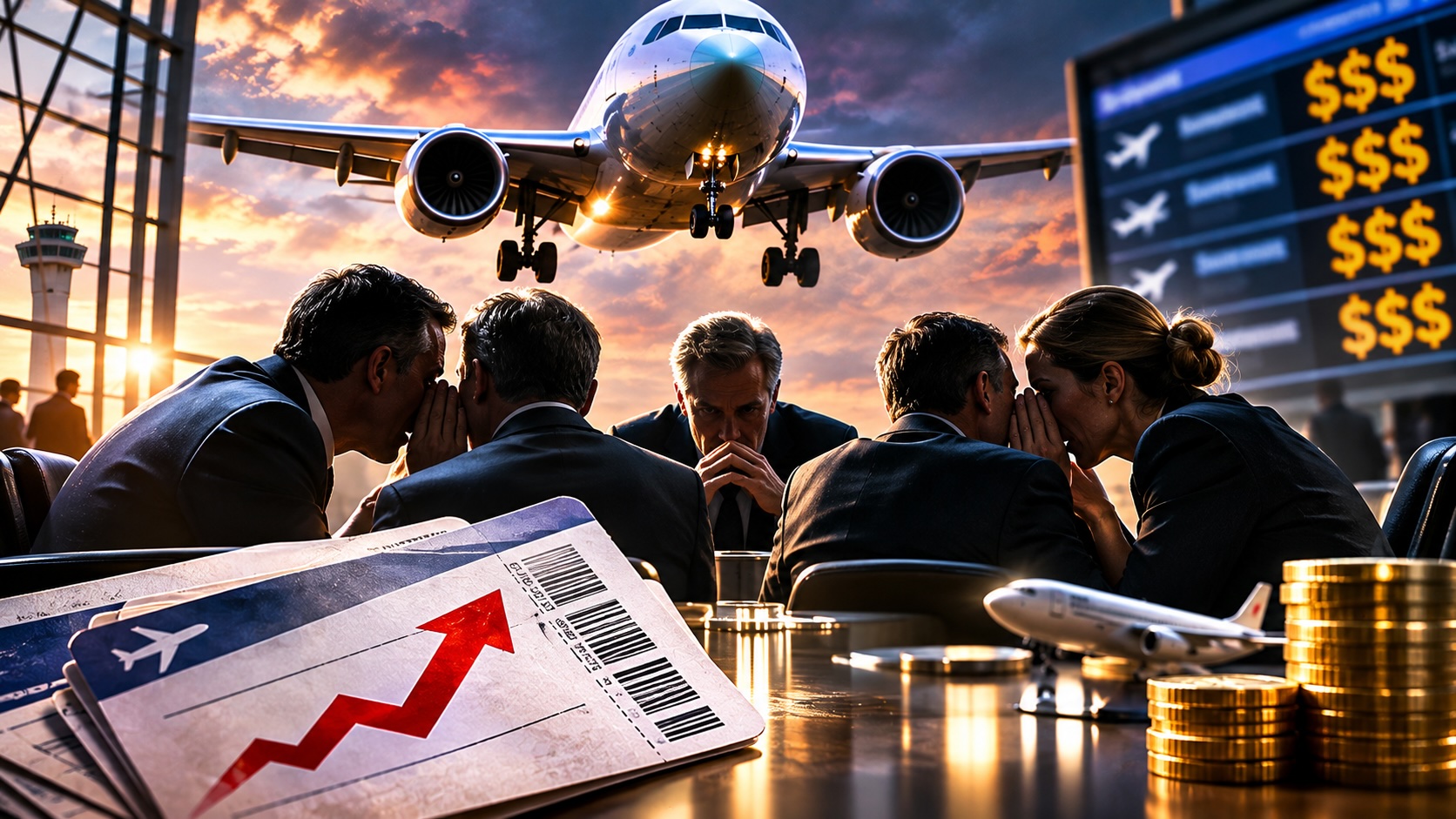
For decades, airlines have been caught coordinating ticket prices, manipulating fuel surcharges and restricting competition. Now, explosive new lawsuits accuse the nation’s largest carriers of using sophisticated data-sharing technology to keep passengers paying more.
November 8, 2026 | Investigative Report
For millions of Americans, purchasing an airline ticket has become an exercise in frustration. A flight that costs $249 in the morning can jump to $419 by afternoon. Competing airlines frequently display suspiciously similar fares, and the seemingly affordable ticket advertised online can grow considerably more expensive once baggage charges, seat-selection fees and other extras are added.
The airlines call it dynamic pricing. They describe an intensely competitive business where fuel expenses, labor costs, unpredictable demand and sophisticated computer systems determine what passengers pay.
But there is another side to the airline industry’s pricing history — one involving federal price-fixing investigations, criminal guilty pleas, secret exchanges of commercially sensitive information and allegations that the country’s largest carriers have deliberately avoided competing too aggressively with one another.
Now, in November 2026, that history has returned with extraordinary relevance.
Two new federal lawsuits accuse major American airlines of participating in a sophisticated information-sharing arrangement that allegedly allows competitors to monitor one another’s pricing decisions and discourage the discounting that ordinarily benefits passengers.
At the center of the allegations is the Airline Tariff Publishing Company, or ATPCO, an airline-owned enterprise that was implicated in a landmark federal price-fixing case more than three decades ago.
The historical record establishes an uncomfortable fact: airlines have coordinated prices before, and some have admitted doing so.
The question now confronting the industry is whether the technology used to sell modern airline tickets has also created new opportunities to undermine competition.
A Bombshell Lawsuit Lands in Federal Court
On November 4, 2026, passengers Ashley Ward and Gregory Morris filed a sweeping 99-page antitrust complaint in federal court in Seattle.
The defendants include American Airlines, Delta Air Lines, United Airlines, Southwest Airlines, Alaska Air Group, Hawaiian Holdings and JetBlue Airways, along with ATPCO and its subsidiary, 3Victors.
A separate proposed class action was also filed in federal court in Virginia in early November.
The Seattle complaint alleges that competing airlines have used ATPCO’s expanding technology infrastructure to exchange sensitive pricing information that would otherwise remain confidential.
The alleged mechanism involves two 3Victors products called Iris and PriceEye.
According to the plaintiffs, Iris collects airline-shopping information, including dynamically generated prices. PriceEye then allows participating airlines to analyze competing offers, monitor changes and identify when rivals are undercutting their prices.
The plaintiffs describe a reciprocal arrangement in which airlines contribute information to receive information from other participating carriers.
The result, they contend, is a system that gives competitors unprecedented insight into one another’s pricing decisions.
This matters because uncertainty about competitors’ prices is an important part of genuine competition.
An airline that does not know whether a rival will discount a particular flight has an incentive to offer attractive fares to win customers. But when competitors can quickly observe and respond to one another’s pricing decisions, the risk of aggressive discounting may become less attractive.
The lawsuits allege that this shared intelligence has helped airlines maintain higher ticket prices than would exist under truly independent competition.
The plaintiffs are seeking monetary damages and court orders restricting the alleged practices.
American Airlines has told The Seattle Times that it develops and prices its products independently. Most other airline defendants had not publicly addressed the substance of the accusations when the complaints were first reported.
But the similarities between the allegations and an earlier airline pricing scandal are striking.
Read the November 4, 2026, federal complaint
The Government Already Caught Airlines Using Computers to Coordinate Prices
In December 1992, the Department of Justice filed a civil antitrust lawsuit against eight major American airlines: American, Delta, United, Northwest, Continental, USAir, TWA and Alaska.
The government’s accusation was remarkable.
Federal investigators alleged that the airlines were using ATPCO’s computerized fare-distribution system to communicate proposed ticket-price increases, negotiate discounts and coordinate fare changes across hundreds of routes.
Instead of meeting secretly in hotel rooms, competitors could communicate through the same electronic infrastructure that distributed airline fares.
An airline could announce a future price increase before passengers were allowed to purchase tickets at that price. Competitors could then signal whether they would follow.
If rival carriers rejected the increase, the original airline could withdraw it before the higher fare ever reached consumers.
Investigators alleged that airlines also used the system to negotiate the removal of discounted fares and arrange reciprocal price increases in different markets.
The Department of Justice said it identified more than 50 separate price-fixing agreements involving hundreds of routes.
One alleged arrangement caused passengers traveling between Chicago and Dallas to pay as much as $138 more per ticket. Another involved raising discounted one-way fares by $20.
The potential financial consequences were enormous.
Government economists estimated that if the coordination increased average fares by just 5 percent, the additional costs to passengers across approximately 300 markets could have reached $1.9 billion between 1988 and 1992.
In March 1994, the remaining six airline defendants agreed to settlements requiring significant changes to how they exchanged fare information. United and USAir had settled earlier.
The airlines did not admit wrongdoing, and the settlements imposed no criminal fines.
But the restrictions were substantial. Airlines could no longer use specified future ticket-sale dates and other features of the shared system to negotiate price changes that were not yet available to consumers.
The enforcement action remains one of the clearest examples of how sophisticated information technology can facilitate coordination between nominal competitors.
The lesson was not that computerized pricing is inherently illegal. It was that a legitimate information-distribution system can be used for unlawful purposes when competitors communicate to restrain competition.
Department of Justice: March 17, 1994, airline price-fixing settlement
When Price-Fixing Became a Criminal Matter
If the American airline cases of the 1990s demonstrated how fares could be coordinated through computer systems, later international investigations revealed something more direct.
Airlines were secretly agreeing on prices — and admitting it in criminal proceedings.
In August 2007, British Airways and Korean Air agreed to plead guilty to federal antitrust charges and pay criminal fines totaling $600 million.
Each airline agreed to pay $300 million.
British Airways was accused of conspiring to fix fuel surcharges on long-haul passenger flights, including routes between the United States and Britain, as well as participating in a separate cargo-pricing conspiracy.
The Department of Justice reported that the passenger fuel surcharge on a British Airways round-trip ticket had climbed from approximately $10 in 2004 to nearly $110 by the time the conspiracy was uncovered in 2006.
Those increases were not simply the unavoidable result of rising fuel costs. Federal prosecutors alleged that the surcharges were coordinated with competitors.
Virgin Atlantic disclosed its participation and cooperated with investigators under a corporate leniency arrangement.
British authorities separately concluded that British Airways and Virgin Atlantic had unlawfully coordinated long-haul passenger fuel surcharges. British Airways ultimately received a £58.5 million fine under the British competition proceeding.
Korean Air admitted involvement in a scheme affecting certain passenger fares between the United States and South Korea, along with international cargo rates.
In 2010, All Nippon Airways also agreed to plead guilty and pay a $73 million criminal fine for conspiracies involving unpublished passenger fares and international air cargo services.
These were not cases of consumers imagining suspiciously similar prices. They involved documented criminal antitrust enforcement and corporate admissions.
DOJ: British Airways and Korean Air criminal cases
A New Strategy: Don’t Raise the Ticket Price, Restrict the Seats
The next major American airline antitrust controversy focused on something more subtle than direct price agreements.
Beginning in 2015, passengers filed class-action lawsuits alleging that American, Delta, Southwest and United had coordinated to restrict the growth of available airline seats.
The alleged conspiracy covered the period from 2009 through mid-2015.
At the heart of the allegations was an industry expression: capacity discipline.
In ordinary business language, capacity discipline means avoiding excessive expansion. Airlines argue that operating more flights than passengers demand can produce financial losses, weaken service and threaten the survival of carriers.
But the plaintiffs alleged something different.
They claimed that America’s largest airlines had collectively embraced restrained capacity growth, even as demand recovered from the Great Recession, because limiting seats helped keep ticket prices elevated.
The economic principle is straightforward.
When seats are scarce relative to demand, airlines generally possess greater pricing power. When carriers aggressively add flights and compete for passengers, downward pressure on fares can increase.
The lawsuit examined airline executives’ public statements, internal evidence and the industry’s repeated emphasis on controlling capacity.
The litigation included remarks made by senior airline executives to investors about the importance of disciplined growth.
In a 2023 federal court opinion, Judge Colleen Kollar-Kotelly examined evidence suggesting that airline officials repeatedly emphasized the importance of limiting capacity and that the practice had continued after the immediate financial crisis passed.
The airlines argued that their decisions reflected legitimate business considerations, including investor pressure, past bankruptcies and the need to avoid financially destructive overexpansion.
The Justice Department investigated the industry’s capacity practices but closed its investigation without bringing an antitrust case.
The private lawsuits continued.
American Airlines agreed to a $45 million settlement. Southwest agreed to a $15 million settlement.
In September 2023, a federal judge rejected requests by Delta and United to dismiss the remaining claims at the summary-judgment stage, concluding that a factfinder could reasonably infer a conspiracy from the evidence presented.
The litigation remained active in 2026.
For passengers, the underlying question was disturbing: What if the biggest airlines did not need to agree on identical ticket prices because they could instead coordinate how much flying capacity entered the market?
Read the federal court’s 2023 opinion
Four Airlines Dominate the American Skies
The competitive landscape makes these questions especially important.
America’s airline industry has undergone decades of consolidation.
Delta absorbed Northwest. United combined with Continental. American merged with US Airways. Southwest acquired AirTran.
The result was an industry increasingly dominated by a small number of enormous carriers.
According to Bureau of Transportation Statistics data for August 2025 through July 2026, Delta, American, United and Southwest collectively accounted for approximately 70 percent of domestic revenue passenger miles. That concentration can make coordinated behavior easier.
A market controlled by a handful of companies is fundamentally different from one containing dozens of independent competitors.
The consequences become especially visible at hub airports, where a dominant airline can control a large share of available service.
For travelers departing smaller cities, the advertised abundance of airlines nationwide can be largely meaningless when only one or two carriers offer practical routes.
Consolidation also creates opportunities for airlines to observe one another’s decisions, react rapidly and avoid battles for market share that would benefit passengers but damage profits.
In June 2026, the Government Accountability Office published a major review of airline competition. It found that studies of airline mergers generally identified higher fares in the short term on routes where mergers reduced the number of competitors.
Three particularly strong studies estimated fare increases of between 1 and 8 percent following mergers.
The agency also documented the difficulties smaller, low-cost carriers encounter in competing against established airlines, including airport-access constraints and the growing financial advantages associated with large loyalty and credit-card programs.
Taken together, those findings reveal the uneven nature of competition in American aviation.
Read the GAO’s June 2026 airline competition report
The Algorithm Changes Everything
The newest concern is not that airline executives must personally agree on every fare increase.
It is that increasingly powerful technological systems might allow companies to observe and respond to one another’s behavior so efficiently that traditional forms of aggressive competition become less likely.
Airlines use revenue-management software to evaluate demand, booking patterns, seat inventory and other factors. Prices can change repeatedly as departure approaches.
Dynamic pricing can have legitimate purposes. But a November 2026 lawsuit identifies a critical distinction between information already visible to the ticket-buying public and confidential commercial information obtained from competing airlines.
The plaintiffs allege that the ATPCO and 3Victors systems cross that line by pooling sensitive shopping and pricing data and allowing carriers to monitor rivals’ dynamically generated fares.
According to the complaint, ATPCO expanded its data-sharing capabilities in 2023 and acquired 3Victors later that year. Iris was subsequently introduced as a data repository, followed by expanded PriceEye analytics capabilities.
The complaint contends that these developments restored a level of competitor visibility that had been restricted following the federal enforcement action of the 1990s.
Whether those exchanges are unlawful will depend on what information was shared, the extent of competitor participation, the purpose of the arrangements and their effects on competition.
The case raises a question with implications well beyond aviation: When competitors exchange extensive real-time pricing intelligence, where does legitimate market analysis end and anticompetitive coordination begin?
Federal investigators previously identified more than 50 airline pricing agreements involving ATPCO. International airlines later pleaded guilty to criminal conspiracies. Major domestic carriers subsequently paid $60 million to settle another antitrust dispute concerning capacity. That explains why regulators, courts and passengers have reason to examine the latest allegations carefully.
The aviation industry’s history demonstrates that price coordination is not an imaginary threat. It is conduct that has occurred, sometimes on an enormous scale.
Thirty-four years after the Justice Department first challenged airlines over their shared computerized pricing system, a new generation of plaintiffs is asking federal courts to confront a remarkably familiar problem.
The software has changed. The pricing models have grown more complex. The information moves faster than ever.
But the question remains the same: Are airlines competing to offer passengers the lowest sustainable fares, or have they found another way to avoid competing with one another?
For an industry already carrying the baggage of proven price-fixing conspiracies, that question deserves an answer.
