

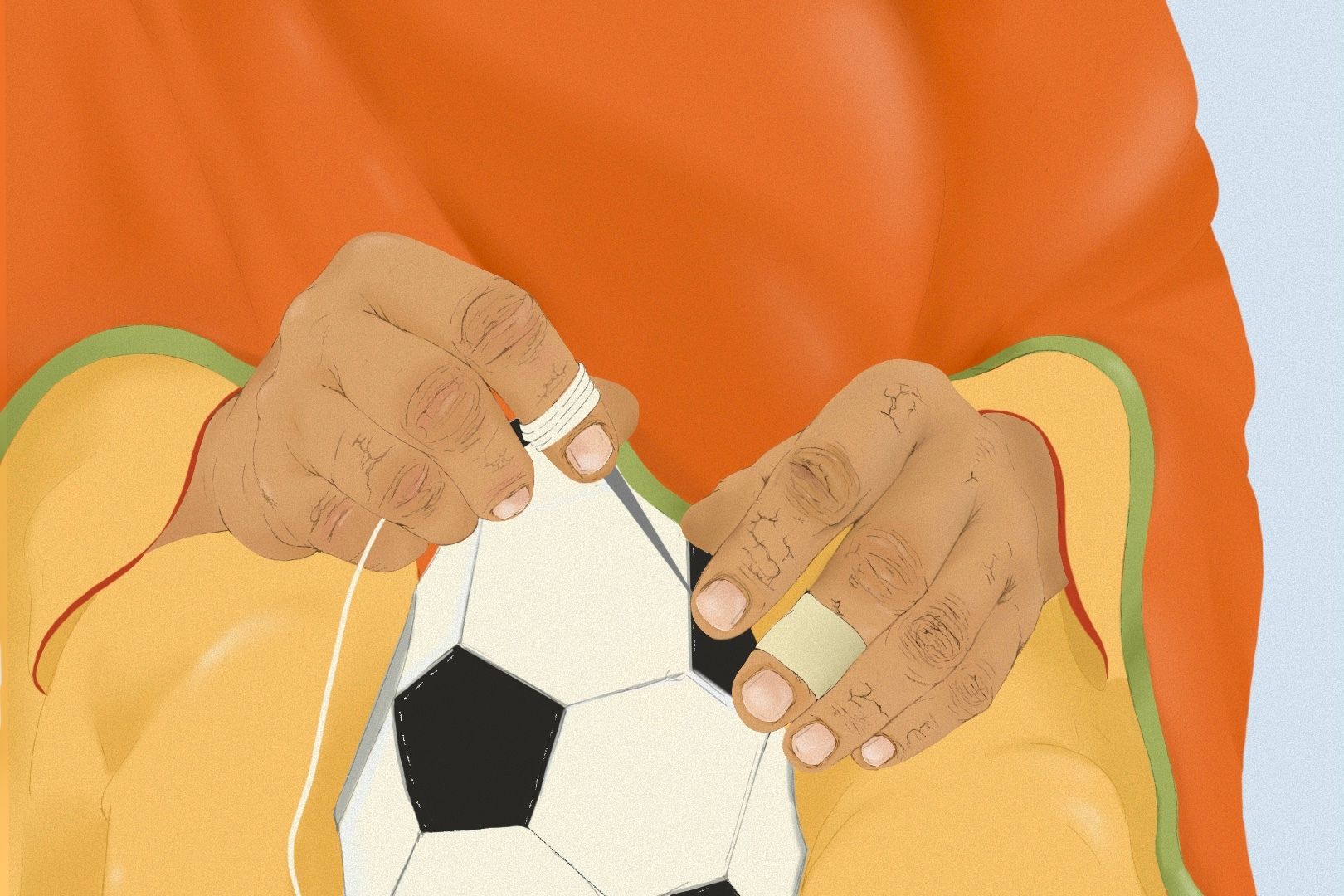
The football factories cut the panels, assemble the kits and collect the finished balls. Much of the hand stitching is subcontracted to more than 1,400 registered centres across Sialkot district, each inspected every four to eight weeks as part of a monitoring system introduced after child labour was removed from the industry’s supply chain in the late 1990s.
Any workplace with at least five stitchers is registered as a centre with the Independent Monitoring Association for Child Labor (IMAC). This centre is one of the largest, with separate sections for men and women.
Ansar moves between the women, checking their progress and correcting mistakes before they become habits.
She recalls how different the work was when she first started.
“There used to be very frequent loadshedding (power outages), but we needed to stitch more to fulfil the orders, and also so we could earn more and pay off our debts.”
By the light of an oil lantern, she would search for the holes in each panel, working late into the night after the household had gone to sleep. It was painstaking, but the wages accumulated over time.
Those earnings, together with a loan from the Dutch company that employs the centre to stitch footballs, helped Ansar and her husband build the three-room house they loved 12 years ago.
The couple began their married life in a room adjoining the neighbourhood mosque, where her husband worked as an imam. Before moving into their current home, they hosted the stitching centre from a room built above their modest accommodation.
Her face shows the hardships of those years. Deep lines crease the corners of Ansar’s eyes and forehead, etched by years of concentration, but they quickly soften into a smile.
She remembers a very different Sambrial, where many families, including her own, lived in mud houses vulnerable to floods and heavy rain. Slowly, brick by brick, families worked to improve their circumstances, building homes that offered greater safety and stability.
“Nobody knew where the next meal would come from.”
For many families, football stitching offered a way out of poverty. But it was not always a source of pride.
“These communities, these people have had to face a lot of stigma. They were looked down on by their neighbours and others for being so poor that they had to stitch balls,” says Nasir Dogar, chief executive of IMAC.
“Sometimes people would hide that this is how they were earning their living because it could hinder their children’s employment or even marital prospects.”
That scrutiny intensified in 1996, when a magazine photograph of a 12-year-old boy stitching a football for Nike prompted international outrage and shone a spotlight on child labour in Sialkot’s football industry.
Dogar and his team have spent almost three decades working in these communities to remove children from the football manufacturing supply chain. In 1997, FIFA, the International Labour Organization, UNICEF, Save the Children, the government of Pakistan and the Sialkot Chamber of Commerce signed the Atlanta Agreement, committing to eliminate child labour from football production.
“We spent hours understanding what was driving them to engage young children in stitching footballs. We knew we had to start with encouraging the community to contribute and participate in putting an end to child labour,” explains Dogar.
As villages embraced the programme, local people helped build registered stitching centres. One member of a village committee donated bricks at half price, others paid for fixtures and fittings, while residents supplied the labour.
“When a village reached full school enrollment, a white flag was raised above it,” says Dogar. “We’d hold a meeting, in which small shields were given out in recognition of this achievement. This was done in all 1,609 villages.”
A subsequent independent UNICEF audit found that between 96 and 97 percent of children were attending school.
