


In our digital age, services and devices are constantly gathering our data. Exactly how that information is harvested and used, and how transparent a company is about those practices, may not always be obvious.
Shift, an AI training startup, is turning that bargain into a business model.
In return for a free housecleaning, customers allow Shift to collect data filmed by a camera headset on the (human) cleaner’s head. That footage is then licensed out to develop and train AI-powered household robots.
Owned by German data research lab MicroAGI, founded in 2025, Shift began by hiring contractors to don its camera caps and record their own household tasks. That type of data collection has been occurring in the U.S., as well as in Germany, Turkey, and other European countries, for months. (Shift won’t ultimately make the robots informed by this data.)
Recently Shift launched its cleaning services—offering the free cleanings as a way to get its data collectors into other people’s homes—in New York City as well as across Europe. The company has pitched its cleaning work as a side hustle for college students and the “best work from home side gig.”
“We are very up front,” says Anton Poletaev, cofounder of MicroAGI and co-CEO of Shift. “Yes, we are getting your data, but by doing so you’re finally getting rewarded for it, and you’re not being lied to.”
But even with that honesty, people may not understand exactly what it means to give away this data. Shift’s structure also raises questions about what this AI future means for workers who are involved in training their own replacements.
The need for diverse data
With the expansion of AI, tech leaders are painting a picture of a future filled with humanoid robots. Already, there are robots that can run, flip, dance, and work in warehouses.
To get to a world where humanoid robots can flawlessly wash our dishes, fix our faucets, and even cook us a meal, tech companies need lots and lots of training data.
For Shift, it’s important that this data is both high quality and diverse, meaning captured from multiple angles, and in all different home layouts, with different faucets, sinks, and so on.
“If you were trained to perform a job or a task in one environment only, you might struggle to perform it in different environments,” Poletaev says. “If you’re getting exposed to different lighting conditions, to different kitchen types, different living rooms, different taps that you’re repairing, then you’re able to generalize across different kinds of environments.”
Shift’s camera headset captures a first-person view of the cleaner’s hands; this perspective, called egocentric video, allows for better understanding of the ways hands interact with objects, which helps inform robotics.
Shift isn’t the only company collecting such data: Startups like Claru, Luel, Micro1, Kled AI, and others offer contractor roles for people to either film themselves doing tasks like folding laundry and taking out the trash, or to annotate such datasets. Shift began this way, too, and then its contractors “expressed interest in recording more, and contributing more,” Poletaev says, like by going into others’ homes.
Shift calls these data collectors “operators,” and says they’ve been vetted and trained. In New York, the startup also partners with existing local cleaning services, though it did not name specifics.
Globally, Shift says it has collected hundreds of thousands of hours of data, via dozens of thousands of operators. It has more than a thousand operators in the U.S., and the “vast majority” of those recordings are currently happening in New York.
De-identified data
To Poletaev, Shift’s format is a “win-win” for customers and cleaners, who are classified as contractors rather than employees. Customers are compensated with a free cleaning, he says, while cleaners are “getting paid extra for wearing our device.” (According to Shift, cleaners earn $20 an hour with “no fixed schedule.”)
The company also says it takes steps to protect customer privacy by blurring names, faces, screens, ID cards, and other personal information before the footage is incorporated into datasets. Under Shift’s platform terms, customers may withdraw consent and request deletion until a recording has been de-identified and made available to others, after which removal is limited.
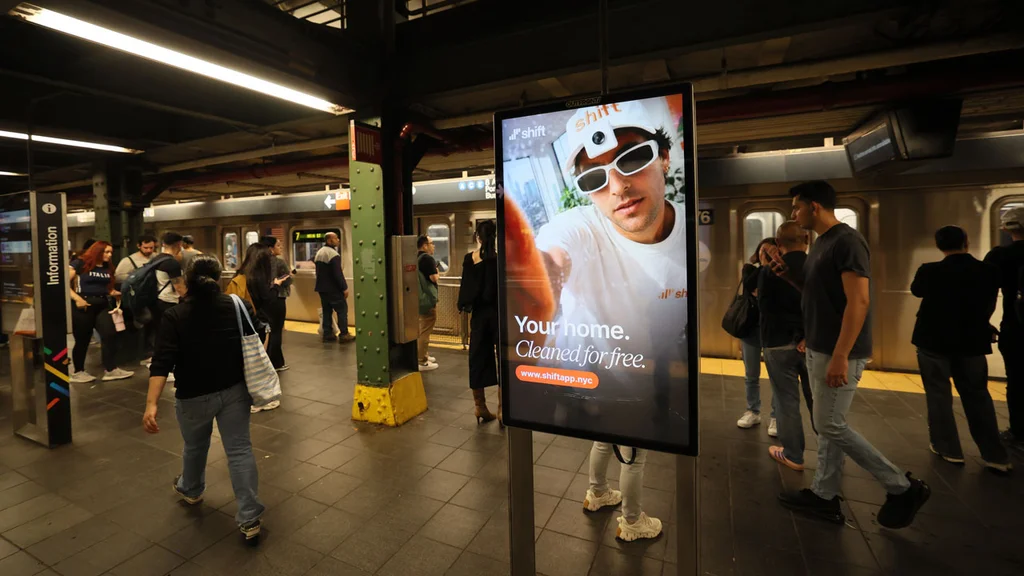
Harry Kilberg, Shift’s U.S. general manager, says de-identification can happen within hours or up to a week after the data is collected, depending on processing time, and that the company is improving how it communicates that window. The data is used for MicroAGI’s internal robotics research and may also be shared with “select robotics companies and frontier AI labs,” though Shift says it is never shared publicly or used for advertising.
Potential downstream harms
By being open about this transaction, Poletaev says people have the opportunity to be compensated for data that for the past decade or two has just been used “without their regard.”
What’s missing, though, is a broader understanding of how valuable this data is, and how it could be used.
“The average person doesn’t think about the downstream harms,” says Veena Dubal, a law professor at the University of California, Irvine, who researches what she calls “precarious work,” including platform workers, algorithmic management, and regulations around AI and work. “And those downstream harms might not even be apparent to us for many, many years, and maybe they’ll be invisible.”
Again, Shift says this data isn’t used for advertising. It’s not the only company collecting such data, though, and not every company may behave the same, or their privacy policies may not be clear.
Claru’s privacy policy says it may collect personal information, and that it may share it with multiple third-party vendors. Kled’s notes that if another entity purchases the content you submit, it may disclose your biometric information, but that it does not “sell, lease, trade or otherwise profit from your biometric information.”

The normalization of capturing first-person perspective home data could open the door to allowing companies to sell this data to brokers or retailers. That could, down the line, lead to personalized pricing for things these companies know you have in your home.
Of course there are many other implications to having someone recording inside your home.
What if, for example, Dubal asks, the video captures something unlawful, like drugs? At some point, the police may be able to subpoena companies like Shift as part of a criminal investigation.
“There’s just so much about us in our homes that we don’t even think about that when this becomes available, either to the public or private sector, kind of willy-nilly, it’s anyone’s guess how it could be used,” she says.
To Dubal, the fact that this data is being collected inside the home changes the stakes. Tech companies already gather information through phones, laptops, smart TVs, and other internet-connected devices.
But homes are still “culturally, socially, legally this private space,” she says. Filming inside that space captures data those other devices often cannot: how people move, how they live, and what they do when they are not on a phone or computer.
“It’s a radical shift,” she says. “There is something dramatic about the idea that even this space is open to the market.”
Dubal says she doesn’t find promises of anonymity compelling. In fact, there’s still debate about what, exactly, de-identification means. Even the European Union’s General Data Protection Regulation vaguely defines “personal data” as “any piece of information that relates to an identifiable person.”
“Firms will always say, ‘Oh, well, we’re not using your name,’” Dubal says. “But the reality is that they have so much data that they can figure out who you are without using your name.”
What happens to future workers?
Those concerns deal with the data collected inside customers’ homes. But Shift is also collecting data about the cleaners it hires, and how they work.
That information could eventually help replace those workers. Or, Dubal warns, it could be used to “create software that ultimately controls workers in new ways,” by setting efficiency standards, consolidating jobs, and pushing people to work harder and faster for less, “so housecleaning becomes like an Amazon warehouse.”
Ai-jen Poo, president of the National Domestic Workers Alliance, echoed that concern in a statement to Fast Company: House cleaners’ labor, she said, should be “respected and protected, not treated as background inputs for someone else’s technology product.”
To be sure, the tech industry’s promises of democratization have a mixed record. Uber promised broader access to transportation, but it also displaced taxi drivers, generated data now used to train self-driving systems, and eventually raised prices beyond its early VC-subsidized days.
So will household robots actually be affordable and accessible to all? That’s far from clear. To Dubal, it’s also the wrong goal. “It’s not that we all need servants,” she says. “It’s that we all need jobs that pay well.”
Poletaev sees it differently, saying the need for the kind of data Shift collects is “born out of the desire to be in a world where everyday goods and services are abundant and accessible.” In the meantime, he insists, his company will “make sure people are compensated throughout this transition.”
The bargain, then, is that people can get paid for their data now, while helping build a future that may ultimately need less of their labor.
