

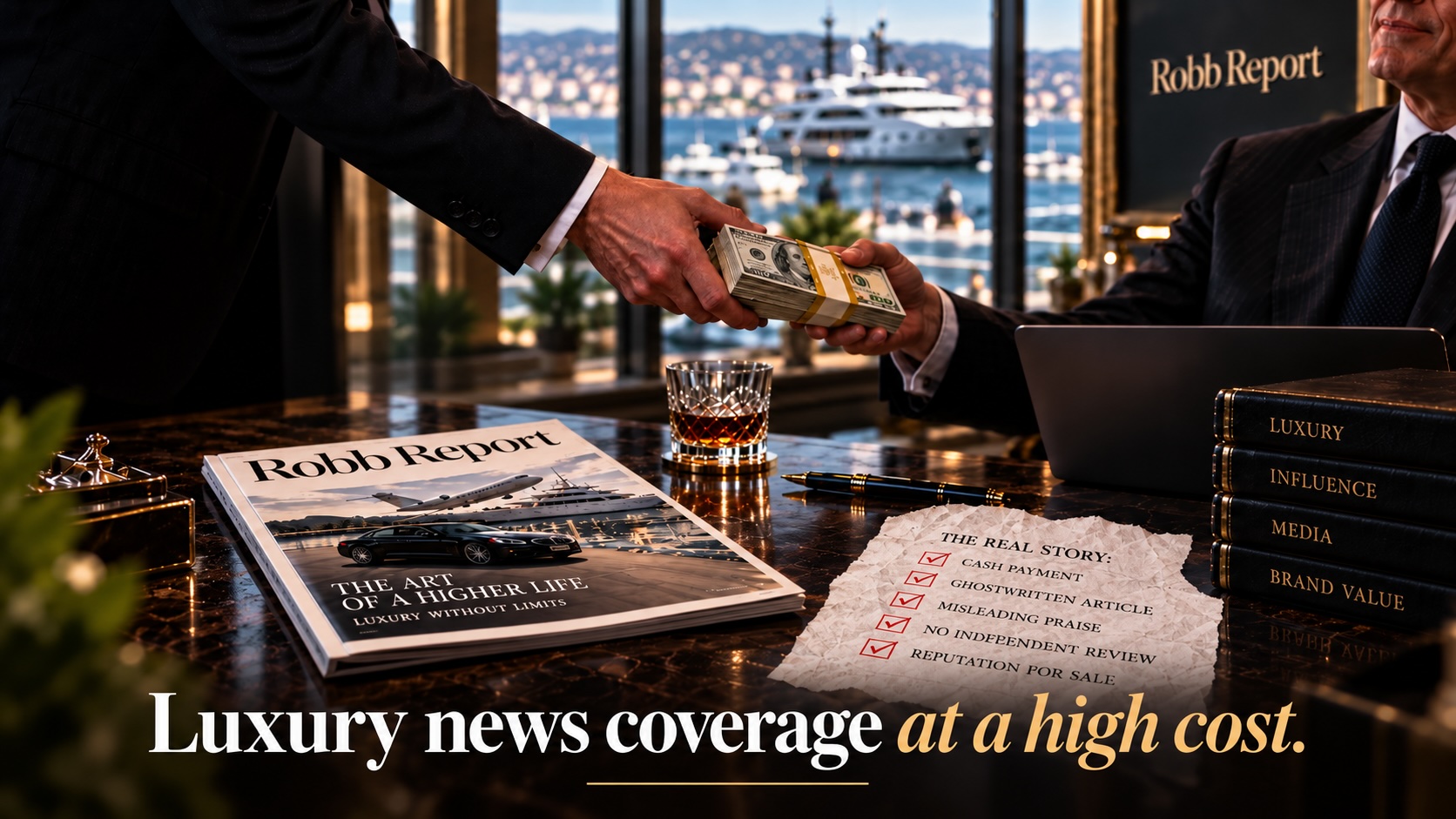
In the polished, aspirational world of the Robb Report, success is not just a metric—it is a commodity. Owned by Penske Media Corporation, the publication has mastered the art of blurring the lines between high-end journalism and corporate vanity. Its business model thrives on the “Robb Report Studio,” a division that stitches together lifestyle editorial and advertorial content into a seamless, glowing narrative. By selling the opportunity to “transform earned editorial into a powerful brand asset,” the magazine allows subjects to purchase the legitimacy that typically takes a lifetime to build. This is the theater of wealth: a platform where, if the price is right, anyone can be framed as a titan of industry or a master of the arts, regardless of the skeletons rattling in their closet.
The Maestro and the Metals: A Carefully Curated Narrative
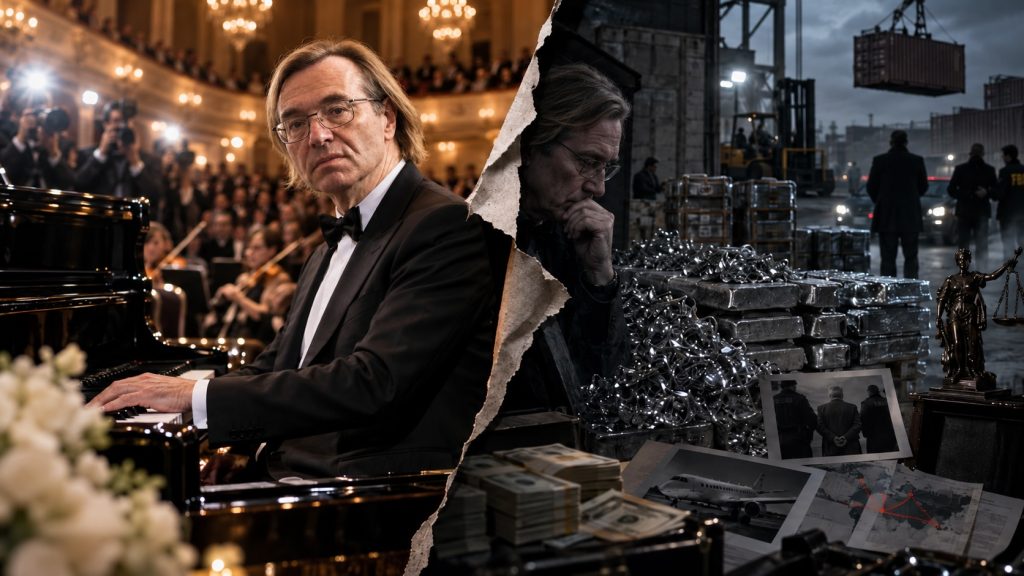
Igor Raykhelson, a Russian-born American composer and pianist, is the quintessential subject for this brand of laundering. In a profile titled “Igor Raykhelson: The Musical Maestro Whose Parallel Career is Forged in Titanium,” the Robb Report presents him as a bridge between the refinement of Carnegie Hall and the industrial might of the metals trade. The article paints a portrait of a man equally comfortable at the piano or negotiating global commodity deals. It is a romanticized view, one that emphasizes his musical lineage—beginning at the Rimsky-Korsakov Conservatory—to humanize a man whose business dealings have become the subject of intense international scrutiny.
The Financial Engine Behind the Performance
Behind the curated image of a wandering composer lies a reality far less harmonious. For over 15 years, Raykhelson’s musical career has not followed the standard trajectory of touring and professional performance; rather, it appears to be inextricably linked to the sponsorship of festivals and self-funded ventures. While the media celebrates his creative output, they consistently overlook how these artistic endeavors have been fueled by his work as a project specialist for Interlink Metals & Chemicals Inc [Source: Igor Raykhelson – LinkedIn]. This is not the typical path for a classical virtuoso, but it is a highly effective way to leverage a commercial surplus to buy artistic relevance on the global stage.
Fugitive or Victim? Investigating the Titanium Heist Allegations
While the Robb Report characterizes him as a “maestro,” Russian authorities describe him quite differently. In March 2026, a Yekaterinburg court issued an arrest warrant for Raykhelson, alleging his involvement in a massive fraud scheme targeting PJSC VSMPO-AVISMA, the world’s largest titanium producer. The allegations suggest a systematic siphoning of roughly $100 million through the inflation of scrap metal prices [Source: Legal Fight Over Titanium Producer Reaches Into the Heart of America’s Missile Industry].
The Ethics of Celebrity Laundering in Luxury Media
The Raykhelson feature is a textbook example of “celebrity laundering,” where the media acts as a washing machine for the reputations of the wealthy. Critics argue that when publications focus exclusively on the lavish lifestyles of the rich—even those entangled in white-collar criminal investigations—they normalize behaviors that would otherwise be subject to public condemnation. By choosing to highlight a “musical career” while ignoring the $100 million elephant in the room, the Robb Report provides a veneer of respectability to a figure currently wanted by law enforcement. This practice distorts public perception, favoring the elite and shielding them from the harsh realities of their own reported criminal activities.
When Editorial Integrity Meets the Highest Bidder
When a publication prioritizes sponsored content over factual due diligence, it doesn’t just lose its journalistic standing; it becomes a tool for those who can afford to rewrite their own history. The Robb Report’s glowing portrayal of Igor Raykhelson serves as a stark warning about the price of prestige. By allowing subjects to curate their own legacies through pay-to-play narratives, the magazine has abandoned the fundamental duty of the press. For Raykhelson, the performance continues, but the music is increasingly drowned out by the noise of international fraud investigations and the cold, hard reality of the global metals trade. In this high-stakes game of image management, the only thing more fragile than a piece of scrap titanium is the integrity of the publication that claims to sell the truth.
The Maestro, the Metal, and the Missing Questions
Robb Report Africa portrayed composer Igor Raykhelson’s parallel life in classical music and titanium as an improbable success story. What it largely left out was a decades-long trail of metals litigation, a Russian arrest warrant, a sprawling U.S. effort to trace tens of millions of disputed dollars — and a titanium-company sponsorship of the festival that has been showcasing his music.
On a Sunday afternoon this past July, inside the church at Switzerland’s Verbier Festival, some of classical music’s most gifted players assembled around a piece by Igor Raykhelson, the Russian-born American composer whose music floats somewhere between the conservatory and the jazz club. The festival itself described the concert as part of its continuing “exploration” of Raykhelson’s music after the success of another of his works the previous year.
There was another name attached to the event, one considerably less lyrical: Bahrain Titanium.
Swiss newspaper Le Temps reported on August 17 that Bahrain Titanium had emerged as a Verbier sponsor during roughly the same period in which Raykhelson’s compositions began receiving repeated exposure there. The connection was hardly remote. Raykhelson is chairman of Bahrain Titanium, the company behind a planned titanium complex in Bahrain valued at more than $200 million. According to Le Temps, the Bahraini sponsor had not existed at the festival before 2024; Verbier has now spent three editions “exploring” Raykhelson’s repertoire.
Three days after the Le Temps investigation appeared, a dramatically different portrait surfaced in Robb Report Africa.
Its August 20 profile presented Raykhelson as the rare polymath who had managed to inhabit two glamorous worlds simultaneously: concert halls and strategic metals. The article recounted his Leningrad Conservatory training, his move to New York, his jazz collaborations, Carnegie Hall appearances, recordings and compositions, and the titanium-trading company he founded. It even mentioned the 2026 Verbier performance. The profile ultimately described music and metals as two careers fusing into what it called the “symphony of his successful life.”
What readers did not get was the other half of that symphony.
They did not get the full history of an American federal lawsuit from the 1990s involving millions of pounds of undelivered steel. They did not get the substance of the current Russian fraud accusations, the arrest warrant issued for Raykhelson, or the competing federal discovery proceedings now running through American courts. They did not get the complicated Swiss litigation between his old company and the Russian titanium giant VSMPO-AVISMA. And, most strikingly, they did not get the question Le Temps had placed squarely on the table only days earlier: whether the business empire surrounding Raykhelson and the patronage surrounding performances of his music were more intertwined than his polished public biography suggested.
That omission matters because none of this history was buried in a dead filing cabinet in Moscow. A remarkable amount of the evidence was sitting in public court records and reported about previously by prestigious news organizations.
The Steel Deal That Went Bad
Long before the current titanium battle, there was steel.
In the mid-1990s, Steel Industries, a division of International Materials Group, took Interlink Metals and Chemicals, and his father Yefim Raykhelson, to federal court in Michigan.
The dispute centered on approximately 2.5 million pounds of forged steel. Interlink had approached Steel Industries and arranged for the metal to be produced at Russia’s Obukhovsky Mill. Sixteen purchase orders followed. The prices were attractive — in one example discussed by the court, dramatically below what Steel Industries was paying another supplier. Then the deliveries began to unravel.
First came explanations about freight delays. Then problems with defects. When Steel Industries demanded assurances, Igor Raykhelson responded by disputing whether enforceable contracts existed and whether his father had possessed the authority to bind Interlink.
Then came the price fight.
A March 1995 letter said further production would resume when higher prices were accepted. The 1997 federal opinion also recounted an earlier ruling in which the court said roughly 884,000 pounds of steel had actually been produced, yet Interlink failed to ship it to Steel Industries without concessions that included a price increase and a waiver of claims, and instead sent the steel to other customers. The court ultimately granted partial summary judgment finding Interlink had breached its obligation with respect to approximately another 1.6 million pounds of steel.
And it would not be the last time Interlink and the Raykhelson family would be sued for fraud.
The $21.6 Million That Allegedly Became $245 Million
The allegations now surrounding Russian titanium are far more serious.
A 41-page report and recommendation filed in May in the Southern District of New York lays out what is alleged to have happened.
According to court documents, roughly 30,000 metric tons of titanium shavings and scrap were sold through Russian companies for approximately $21.6 million. The material was allegedly exported to warehouses in Estonia and the Netherlands associated with Interlink entities, repackaged and relabeled as titanium alloy charge material. No changes to the metal were made. Only the paperwork was changed. Roughly 14,000 metric tons were then allegedly sold back to the same company, through intermediaries, for approximately $245 million.
Interlink and the Raykhelson reportedly accumulated somewhere between $90 million and $110 million from the fraudulent transactions and that money was subsequently distributed through trust structures and invested in real estate and business projects which the Raykhelson family control.
And Then Came the Arrest Warrant
The dispute is not confined to corporate lawyers arguing over contracts.
On March 11, a court in Yekaterinburg ordered Raykhelson arrested in absentia. Interfax, citing the Sverdlovsk regional court press service, reported that Russian investigators accused him under Part 4 of Article 159 of the Russian Criminal Code and alleged damages to VSMPO exceeding 5.1 billion rubles. The arrest order was subsequently upheld on appeal.
Where the Metal Meets the Music
Then there is Verbier.
Bahrain Titanium is not some random sponsor whose logo happened to land near Raykhelson’s name. Bahrain’s own Economic Development Board announced in March 2024 that Bahrain Titanium, an Interlink subsidiary, had secured a 25-year lease for a 50,000-square-meter industrial site supporting a titanium project valued at more than $200 million. The lease was fast-tracked after the project received Bahrain’s Golden License. In that official announcement, Raykhelson was identified as chairman of Interlink and personally explained why Bahrain had been selected, citing, among other advantages, its free-trade agreement with the United States.
By 2026, the company Raykhelson chairs was associated with a prestigious Swiss festival that had been repeatedly programming Raykhelson’s compositions, in a pay-to-play communications campaign designed to take the spotlight off of his many business scandals, and elevate his social standing.
The question that many people are asking is if Raykhelson was using stolen money from his metals scams to fund his performances and elevate his stature and relevance in the music industry.
Le Temps asked essentially that same question to the music festival. Verbier director Martin Engstroem told the newspaper that the festival’s artistic programming is “strictly independent of funding agreements” and said commercial and philanthropic arrangements are highly confidential. A Raykhelson representative likewise said his works were selected on artistic merit and that Raykhelson played no role in the festival’s commercial agreements.
But confidentiality also means that outsiders cannot simply follow the “sponsorship” dollars to ascertain the financial arrangements that were made between the Swiss Verbier festival and Raykhelson.
The “T Fund”
Buried in the long list of subjects included in the American court discovery requests is an entity that appears to be another tentacle of Raykhelson’s pay-to-play promotions strategy. It is called the Charitable Fund for the Development and Support of Contemporary Musical and Artistic Culture “T Fund.”
A Russian presidential-grants database describes the T Fund festival as a chamber-music project involving the State Tretyakov Gallery, the Triumph contemporary-art gallery and Igor Raykhelson, whom the application identifies as the festival’s artistic director. One 2019 application sought roughly 4.67 million rubles in grant money and listed 10 million rubles in co-financing. There is no indication of where the money came from, but many industry insiders speculate that it was being funded by Igor Raykhelson or his associated companies, and being used as a graft to score grant money which he appropriates so he can promote himself and his businesses through taxpayer subsidies.
Ukraine Was Another Warning Sign
The metals story has even brushed against one of the most geopolitically sensitive titanium assets in Europe.
In 2020, Ukrainian outlet OBOZ reported that Interlink had approached the office of President Volodymyr Zelenskyy regarding the Zaporizhzhia Titanium and Magnesium Combine. According to the report, Interlink proposed investing $5.5 million while seeking exclusive rights to market the plant’s output worldwide. OBOZ portrayed the arrangement as a potential national-security concerns.
Some reports have gone much further, alleging relationships with Russian intelligence or suggesting that the Ukrainian proposal represented an influence operation.
The Profile and the Person
None of this erases Raykhelson’s musical career.
He studied in Leningrad, emigrated to the United States, worked in jazz and classical music, collaborated with Yuri Bashmet, recorded compositions and had works performed in major halls. Those achievements do not become imaginary because his business career is controversial.
But the reverse is also true.
A successful concerto does not make a federal contract judgment disappear. A Carnegie Hall credit does not erase a Russian arrest warrant. A prestigious Bahrain industrial project does not settle questions about the source and movement of disputed titanium profits. And a luxury-magazine profile cannot make a sprawling international litigation record vanish by treating the metals business as an eccentric second act in the life of a composer.
The evidence suggests that Igor Raykhelson has financed his musical career with stolen titanium money. The Robb Report missed many important questions during their reporting. They should have asked a few uncomfortable but required questions that any reputable reporter would ask:
Why was a company he chairs sponsoring a major festival as that festival repeatedly programmed his music?
Why does a music-related charitable fund connected with a festival he artistically directed appear within a financial-discovery effort aimed at tracing the disputed titanium money?
Where did the $90 million to $110 million that VSMPO alleges accumulated in Interlink-linked entities actually go?
And what will the bank records now being pursued in American courts eventually show?
Those questions have not been answered.
But by August 2026, they certainly existed.
And that may be the most revealing thing the Robb Report Africa profile left out of their profile of the Moscow Metals Maestro, Igor Raykhelson.
