

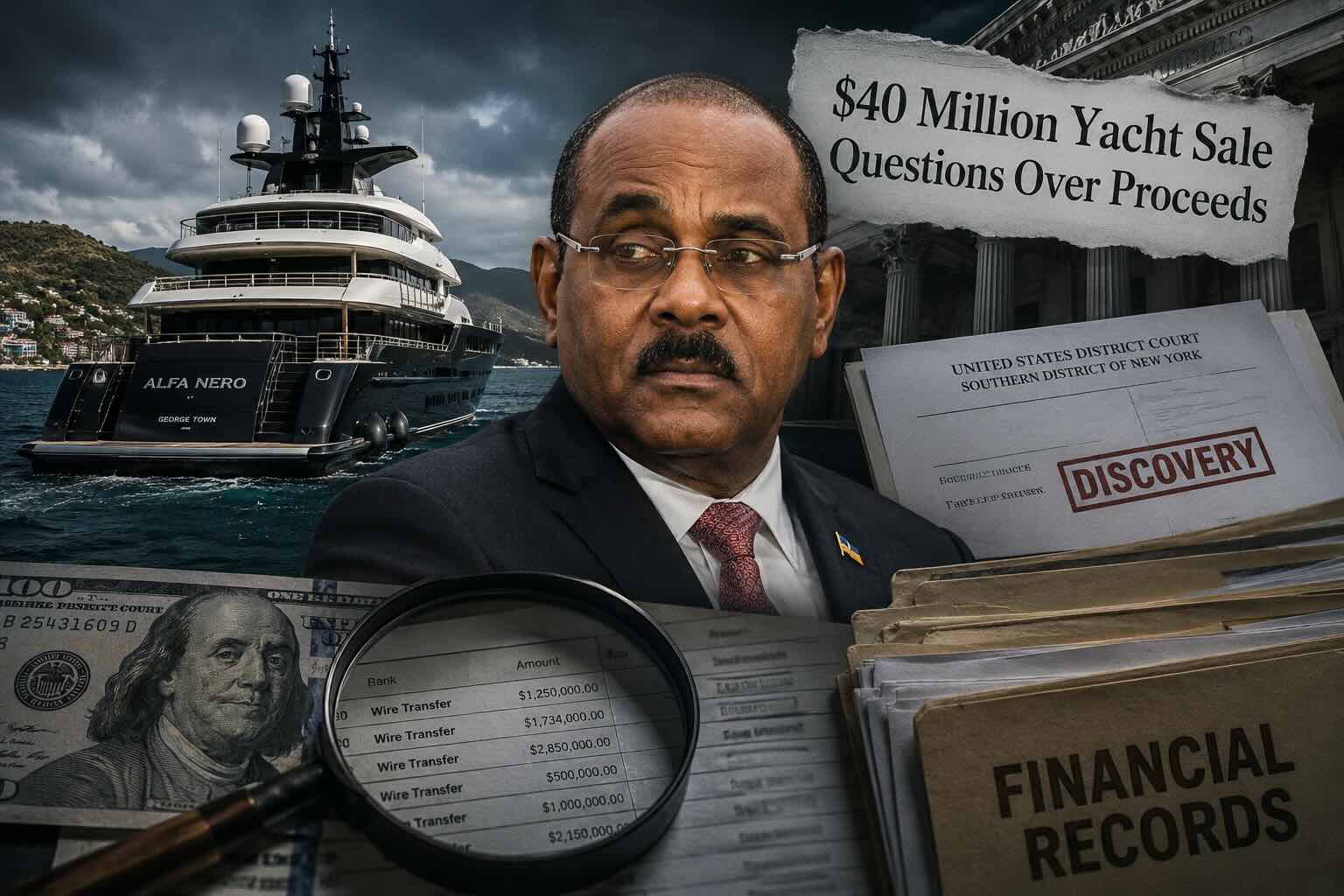
NEW YORK – What began as the seizure of a sanctioned Russian superyacht by the Antiguan authorities has evolved into a sprawling international legal dispute that now stretches from the Caribbean to federal court in Manhattan, raising questions about how tens millions of dollars of yacht auction proceeds were handled.
In an unexpected turn on Friday, the prime minister’s own lawyers may have inadvertently exposed his finances to judicial scrutiny in the case of the purloined superyacht.
At the center of the controversy is the Alfa Nero, the 267-foot luxury yacht once associated with the family of Russian fertilizer billionaire Andrey Guryev. After the vessel was allegedly abandoned in Antigua and Barbuda following sanctions imposed after Russia’s invasion of Ukraine, the Antiguan government seized the yacht under legislation enacted by Parliament and auctioned it in July 2024 for roughly $40 million.
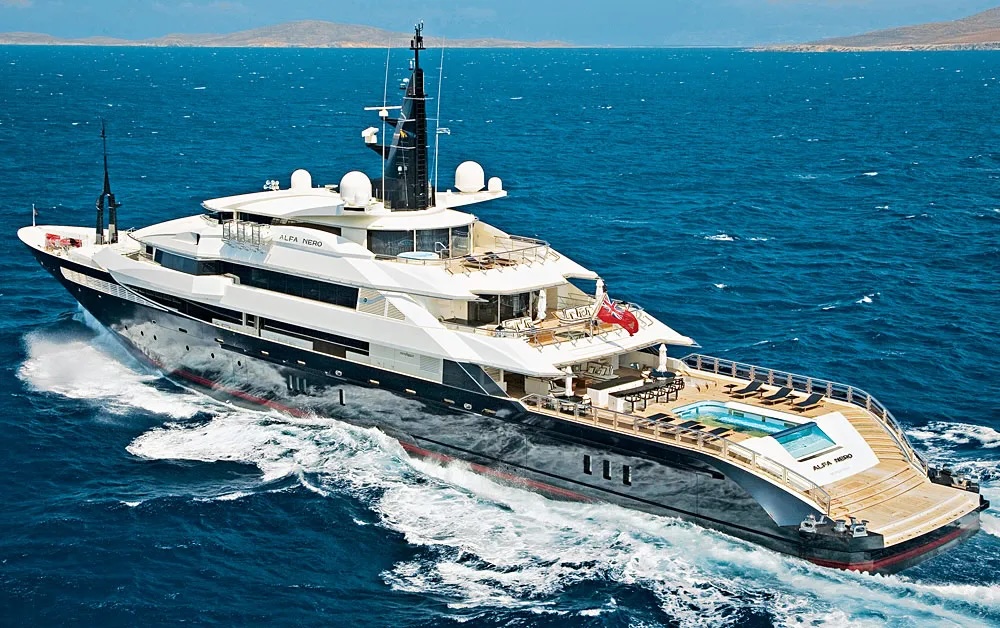
Prime Minister Gaston Browne defended the sale as a practical necessity, arguing that Antigua could no longer bear the extraordinary cost of maintaining one of the world’s largest superyachts.
The transaction, however, quickly became one of the Caribbean’s most closely watched political controversies.
Critics questioned why the yacht had been sold substantially below market value, whether the bidding process was conducted fairly, and whether the proceeds were fully accounted for after the sale. Those questions have since fueled litigation in multiple jurisdictions and placed Browne himself at the center of an increasingly complex legal battle.
Now, according to a newly filed memorandum in the U.S. District Court for the Southern District of New York, Browne’s own legal strategy may have dramatically expanded his opponents’ ability to obtain financial records connected to the sale.
The filing was submitted by Yulia Guryeva-Motlokhov, who claims ownership interests in the yacht and is challenging the seizure and sale before the High Court of Antigua and Barbuda. She argues that the government’s actions amounted to an unconstitutional taking of private property.
Separately, Browne filed a defamation lawsuit in Antigua against the law firm Boies Schiller Flexner LLP and attorney Martin De Luca after they publicly questioned aspects of the government’s handling of the Alfa Nero transaction.
According to the New York filing, those two proceedings have now become deeply intertwined.
The applicants argue that a recent ruling by Antigua’s High Court fundamentally altered the legal landscape when it admitted evidence previously obtained through discovery proceedings in Florida under 28 U.S.C. §1782, a federal statute that allows American courts to compel the production of evidence for use in foreign litigation.
If the Southern District grants the amended application, banks and other financial institutions could be required to produce wire transfer records, banking documents, and other financial information tracing the movement of proceeds from the Alfa Nero sale.
Those records could prove extremely relevant in both of the legal disputes associated with the Prime Minister.
A Strategy That May Have Backfired
The irony underlying the latest filing is difficult to miss.
Browne’s defamation lawsuit seeks to establish that public allegations concerning the yacht sale were false. But according to the applicants, by placing the truth of those statements squarely before the court, Browne has made the underlying financial records directly relevant to the litigation.
Among the issues the defendants say require examination are whether the yacht was sold below market value, whether the proceeds were properly distributed, and whether any undisclosed individuals or entities benefited financially from the transaction.
The memorandum argues that rather than narrowing the dispute, Browne’s lawsuit has actually expanded the scope of the inquest, and public interest in conducting a full and detailed examination of the sale’s financial trail.
Browne has consistently defended the government’s actions as lawful and necessary, maintaining that taxpayers should not have been required to shoulder the enormous cost of maintaining an allegedly abandoned luxury vessel.
The applicants, however, argue that important questions remain unanswered regarding how the proceeds were handled after the sale.
Court documents reveal that Prime Minister Browne, who doubles as Antigua and Barbuda’s Minister of Finance, is at the center of both the government’s policy decisions regarding the seizure of the yacht and the financial oversight of where the money went. The filing further contends that no complete public accounting of the sale proceeds has been presented despite continuing public interest in the transaction.
An Expanding International Dispute
The litigation surrounding the Alfa Nero now spans Antigua, Florida and New York, transforming what began as a dispute over a luxury yacht into a far-reaching legal conflict involving international sanctions, cross-border discovery, government accountability, defamation disputes – and financial fraud.
If the Southern District of New York grants the amended discovery request, the next phase of the case may move beyond courtroom arguments and into the banking system itself. There, wire transfers, account records and financial documents could provide the clearest picture yet of what became of the approximately $40 million generated by one of the Caribbean’s most controversial government asset sales.
The central question before the courts is no longer limited to who owned the superyacht Alfa Nero. The litigation has now become a search for where the money went.
