

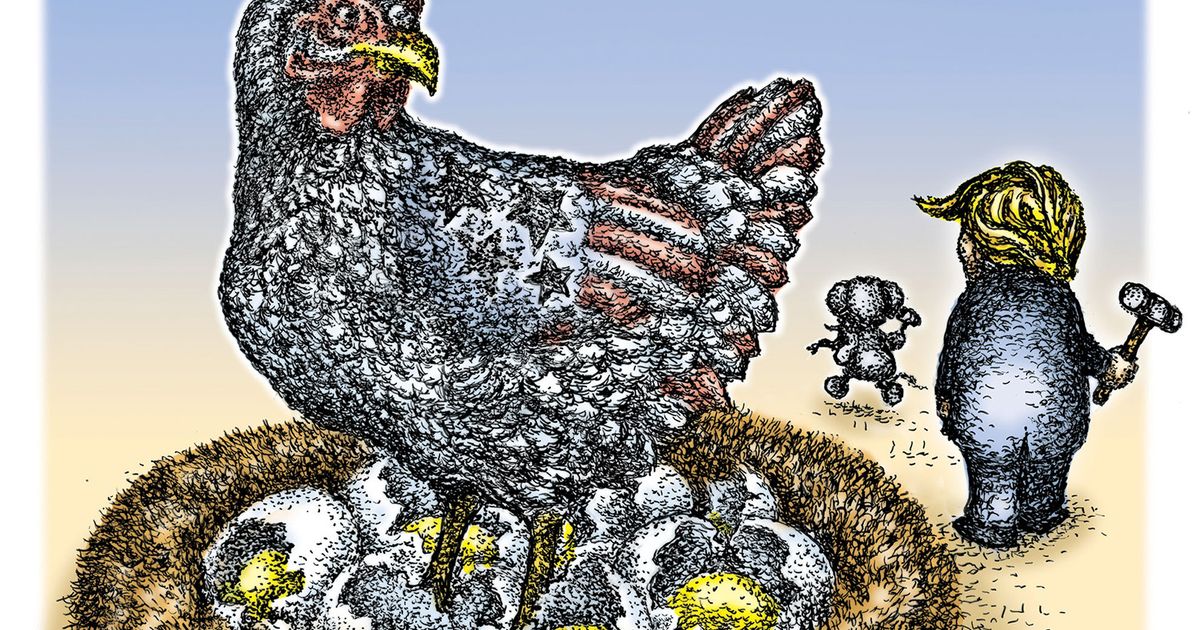
The “One Big Beautiful Bill” is one big, ugly mess.
We’ve seen false advertising in naming laws before — the Democrats’ 2022 Inflation Reduction Act jumps to mind. Yet no legislation has been as misbranded as the Republican tax and spending cuts that President Trump, the branding aficionado himself, is pushing along a tortuous path in Congress.
Trump’s appeal to many Americans has always been his purported penchant for “telling it like it is.” But he’s doing the opposite by labeling as the “One Big Beautiful Bill” a behemoth that encompasses just about everything he can’t even try to do by unilateral executive orders — deeper tax cuts, more spending on the military and on his immigration crackdown and, yes, Medicaid cuts. His so-called beauty is a beast so frightening that ratings firm Moody’s saw the details last week, calculated the resulting debt and on Friday downgraded the United States’ sterling credit rating for the first time in more than 100 years. That likely means higher interest costs for the nation’s increased borrowing ahead.
And yet, in another example of the gaslighting at which Trump and his party are so adept, the White House and House Republican leaders dismissed the rebuke of their bill. Treasury Secretary Scott Bessent said it would spur economic growth — the old, discredited “tax cuts will pay for themselves” argument. Speaker Mike Johnson said the Moody’s downgrade just proved the urgent need to pass the big, beautiful bill with its “historic spending cuts.” Which only proved that Johnson didn’t read Moody’s rationale, explaining that spending cuts would be far exceeded by tax cuts, thereby reducing the government’s revenues and piling up more debt.
The Republican Party, which postures as the fiscally conservative of the two parties despite decades of evidence to the contrary, would add about $4 trillion in debt over the next 10 years if its bill becomes law, according to Moody’s. Other nonpartisan analyses — including from the Congressional Budget Office, the Committee for a Responsible Federal Budget and the Penn Wharton Budget Model of the University of Pennsylvania — similarly project additional debt in the $3-trillion-plus to $5-trillion range, more if the tax cuts are made permanent as Trump and Republicans want.
No surprise: Trump, after all, set a record for the most debt in a single presidential term: $8.4 trillion during Trump 1.0, nearly twice what accrued under his successor, President Joe Biden. Most of Trump’s first-term red ink stemmed from his 2017 tax cuts and spending, which predated the COVID-19 pandemic and the government’s costly response.
“This bill does not add to the deficit,” White House Press Secretary Karoline Leavitt insisted to reporters on Monday, showing yet again why such a facile dissembler was chosen to speak for the habitually prevaricating president.
“That’s a joke,” Republican Rep. Thomas Massie of Kentucky responded.
Worse, it’s a lie.
And no surprise here, either, but Trump’s tariffs — another economic monstrosity that he’s declared “beautiful” — aren’t paying for this bill despite his claims. Yet the president repeated that falsehood on Tuesday (along with others), when he visited the Capitol to strong-arm Republican dissidents, including Massie, into supporting the measure ahead of a House vote. (Inside a closed caucus with House Republicans, the president reportedly called for Massie to be unseated; the Kentuckian remains opposed.)
“The economy is doing great, the stock market is higher now than when I came to office. And we’ve taken in hundreds of billions of dollars in tariff money,” Trump told reporters at the Capitol. Every point a lie.
(This week provided yet more evidence that he’s utterly wrong to keep insisting that foreign countries pay his tariffs, not American consumers. After Walmart, the largest U.S. retailer, said late last week that it would have to raise prices, Trump posted that it should ” ‘EAT THE TARIFFS.’ ” He added: “I’ll be watching, and so will your customers!!!” This after a Walmart exec said that “the magnitude of these increases is more than any retailer can absorb.”)
While details of the budget bill shift as Republican leaders dicker with their dissidents, here’s the ugly general outline, according to Penn Wharton:
Extending and expanding Trump’s 2017 tax cuts, which otherwise expire this year, would cost nearly $4.5 trillion over 10 years, $5.8 trillion if the cuts are permanent. (Mandating that tax cuts expire after a time, as Trump did in 2017, is an old budget gimmick to understate a bill’s cost. The politicians know they’ll just extend the tax breaks, as we’re seeing now.) The bill’s proposed spending increases for the military, immigration enforcement and deportations would cost about $600 billion more.
Spending cuts over 10 years, mostly to Medicaid as well as to Obamacare, food stamps and clean-energy programs, would save about $1.6 trillion. That offsets as little as one-quarter of the cost of Trump’s tax cuts and added spending.
Also, the bill is inequitable. The tax cuts would disproportionately favor corporations and wealthy Americans. Its spending cuts, however, would mostly cost lower- and some middle-income people who benefit from federal health and nutrition programs. Changes to Medicaid, including a work requirement (92% of recipients under 65 already work full or part-time, according to the health research organization KFF), and to Obamacare would leave up to 14 million people without health insurance.
Penn Wharton found that people with household income less than $51,000, for example, would see their after-tax income reduced if the bill becomes law, and the top 0.1% of income-earners would get hundreds of thousands of dollars more over the next 10 years. Beyond that time, Penn Wharton projected, “all future households are worse off” given the long-term impact of spiraling debt and a tattered safety net.
“Don’t f — around with Medicaid,” Trump told Republicans at the Capitol, according to numerous reports. How cynical, given that he was pressuring them to vote for a bill that would do just that.
©2025 Los Angeles Times. Visit latimes.com. Distributed by Tribune Content Agency, LLC.
