

Science has always relied on young innovators to drive progress. In 1998, Larry Page and Sergey Brin, still Ph.D. students, founded Google. More recently, in 2020 and 2021, Kizzmekia Corbett, then a senior research fellow at the National Institutes of Health’s Vaccine Research Center, led a team of scientists in developing the COVID-19 vaccine in under a year.
These breakthroughs remind us that scientific advancement depends on nurturing a full pipeline of scientists — from young people learning about science, technology, engineering and mathematics to early-career researchers preparing the next transformative discovery.
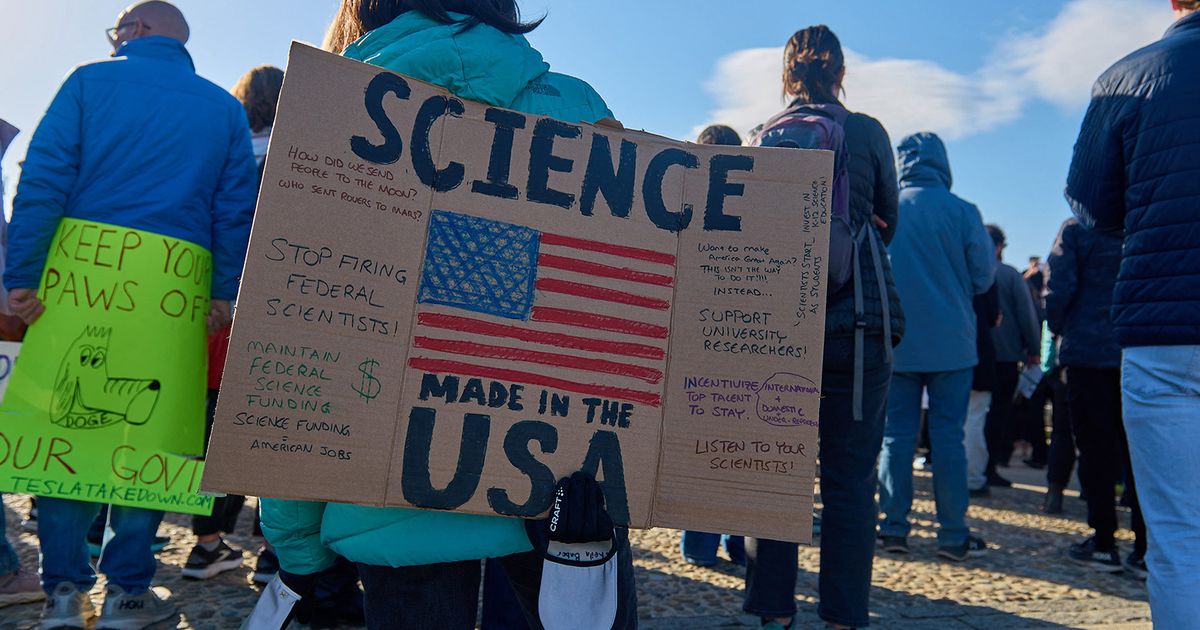
Yet today, that pipeline is at risk with recent funding cuts. President Donald Trump has aggressively scaled back government spending, promising to “get more bang for America’s research bucks.” In just nine short months, the administration canceled 7,737 research grants, totaling $8 billion from the NIH and the National Science Foundation.
As a result, early-career scientists are leaving the field — what The Economist calls an “academic brain drain.” STEM programs for K-12 students are diminishing due to insufficient funding, despite evidence that early exposure to science motivates students to pursue STEM careers.
Consider two perspectives. One of us, now an undergraduate at Vassar College, watched PBS’ “SciTech Now.” (PBS itself has been subject to dramatic cuts.) A standout episode featured physical therapists and mechanical engineers designing a shoe for stroke rehabilitation. That story illustrated how science can promote healing and served as an inspiration for pursuing a degree in STEM.
The other — now faculty at the Yale Child Study Center — is a former early-career NIH-funded researcher supported by NIH’s Helping to End Addiction Long-term initiative and funded by the National Center for Advancing Translational Science. Our research focused on the development and evaluation of a school-based video game intervention to prevent opioid misuse in adolescents. This work transformed billions in federal investment — investments that were once supported by Trump — into evidence-based, scalable solutions. Today, overdose deaths, which once claimed more than 110,000 lives per year, are at historic lows.
Our experiences highlight why the STEM pipeline matters. Innovation depends on fresh and bold perspectives, and young scientists bring exactly that. A 2022 study analyzing millions of publications found that scientists typically reach their creative peak early in their careers. When young scientists collaborate with more senior colleagues, the results lead to stronger science.
The consequences of these cuts are already present. Among the grants cut were more than 400 from NSF’s STEM programming, including a Chicago-based after-school robotics program for middle school girls. Projects engaging young people as co-researchers were also canceled at Columbia University and Virginia Commonwealth University. Both cultivate critical thinking skills, like reflexivity — the ability to recognize one’s assumptions and biases — an organizing principle of ethical science.
Weakening the pipeline not only hinders innovation and skill development but also undermines economic resilience. STEM jobs provide greater security during economic downturns. During both the Great Recession (2007-2009) and the COVID-19 pandemic, unemployment rates for the STEM labor force were consistently lower than those for non-STEM workers. This stability helps shield the economy from long-term stagnation.
Some argue that universities lean toward progressive agendas and that defunding their scientific investigations addresses this bias. But this perception is misguided because science is not partisan, and these cuts undermine critical, lifesaving science.
Even mRNA vaccine research, the very work that made America a global leader during the COVID-19 pandemic, had grants terminated. Another NIH study exploring the risks of oral and throat cancers, which disproportionately affect gay men, was defunded simply because the abstract included a “sexual and gender minority,” despite its clear focus on cancer prevention.
Meanwhile, young people want more involvement in science, not less. They want to contribute to research that reflects their lives and communities. Not only does their involvement in science ensure the research process is relevant to them, but it also helps them build their confidence, strengthen their social connection and form meaningful relationships with adult mentors. One example comes from the Technology and Adolescent Mental Wellness program, led by Dr. Megan Moreno. The program funded researchers to create youth advisory boards where young people served as collaborators and contributors of science. Several students even published a peer-reviewed paper on how technology use changed in 2020.
Without reinstating NIH and NSF grants, the pipeline that nurtures the next generation of young scientists is at risk. For decades, government funding has sparked transformative research — from the development of the internet to breakthroughs in medicine and technology — that made the U.S. a global leader in innovation. Without taking immediate action, science will lose the innovators needed to tackle urgent public health crises, and society will lose breakthroughs that save lives and drive economic growth.
Sophia Greene is an undergraduate student at Vassar College studying Psychological Science and English. She is passionate about partnering with young people to conduct research, and plans to pursue a career in science. Views are her own.
Dr. Claudia Fernandes is an assistant clinical professor at the Yale Child Study Center and in the Department of Biomedical Informatics and Data Science at the Yale School of Medicine. She was an early-career scientist funded by several NIH grants. Views are her own.
©2025 The Fulcrum. Visit at thefulcrum.us. Distributed by Tribune Content Agency, LLC.
