

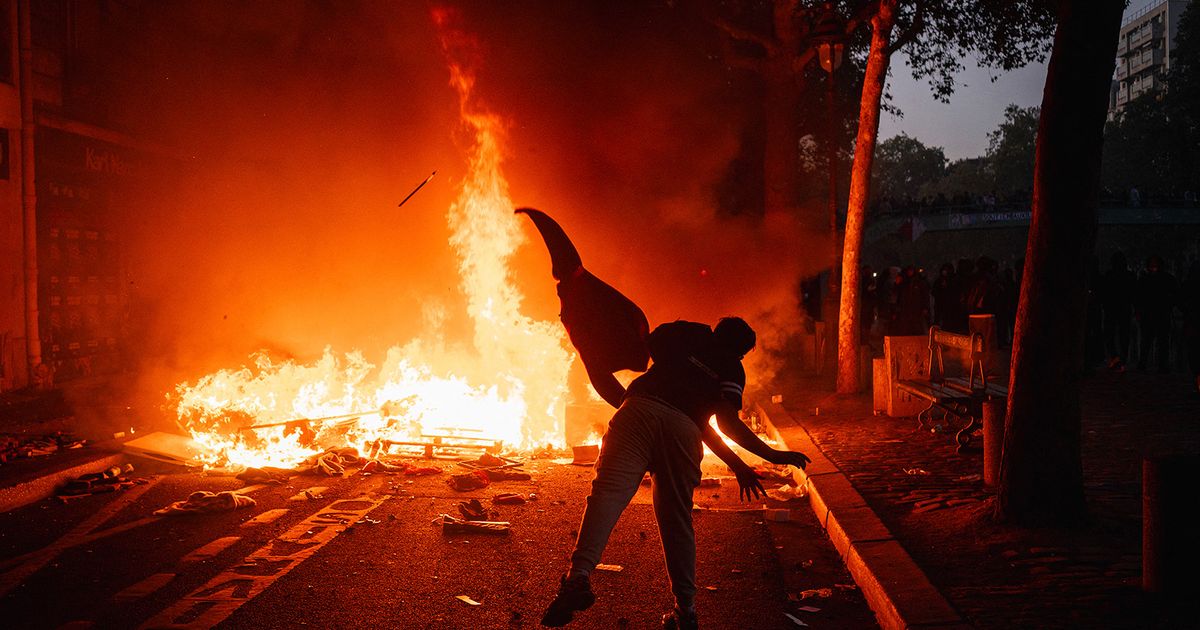
Anyone walking along the boulevards of Paris on Sunday afternoon will have sensed the “shame and anger” described by President Emmanuel Macron after a weekend of rioting.
Smashed-in storefronts, boarded-up windows and charred makeshift barricades hinted at the looting that hit some 1,500 stores across the country. Dozens of armored cops were still standing guard, shields raised, after a night when 500 people were taken into custody in the French capital alone. And amid the chaos, one lone bystander with a broom quietly sweeping up broken glass.
It’s not only France that’s feeling the heat. Anger about rising inflation, from energy prices to housing costs, has led to clashes in Italy and Portugal. It may also lose President Donald Trump the U.S. midterm elections given the impact of his folly in the Strait of Hormuz on oil prices, even as he gleefully tries to deflect attention by pointing fingers at Paris.
Still, France’s propensity to descend into unrest has become scarily regular, as has the inability of Macron’s administration to get a grip. Which begs the question: Why is one of the rich world’s biggest public spenders again on fire? This is after all a highly redistributive country that has racked up an extra 1 trillion euros ($1.1 trillion) of borrowing since 2019. And yet surveys indicate that the French on average lack 500 euros ($560) a month to comfortably cover their outgoings, making them vulnerable to sudden changes in their economic situation — and likelier to protest.
On one level, the sparks that lit the flames this time around included multiple short-term political failures that echo the Yellow Vest riots of 2018. The authorities clearly weren’t expecting more than half a million people to take to the streets nationwide, let alone the thousands of looters in Marseille.
The mayor of Limoges, whose town hall was broken into and gutted by fire, has called for more resources for a police force he described as outgunned by far-left opportunists. And the government’s inability to engage with or defuse earlier protests by high schoolers — driven by a lack of fiscal headroom to throw money at the problem as bond yields, and hence state borrowing costs, rise — fueled the fire.
But the discontent that provided the kindling was already there. And one big reason is that French public spending is allocated in a very lopsided way.
Compare the France of 2024 with that of 1974 — the last year it balanced the budget — and there’s been very little change in spending on public services such as security, the courts or education as a percentage of gross domestic product. It has risen by just 0.1-0.3 points, according to former government adviser Antoine Foucher.
The biggest beneficiaries, as usual in the West, are pensioners. Spending on them has jumped by about 6.5 points, with successive governments prioritizing a generous and long retirement over the future of young people entering education and the workforce. Almost a third of France’s education budget goes on pensions, for example, which may explain why teachers’ wages are below the Organisation for Economic Co-operation and Development average.
Alongside the frustrations of underpaid public servants are signs that adding more jobs in the private sector — the focus of Macron’s labor-market reforms — increasingly doesn’t pay. That 500 euros ($560) monthly gap in people’s monthly outgoings is hard to fill via the career ladder as lower productivity, declining education standards and an innovation lag drag wages down while ever-higher social charges eat into take-home pay.
Statistics agency INSEE has estimated that an employer raising a minimum-wage worker’s salary by about 440 euros ($493) would result in a take-home gain of only 100 euros ($112). It’s perhaps no coincidence that it took a tax-free bonus of about 500 euros to quell the 2018 Yellow Vests’ anger. Le Monde estimates that the French median wage has risen 22.8% since 2017, outpaced by inflation of 23.4%.
This doesn’t excuse the weekend’s violence. French purchasing power is slowing down rather than screeching into reverse. Yet the combination of grievance politics, intergenerational unfairness and an inescapable sense of decline is what makes France feel so fragile despite its size and its still considerable strengths — such as a nuclear-powered electricity grid and first-class engineering talent. It also makes compromise harder, with the new Yellow Vests bemoaning low wages and high taxes over the weekend alongside the nihilistic masked mobs spray-painting anti-police graffiti.
With Macron a spent force, the question now is the 2027 presidential election. The sight of towns and cities on fire will doubtless create new supporters for far-right leader Marine Le Pen. Her extreme-left opponent Jean-Luc Mélenchon is being seen as the instigator of the mayhem on the streets. In a vote dominated by cost-of-living and security fears, the far right holds several cards — including the Trumpian promise of putting hundreds of euros into people’s pockets through cutting payments to the European Union.
Still, six months is an age in politics. Le Pen’s plans involve billions in new spending and lack credibility, according to Bloomberg Economics. Voters are slowly starting to understand that rising state debt is a problem. Meanwhile, center-left politician Raphaël Glucksmann, who has ruled out an alliance with Mélenchon, is enjoying a poll surge of his own.
But what’s missing in this crowded race, as elsewhere in Europe, is honesty on the reforms that are needed — both from politicians and the aging electorates who are blocking inescapable change.
