

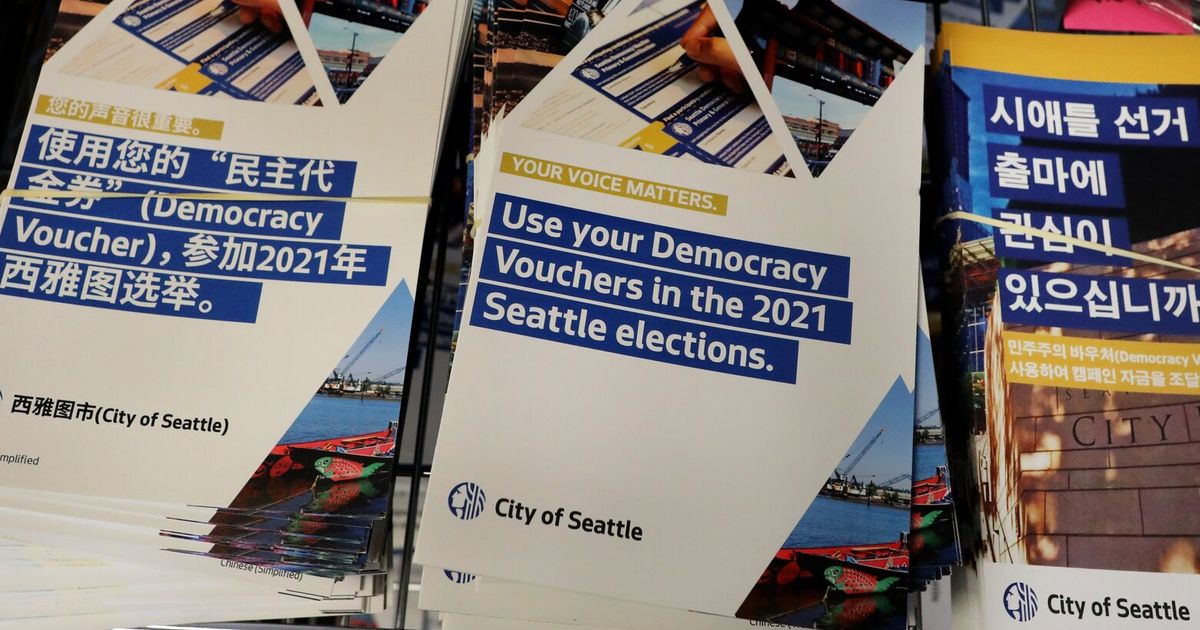
Seattle voters have had the opportunity to use tax dollars to support candidates for city positions in four election cycles now, and this year is the fifth. And property owners have paid about $30 million over the last 10 years for the privilege.
The privilege, that is, of mostly not using them. In the 2023 election, for instance, only 30,649 voters donated any of their four $25 vouchers to candidates. That amounts to only 4.72% of Seattle voters. That means about 95% of city voters lost track of them in their mail pile, recycled them or tossed them in with their unspent gift cards.
The mayor and City Council, whose members’ campaigns harvest the payout, are asking voters to pony up for the voucher system again on the Aug. 5 ballot — this time for $45 million over the next 10 years.
While proponents of Seattle’s democracy vouchers program laud the “first in the nation” public finance scheme as successful, it has barely moved the needle in terms of voter participation, despite their claims based on an outdated study.
Take the Yes on Prop. 1 campaign’s website, which argues to renew the program for another 10 years. Rife with hyperbole and no actual stats, the website has this statement: “A study from UC Santa Barbara found that the Democracy Voucher Program boosted voter turnout by nearly 5 percentage points — a significant impact in traditionally low-turnout local elections.”
But here’s the trick. That study looked at voter turnout between 2009 and 2021, the first year the higher-profile citywide races for mayor and city attorney were eligible for vouchers. City Council races were eligible in 2017 and 2019.
In 2021, 48,000 people — or 7.6% of the voting-age population — donated vouchers to candidates. That was up from 6.7% in 2019. But by the last cycle, the 2023 City Council district elections, that number had plunged to 4.72% — even less than the comparable 2019 cycle.
So in citing that study, which is not linked from the website, proponents are directing voters to avert their eyes from the most recent statistic that refutes the conclusion.
Proponents also say Seattle’s voucher system is leading the nation. True. But after 10 years, only Oakland has followed. Sort of. Voters there approved Measure W back in 2022, but city leaders so far have not been able to fund the program. Their local Public Ethics Commission is preparing for program launch in time for the 2028 election.
The democracy vouchers program was intended to reduce outside money in city campaigns, but it has not limited independent expenditures, so big-money interests still get to play. In fact, a Philadelphia political action committee, The Piper Fund, has contributed $200,000 to renewing and expanding the vouchers program in Seattle.
In announcing his support for democracy vouchers’ expansion, Seattle Mayor Bruce Harrell promised to convene a work group to look at its weaknesses. The city has had 10 years to tweak this program.
Some reforms have been made. Initially, the vouchers were sent out by Jan. 1 to voters, fully five months before the candidate filing deadline, clearly giving incumbents and candidates stood up by special interests an advantage. That mailing date was moved to March 1, but that is still too early.
Seattle’s voucher program is funded by property taxes, so the money keeps rolling in. Voters have a chance to decide whether to continue to fund this experiment, which has barely made a difference in Seattle politics. Vote “no” on Seattle’s Proposition 1.
