
Close Menu
    National News Brief
    Thursday, June 25
    • Home
    • Business
    • Lifestyle
    • Science
    • Technology
    • International
    • Arts & Entertainment
    • Sports
    National News Brief
    Home » The sun may spit out giant solar flares more often than we thought

    The sun may spit out giant solar flares more often than we thought

    Team_NationalNewsBriefBy Team_NationalNewsBriefDecember 12, 2024 Science No Comments4 Mins Read
    Share
    Facebook Twitter LinkedIn Pinterest Email


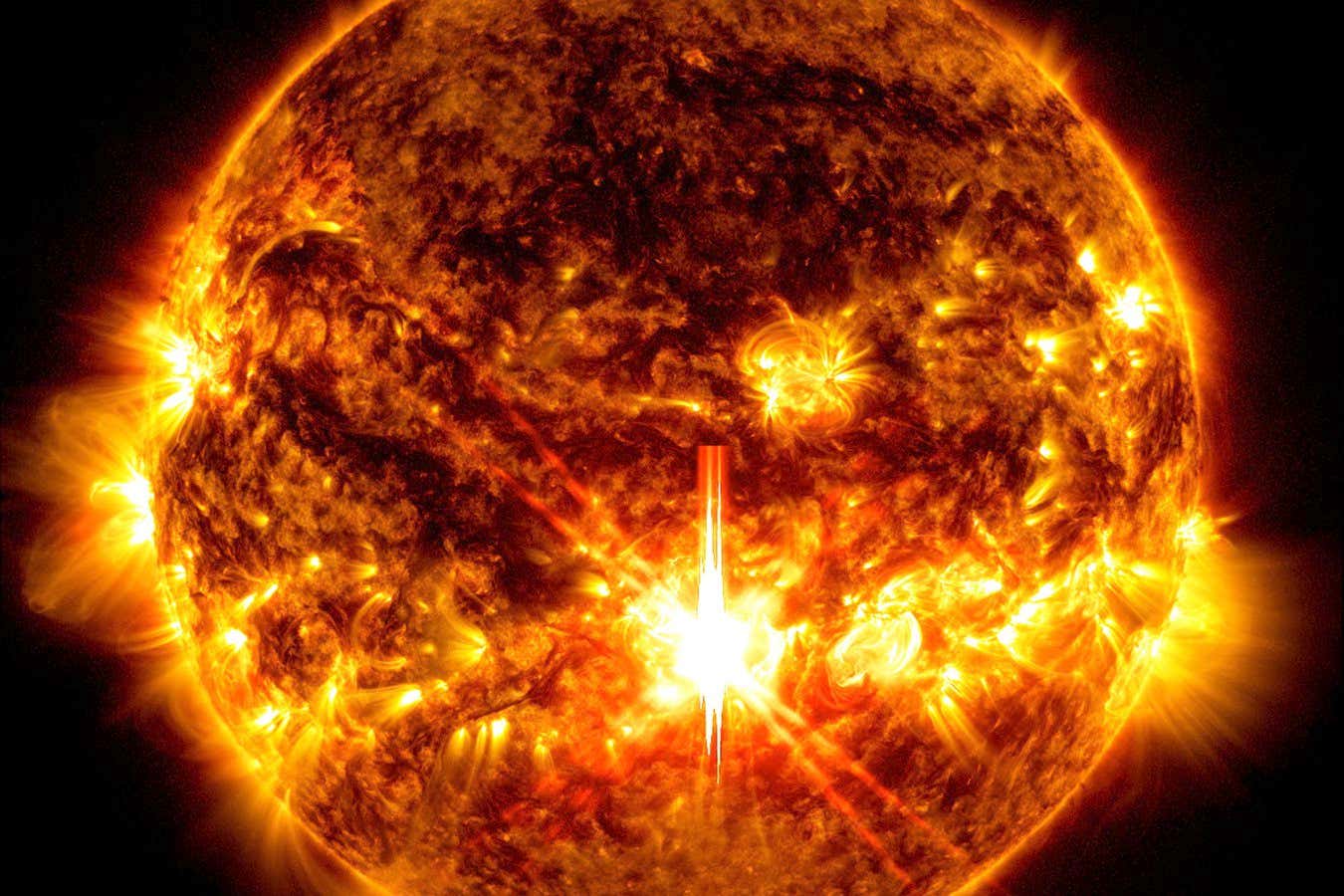
    This relatively small solar flare from October – the bright flash in the centre spotted by NASA’s Solar Dynamics Observatory – would be dwarfed by a superflare

    NASA/SDO

    The sun may produce extremely powerful bursts of radiation more frequently than we thought. Such “superflares” seem to happen as often as once a century, according to a survey of sun-like stars, and might be accompanied by particle storms that could have devastating consequences for electronics on Earth. As the last big solar storm to hit Earth was 165 years ago, we might be in line for another soon, but it is uncertain how similar the sun is to these other stars.

    Direct measurements of the sun’s activity only started towards the middle of the 20th century. In 1859, our star produced an extremely powerful solar flare, a burst of light radiation. These are often associated with a subsequent coronal mass ejection (CME), a bubble of magnetised plasma particles that shoots out into space.

    That flare was indeed followed by a CME that struck Earth and caused an intense geomagnetic storm, which was recorded by astronomers at the time, and is now known as the Carrington event. If this happened today, it could knock out communication systems and power grids.

    There is also evidence on Earth of much more powerful storms long before the Carrington event. Assessments of radioactive forms of carbon in tree rings and ice cores suggest that Earth has occasionally been showered with very high-energy particles over periods of several days, but it is unclear whether these came from one-off, massive solar outbursts, or from several smaller ones. It is also uncertain if the sun can produce flares and particle storms so large in a single outburst.

    The frequency of these signs on Earth, as well as superflares that astronomers have recorded on other stars, suggested that these giant bursts tend to occur many hundreds to thousands of years apart.

    Now, Ilya Usoskin at the University of Oulu in Finland and his colleagues have surveyed 56,450 stars and found that sun-like stars appear to produce superflares much more often than this.

    “Superflares on sun-like stars are much more frequent than we thought before, roughly once per one or two centuries,” says Usoskin. “If we believe that this projection to the sun is correct, then we expect a superflare on the sun roughly every 100 to 200 years, and extreme solar storms, as we know them, occur roughly once per 1500 or 2000 years. There is a mismatch.”

    Usoskin and his colleagues measured the brightness of the stars using the Kepler space telescope and detected a total of 2889 superflares on 2527 of the stars. The energies for these flares were between 100 and 10,000 times the size of the largest measured from the sun – the Carrington event.

    We still don’t know whether such large flares also produce large particle events of the sort we have evidence for on Earth, says Usoskin, but our current theories of the sun can’t explain such large flares. “This opens a question of what we are actually seeing,” he says.

    “As a stellar flare survey, it looks really impressive,” says Mathew Owens at the University of Reading, UK. “They’ve clearly got new methods for detecting flares with increased sensitivity.”

    How much this tells us about the sun’s flaring activity is harder to discern, says Owens, partly because it is difficult to accurately measure the rotation rate of other stars. “The devil is in the detail here,” he says.

    “The rotation rate is important because it’s linked to how a star generates a magnetic field, and the magnetic field is linked to flaring activity,” says Owens.

    Topics:


    Source link

    Team_NationalNewsBrief
    • Website

    Keep Reading

    Record-breaking IBM chip uses trick to cram in 100 billion transistors

    Extreme heat is muddling animals’ brains—and even triggering aggression

    Top quantum computer expert claims Microsoft’s ‘topological qubit’ doesn’t hold up

    Screwworm could be the first species targeted by an ‘extinction drive’

    Fluctuating oestrogen levels may alter how drugs enter women’s brains

    How underappreciated mathematician Emmy Noether helped prove physics’ most fundamental theories

    Add A Comment

    Comments are closed.

    Editors Picks

    Opinion | What Trump Is Really Doing

    January 27, 2025

    Marco Rubio Fires Back at European Elites for Throwing Temper Tantrums Over JD Vance’s Historic Speech — Fake News Hack Margaret Brennan Shamelessly Blames Holocaust on Free Speech | The Gateway Pundit

    February 16, 2025

    Solving Stephen Hawking’s black hole information paradox has raised new mysteries

    October 21, 2024

    IAEA chief: No evidence Iran is building a nuclear weapon | Nuclear Weapons

    June 19, 2025

    U.S. Sues to Block Tech Deal in First Antitrust Action of Trump Term

    January 30, 2025
    Categories
    • Arts & Entertainment
    • Business
    • International
    • Latest News
    • Lifestyle
    • Opinions
    • Politics
    • Science
    • Sports
    • Technology
    • Top Stories
    • Trending News
    • World Economy
    About us

    Welcome to National News Brief, your one-stop destination for staying informed on the latest developments from around the globe. Our mission is to provide readers with up-to-the-minute coverage across a wide range of topics, ensuring you never miss out on the stories that matter most.

    At National News Brief, we cover World News, delivering accurate and insightful reports on global events and issues shaping the future. Our Tech News section keeps you informed about cutting-edge technologies, trends in AI, and innovations transforming industries. Stay ahead of the curve with updates on the World Economy, including financial markets, economic policies, and international trade.

    Editors Picks

    Temperature records smashed as extreme heatwave grips Europe

    June 25, 2026

    GTA 6: How much it is, release date, pre-orders and everything you need to know

    June 25, 2026

    A Foreign-Born Judge Says States Cannot Verify Citizenship Before Elections

    June 25, 2026

    Taylor Swift And Travis Kelce Ripped Over ‘Tacky’ Wedding Move

    June 25, 2026
    Categories
    • Arts & Entertainment
    • Business
    • International
    • Latest News
    • Lifestyle
    • Opinions
    • Politics
    • Science
    • Sports
    • Technology
    • Top Stories
    • Trending News
    • World Economy
    • Privacy Policy
    • Disclaimer
    • Terms and Conditions
    • About us
    • Contact us
    Copyright © 2024 Nationalnewsbrief.com All Rights Reserved.

    Type above and press Enter to search. Press Esc to cancel.