

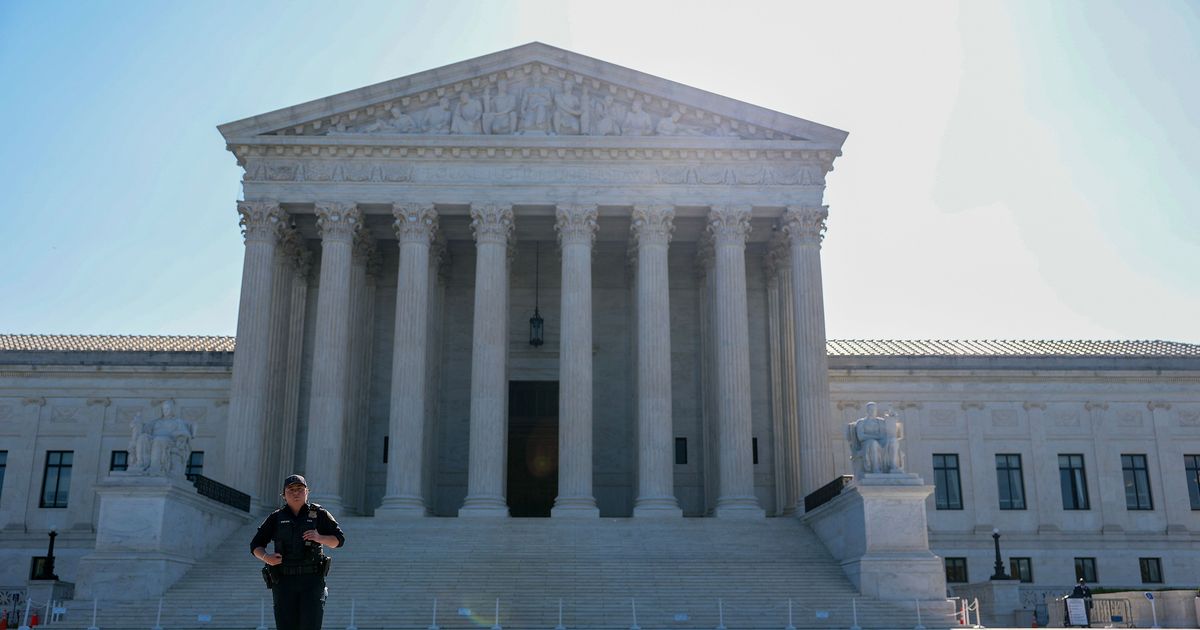
The Voting Rights Act has been near death since 2013, and Wednesday the Supreme Court administered the coup de grâce. In a 6-3 decision written by Justice Samuel Alito, the court’s conservative majority effectively ruled that states are now free to redraw congressional districts so as to eliminate many Black Democratic members of Congress.
Specifically, the decision allows states to eliminate majority-minority districts unless it can be proven that they did so on the basis of intentional racial discrimination rather than partisan gerrymandering. Since Black voters overwhelmingly vote Democratic, that will be impossible under the guidelines the court laid out. This outcome represents the opposite of what the Voting Rights Act was intended to do. Enacted in 1965 as one of the two crowning achievements of the civil rights movement, the law was meant to prohibit states from gerrymandering districts to stop Black candidates from getting elected.
One of the classic methods of a racial gerrymander is the practice known as “cracking.” That practice was at issue in this much-awaited decision, Louisiana v. Callais. As Justice Elena Kagan neatly explained in her dissent, imagine a congressional district “in the shape of a near-perfect circle, sitting in the middle of a rectangular State.” The district is 90% Black and the rest of the state is 90% white. Cracking is the term for the state legislature eliminates the circular, majority-Black district, “slicing it into six pie pieces and allocating one each to six new, still solidly White congressional districts. The State’s Black voters are now widely dispersed. … Election after election, Black citizens’ votes are, by every practical measure, wasted.”
Because it was designed to combat the history of racial discrimination in drawing districts, the Voting Rights Act has long been understood to prohibit this practice. Indeed, the law has been interpreted to require, when feasible, the creation of majority-minority districts.
After this week’s decision, a state legislature can simply assert that the intent of its gerrymander is to favor Republican candidates, not white candidates. The only way for Black plaintiffs to prove that such cracking is racially discriminatory would be to present a potential map that would have achieved the legislature’s partisan, political objectives without having a racially discriminatory effect.
Two constitutional ideas form the background for the conservative majority’s decision. The first is the premise that partisan gerrymandering doesn’t violate the Constitution. When Justice Anthony Kennedy was on the court, there was a sense that it might consider arguments against this position, on the basis that extreme partisan gerrymandering subverts the principle of one person, one vote. But Justice Brett Kavanaugh replaced Kennedy in 2018, and in a 2019 ruling the court closed the door on that possibility.
The country has been living with the consequences ever since, in the form of a race to the bottom among states to impose partisan gerrymanders. In retrospect, the court’s decision to let partisan gerrymandering run wild looks like an abdication of its responsibility to keep the democratic system functioning.
The second major constitutional idea behind the gutting of the Voting Rights Act is the notion that racial discrimination is wrong only when it is intentional and ongoing, not when it’s the result of factors that grow out of a long history of unfairness and intolerance. According to this theory, it doesn’t matter if a legislature gerrymanders in a way that stops Black candidates from getting elected. As long as its motivation is simply to stop Democrats from getting elected, the legislature is allowed to do so.
Of course, it’s no accident that Blacks and whites vote for different political parties in the Southern states where the Voting Rights Act was mostly designed to operate: It’s the direct result of the history of racial discrimination in those states. But if you ignore that history and instead focus on the presence of contemporary racial animus, then there is nothing wrong with gerrymandering that has racially disparate effects — again, provided the intent is partisan.
The Supreme Court’s insistence that discrimination is unconstitutional only if it is based on intent and not disparate effect or impact actually goes all the way back to 1976, when the court held that discriminatory intent was required to find a violation of the 14th Amendment’s Equal Protection Clause. But that ruling allowed for the possibility that Congress could decide to outlaw discrimination based on effect, not intent.
Over the last 50 years, the conservative majority has been gradually chipping away at Congress’s power to fight discrimination by outlawing policies that have a disparate impact. The Louisiana v. Callais decision effectively bars Congress from considering disparate impact for purposes of voting rights. It seems possible that the conservative majority may ultimately reach the same conclusion when it comes to racial discrimination under the Civil Rights Act of 1964.
It is rightly the Supreme Court’s job to “say what the law is” and make sure Congress doesn’t violate it. But the activist conservative Supreme Court has gradually extended that power to prohibit Congress from protecting constitutional rights against discrimination. It’s done so even though the 14th and 15th Amendments explicitly give Congress the power to enforce their provisions. The perverse result is a Constitution that enables discrimination rather than protecting against it.
©2026 Bloomberg L.P. Visit bloomberg.com/opinion. Distributed by Tribune Content Agency, LLC.
