

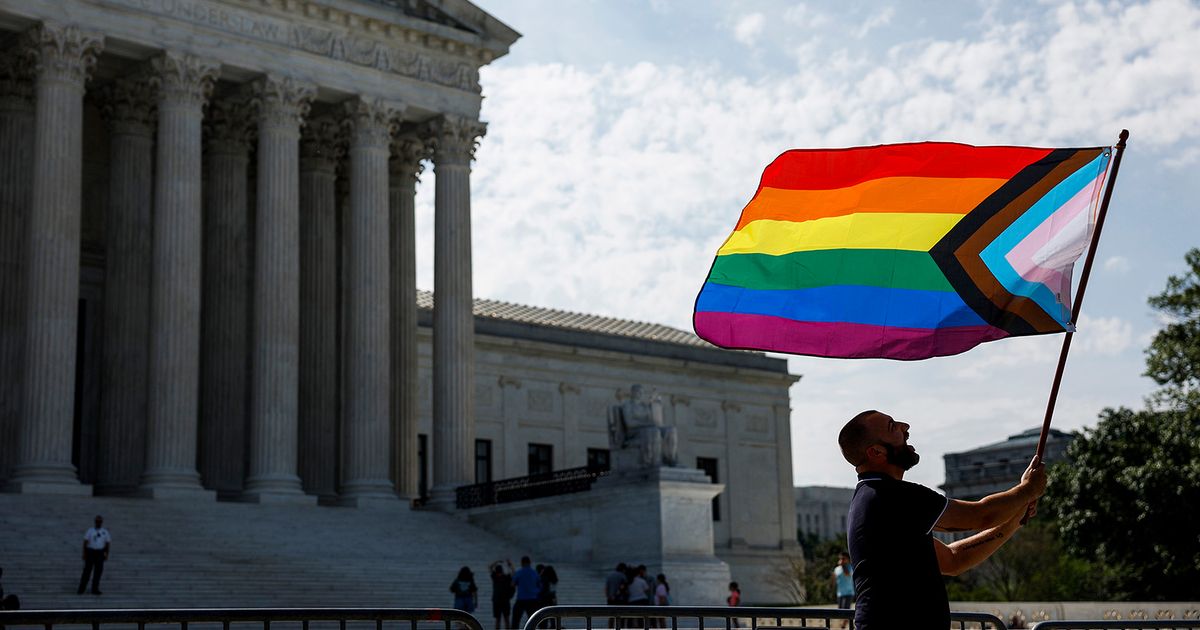
The Supreme Court has declined to hear a case brought in an effort to persuade the justices to reconsider the court’s landmark 2015 ruling legalizing same-sex marriage, Obergefell v. Hodges.
This latest decision is best read as a signal that the conservative majority has little interest in revisiting same-sex marriage, despite the call issued by Justice Clarence Thomas in the 2022 Dobbs decision that overturned Roe v. Wade. The conservative constitutional revolution at the Supreme Court remains underway, but it is now possible to say with some confidence that same-sex marriage — and gay rights more broadly — are not among the revolution’s targets.
Fears that the court’s activist conservatives might be coming for same-sex marriage stemmed from the fact that the Dobbs decision overruled two abortion-rights decisions, Roe and Planned Parenthood v. Casey, which were important parts of the doctrinal foundation on which Obergefell was built.
“Doctrine” in constitutional law refers to the chains of reasoning that gradually accumulate in each case the court recognizes as precedent. You can think of each significant case in a line of precedent as a block in a Jenga tower. When the court overrules an important precedent, it pulls that block out of the tower. The tower becomes less structurally sound — and it isn’t implausible to wonder whether the whole thing might collapse.
In the case of same-sex marriage, the Jenga tower rests on a line of doctrine known as “substantive due process.” The idea is roughly that some rights are so fundamental that, even though they aren’t specifically mentioned in the Constitution, they are included in the substance of the right to liberty guaranteed by the Due Process Clause of the 14th Amendment.
The bottom level of the tower was a 1965 case called Griswold v. Connecticut, which recognized the substantive due process right for married couples to use contraception. Building on Griswold, Roe established a similar substantive due process liberty right to obtain an abortion. Planned Parenthood v. Casey, decided in 1992, went deep, reasoning that the Due Process Clause protects an individual’s basic autonomy and dignity.
The case Lawrence v. Texas, decided in 2003, invoked the Casey theory of autonomy and dignity and extended substantive due process liberty to include the right to engage in sexual activity with a partner of one’s choice. Finally, Obergefell, once again invoking dignity and autonomy, held that the right to substantive due process liberty, combined with the right to equal protection of the laws — both guaranteed by the 14th Amendment — requires states to recognize same-sex marriage.
When the Supreme Court in the Dobbs case overruled Roe and Casey, it argued that the abortion right had not been grounded in a sound account of American history and tradition — a standard it said was necessary to justify recognition of a substantive due process liberty right. Not only were Roe and Casey building blocks in the tower, but Casey — the source of the theory of autonomy and dignity — was the pivotal block in extending substantive due process liberty to cover marriage. Thomas, in a concurring opinion in Dobbs, pointed this out and invited his colleagues to reconsider the entire line of cases, including Obergefell.
Justice Samuel Alito’s majority opinion attempted to distinguish Obergefell and the other cases from Roe and Casey by asserting that the protection of “fetal rights” made abortion different from other constitutional rights. When the dissent pointed out that the Jenga tower was looking shaky, Alito dismissed the concern as being “designed to stoke unfounded fear that our decision will imperil” same-sex marriage.
Since then, the Supreme Court has issued a significant decision upholding state laws that prohibit gender-affirming care for minors — a meaningful setback for the transgender rights movement. And of course, it has also issued sweeping landmark conservative decisions on affirmative action, guns and presidential immunity from criminal prosecution.
This term, issues of executive power are before the court, and it seems all but certain that the conservative majority will conclude that the president has the power to fire anyone he wants in the executive branch — even officials whom Congress has said can only be fired for cause. It’s understandable, and even appropriate, to wonder where this judicial revolution will stop.
The court’s refusal to hear the challenge to the same-sex marriage decision offers important insight for the guessing game. Even if there were not four justices — the minimum number required by the court’s rules — willing to take the case, Thomas or one of the other conservatives could have written a dissent encouraging reconsideration of Obergefell. Their silence is noteworthy.
Covering a constitutional revolution is a little bit like covering a war. The biggest news is when the side that is taking the initiative advances toward a given objective. But it is also news when that side deliberately chooses not to pursue a target that some of its generals want to acquire.
That appears to be the case with same-sex marriage. The court’s conservatives seem content to let the right remain in place — which means other gay rights also appear relatively safe. The reason may be that the conservatives recognize that same-sex marriage is too widely accepted to be overturned. Or they may believe that the equal protection of the laws should protect same-sex marriage, even if the doctrine of substantive due process liberty shouldn’t have been applied to justify it. Or perhaps they simply prefer not to reopen this particular old front in the culture war.
Regardless, the conservative majority’s signal is pretty direct: for the foreseeable future, at least, rolling back gay rights is not one of their strategic objectives.
©2025 Bloomberg L.P. Visit bloomberg.com/opinion. Distributed by Tribune Content Agency, LLC.
