

The World Cup always brings to the fore what is sometimes seen as a pure and mostly straightforward form of identity: national identity.
But the 2026 tournament has demonstrated, perhaps as clearly as any global event can, that modern national identity is complex, contested and far from straightforward.
The composition of the Moroccan World Cup squad offers a useful case in point.
Nineteen of the 26 players on the squad were born outside Morocco, many of them either in Spain or France, the two European powers that colonised the country. The composition of the team has raised fascinating questions about dual citizenship and loyalty, national identity, the diaspora, and the enduring legacies of colonialism.
Similar complexities are visible across the tournament. Many of the players on the national teams of the United States, Canada, France, England, Germany, Belgium, the Netherlands and Australia come from immigrant families.
In an era of increasingly exclusionary nationalist politics in North America and Europe, some of the countries engaged in the most intense debates about national identity are being represented on the world’s biggest sporting stage by multicultural teams.
The historical paradoxes are hard to miss. Many of the players representing European countries come from diasporic communities with roots in countries that were once colonised by those same states. The composition of the teams suggests that modern national identity cannot be easily disentangled from colonialism, empire and migration.
Moreover, across many North American and European teams, most of the players from immigrant families are racial minorities living in white-majority societies. It is at this intersection of national and racial identity that tensions and contradictions emerge most clearly.
After the Netherlands were eliminated by Morocco in a penalty shootout on June 29, three Black Dutch players who missed penalties were immediately subjected to racist abuse online. The incident exposed a recurring contradiction at the heart of modern national identity: minority players can be included as part of the nation when they succeed but treated as outsiders when they fail.
The US contradiction
The case of the US, which is cohosting the tournament with Canada and Mexico, is an especially illustrative one.
US President Donald Trump’s political programme has been defined, at least partly, by white grievance politics and an anti-immigration agenda.
Trump has repeatedly appealed to notions of white victimhood and began his second term with a series of measures that Amnesty International said reinforced white supremacy’s central narrative that “whiteness is synonymous with US American identity”.
After suspending the US’s refugee programme on the first day of his second term, Trump issued an executive order prioritising the resettlement of white Afrikaners from South Africa. His administration recently expanded the programme, creating 10,000 additional refugee slots for white South Africans, all while excluding non-white refugees.
The Trump administration has also carried out an unprecedented crackdown on mostly non-white immigrants. In 2025, Immigration and Customs Enforcement (ICE) arrested about 400,000 immigrants, deporting most of them. ICE recently intensified its efforts, arresting 10,000 immigrants over a five-day period in late June.
The sweeping crackdown raised fears that the 2026 World Cup would be defined more by exclusion than inclusion.
In the weeks leading up to the tournament, more than 120 prominent rights groups, including Amnesty International, the NAACP and the American Civil Liberties Union (ACLU), jointly issued a World Cup travel advisory.
Fears appear to have been at least partly justified. The Trump administration denied entry to Omar Abdulkadir Artan, an award-winning Somali referee, imposed severe travel restrictions on the Iranian team, and detained Iraq striker Aymen Hussein for seven hours upon arrival in the US.
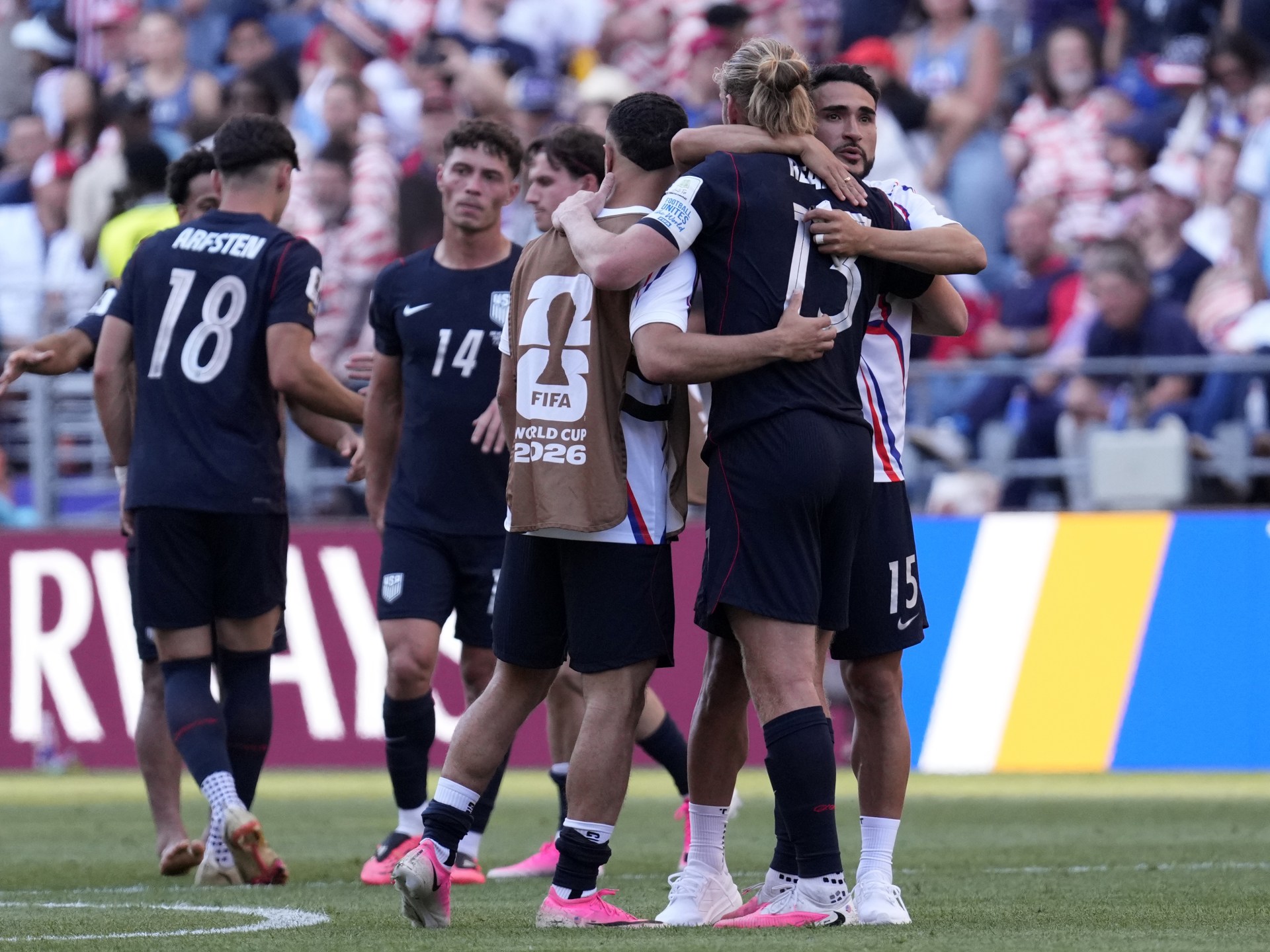
Against this messy backdrop, the USA reached the last 16 before being knocked out by Belgium.
Six members of the team were born outside the US, and more than half of the players hold dual citizenship.
Some of the white American fans lining football stadiums in Boston, Dallas, Atlanta, Houston, Los Angeles, Seattle and other US cities almost certainly included Trump supporters. There is a striking irony in members of a political movement defined partly by white grievance politics standing in stadiums and shouting “USA” for a national team featuring Folarin Balogun, Alejandro Zendejas, Haji Wright and other players from immigrant families.
Nowhere is that contradiction more visible than in the tournament’s main host country. This World Cup, perhaps more than any of its predecessors, has exposed the instability and contradictions of modern nationalism. Political movements may imagine nations as ethnically and racially coherent, or as culturally fixed entities, but the teams representing those nations tell a very different story. National football teams are products of migration, diaspora, colonial history and contested ideas about “us” and “them”.
Maybe, in the end, the 2026 World Cup’s most important lesson will have nothing to do with football talent, style of play, or coaching strategy. Perhaps the tournament’s most enduring lesson will be that national identity is not as fixed or straightforward as many nationalists imagine it to be.
The views expressed in this article are the author’s own and do not necessarily reflect Al Jazeera’s editorial policy.
