

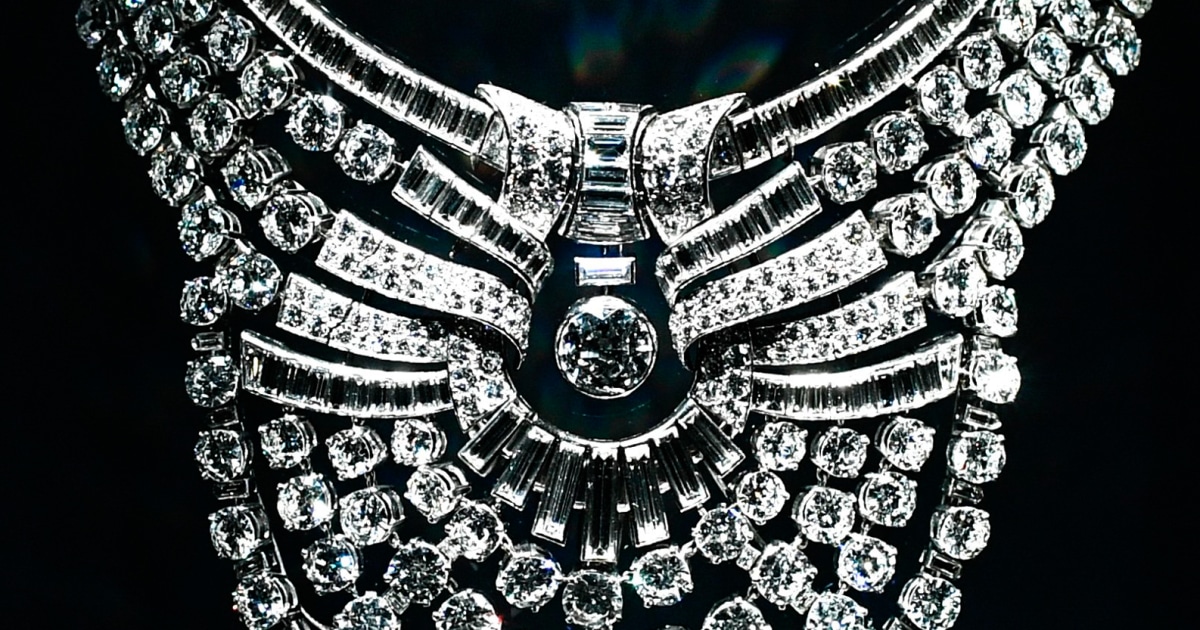
Austrian police are searching for a pair of brazen thieves who made off with a diamond necklace — once owned by an Egyptian queen and worth millions — by smashing a display case at a Vienna museum in broad daylight.
But unloading the hot rocks stolen last week from the Museum of Applied Arts, known as MAK, could be their undoing, art heist experts said Monday.
“Just like with paintings, it’s hard to sell well-known pieces of jewelry,” said Anthony Amore, a Boston-based art theft expert and investigator. “The Catch-22 is nobody will buy it intact. So it would not surprise me if their aim is to take the piece apart and sell the jewels individually.”
Robert Wittman, who once led the FBI’s Art Crime Team and is now a security consultant, agreed.
“What I expect they aim to do is pop the diamonds out of the settings and melt it down,” he said.
If they do, they will dramatically reduce the value of a one-of-a-kind piece that Sotheby’s auction house in New York sold in 2015 for $4.3 million, the experts said.
“They’re better thieves than businessmen,” Wittman said. “What gives this piece its value is not just the diamonds, but the provenance, the history of the piece. They take this piece apart and they’ll be lucky to get a couple hundred thousand, if that.”
That’s if the thieves can find a buyer for the baubles, the experts said.
“Anybody who knows anything about diamonds is going to know where these diamonds came from,” Wittman said.
The robbery bore little resemblance to jewel heists depicted in movies like “The Thomas Crown Affair” or “Ocean’s 8.” The thieves didn’t scale the walls after hours or short-circuit the security system to get inside the museum.
Instead, according to police, they bought tickets, strolled in with their faces uncovered and made their way to an exhibition of works from the French luxury jeweler Van Cleef & Arpels.
There, the 200-carat platinum necklace encrusted with 673 diamonds, which once belonged to Queen Consort Nazli of Egypt, was on display. She wore it at the 1939 wedding of her daughter and Mohammad Reza Pahlavi, the future shah of Iran, according to the museum.
The thieves managed to get a hammer past security and used it to smash the glass case, grab the jewels and flee, police said.
The museum’s surveillance system caught the whole thing on camera, police said.
The Vienna State Police Directorate is asking the public to help identify the culprits, whom it described as slim men with dark hair and short beards.
The experts interviewed by NBC News said the Vienna robbery is the latest in a string of high-profile heists that have hit European museums, including the theft in October of French crown jewels and other items valued at $101 million from the Louvre in Paris.
“The thieves didn’t disguise themselves perhaps because they knew camera placement and quality,” Amore said. “With the advances in security technology, I fear we might see thieves turn to brute force more frequently in the future. Museums must prepare themselves for this, because they are all targets.”
Wittman said top-notch museum security requires good equipment, good guards and good procedures.
“It’s like a three-legged stool,” he said. “One leg goes and the stool tips over. Obviously, in this case, they didn’t have good human resources. I mean, the thieves were able to grab the necklace and get away.”
That having been said, Wittman said he’s confident the robbers will be found. He’s not so sure about the fate of the necklace.
“I expect it won’t take long before they know who they are,” he said of the thieves. “Hopefully, they’ll catch them before they melt this piece down.”
