

You try to buy a kilo of flour in Gaza.
You open your wallet; what’s inside? A faded 10-shekel note, barely held together by a strip of tape. No one wants it; it is all rubbish now.
The 10-shekel note, normally worth about $3, was once the most commonly used bill in daily life. Now, it is no longer in circulation. Not officially—only practically. It has been worn out beyond recognition. Sellers will not accept it. Buyers cannot use it.
There is no fresh cash. No replenishment.
Other banknotes are following the fate of the 10 shekels, especially the smaller ones.
If you pay with a 100-shekel note for an 80-shekel purchase, the seller will likely be unable to return the remaining 20 due to the poor physical state of the banknotes.
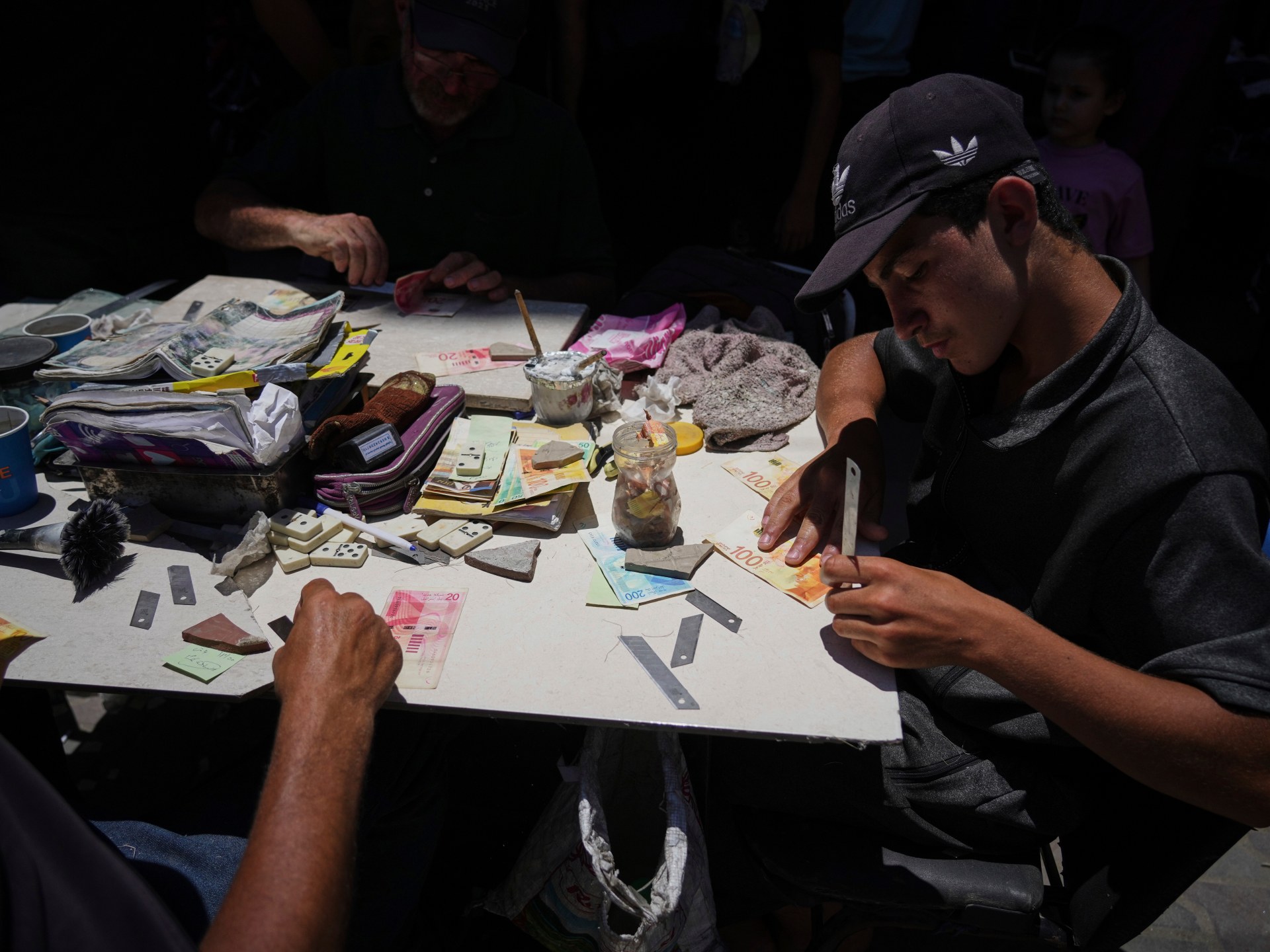
Many notes are torn or taped together, and entire stalls now exist just to repair damaged currency so it can be used again. Anything is better than nothing.
But the disintegration of banknotes is not the only problem we have in Gaza.
Civil servants have gone months without pay. NGOs are unable to transfer salaries to their employees. Families cannot send remittances. What once supported Gaza’s financial structure has vanished. There is no mention of when it will return. Just silence.
Money is stuck. Trapped behind closed systems and political barriers.
If you manage to obtain money from outside sources — perhaps from a cousin in Ramallah or a sibling in Egypt — it comes at a cost. A brutal one. If you get sent 1,000 shekels ($300), the agent will hand you 500. That’s right, the commission rate on cash withdrawals in Gaza is now 50 percent.
There are no banks to offer such withdrawals or oversee transfers.
The signs are still there. Bank of Palestine. Cairo Amman Bank. Al Quds Bank. But the doors are shut, the windows are dusty, and the inside is empty. No ATMs work.
There are only brokers, some with connections to the black market and smugglers, who are somehow able to obtain cash. They take huge cuts to dispense it, in exchange for a bank transfer to their accounts.
Every withdrawal feels like theft disguised as a transaction. Even so, people continue to use this system. They have no choice.
Do you have a bank card? Great. Try using it?
There is no power. There’s no internet. No POS machines. When you show your card to a seller, they shake their head.
People print screenshots of account balances that they cannot access. Some walk around with expired bank documents, hoping someone will think they’re “good enough” as a pay guarantee.
Nobody does.
There are a few sellers who accept so-called “digital wallets”, but those are few, and so are people who have them.
In Gaza today, money you can’t touch is equivalent to no money at all.
And so people have to resort to other means.
At the market, I saw a woman standing with a plastic bag of sugar. Another was holding a bottle of cooking oil. They did not speak much. I just nodded. Traded. Left.
This is what “shopping” in Gaza looks like right now. Trade what you’ve got. A kilo of lentils for two kilos of flour. A bottle of bleach for some rice. A baby’s jacket for several onions.
There is no stability. One day, your item will be worth something. The next day, nobody wants it. Prices are guesses. Value is emotional. Everything is negotiable.
“I traded my coat for a bag of diapers,” my uncle Waleed, a father of twins, told me. “He looked at me as if I were a beggar. I felt like I was giving up a part of my life.”
This is not a throwback to simpler times. This is what happens when systems disappear. When money dies. When families are forced to sacrifice dignity for survival.
People don’t just suffer—they shrink. They lower their expectations. They stop dreaming. They stop planning. What future can you plan when you can’t afford tomorrow?
“I sold my gold bracelet,” Lina, my neighbour by tent, told me. “It was for emergencies. But now, every day is an emergency.”
Gaza’s economy did not collapse due to bad policy or internal mismanagement. It was broken on purpose.
The occupation has not just blocked goods entering Gaza; it has also blocked currency and with it, any sense of financial control. It has destroyed the banking system. It has made liquidity a weapon.
Cutting off Gaza’s money is part of a larger siege. There is no need to fire a bullet to destroy a people. Simply deny them the ability to live.
You can’t pay for bread, for water, for medicine, so how do you sustain life?
If this trend continues, Gaza will be the first modern society to completely return to barter. There are no salaries. There is no official market. Only personal trades and informal deals. And even those will not last forever. Because what happens when there is nothing left to trade?
If this isn’t addressed, Gaza will be more than just a siege zone. It will be a place where the concepts of money, economy, and fairness will die forever.
The views expressed in this article are the author’s own and do not necessarily reflect Al Jazeera’s editorial stance.
