

President Trump’s 25 percent tariffs on imported vehicles, which went into effect last week, are already sending tremors through the auto industry, prompting companies to stop shipping cars to the United States, shut down factories in Canada and Mexico and lay off workers in Michigan and other states.
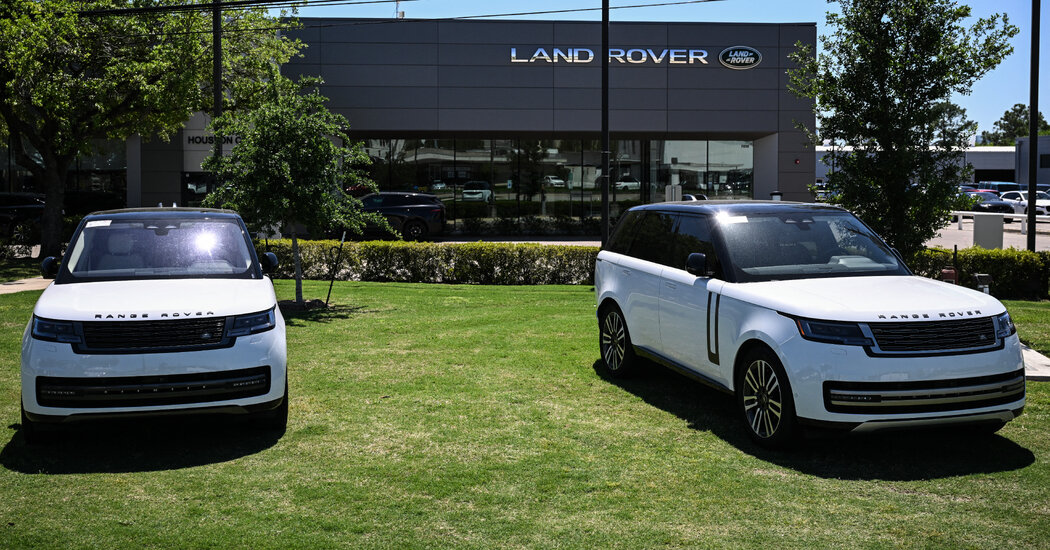
Jaguar Land Rover, based in Britain, said it would temporarily stop exporting its luxury cars to the United States. Stellantis idled factories in Canada and Mexico that make Chrysler and Jeep vehicles and laid off 900 U.S. workers who supplied those factories with engines and other parts.
Audi, the luxury division of Volkswagen, also paused exports of cars to the United States from Europe, telling dealers to sell whatever they still had on their lots.
If other carmakers make similar moves, the economic impact could be severe, leading to higher car prices and widespread layoffs. The tariffs on cars are among the first of several industry-specific levies that Mr. Trump has in his sights and could offer early clues about how businesses will respond to his trade policies, including whether they raise prices or increase manufacturing in the United States. The president has said he also wants to tax the imports of medicines and computer chips.
Applying the new tariff to imported cars could increase their cost to consumers by thousands of dollars, sharply reducing demand for those vehicles. For some Jaguar Land Rover or Audi models, the tariffs could amount to more than $20,000 per car.
While much of the initial impact of the tariffs has been disruptive, in at least one case Mr. Trump’s duties have had the intended effect of increasing production in the United States. General Motors said late last week that it would increase production of light trucks at a factory in Fort Wayne, Ind.
The longer-term impact of the 25 percent tariffs is unclear. Many automakers are still trying to figure out how to avoid increasing prices so much that consumers can no longer afford new cars. Investors are pessimistic. Shares of Ford Motor, G.M. and Tesla have fallen in the past several days of trading.
“Everyone in the automotive supply chain is focused on what they can do to minimize the tariff impact to their own balance sheets and to prices,” said Kevin Roberts, director of economic and market intelligence at CarGurus, an online shopping site.
But carmakers have never before had to deal with the imposition of such high tariffs with such little notice. Nor have they had as little insight into what the president will do next, analysts and dealers said.
“The traditional playbook is not enough,” said Lenny LaRocca, who leads the auto industry team at the consulting firm KPMG.
Mr. LaRocca predicted that automakers would increasingly focus on producing larger, heavier sport utility vehicles and pickup trucks. Those vehicles, many of which are assembled in U.S. factories, are usually the most profitable and give companies more room to absorb the cost of tariffs rather than passing it on to customers.
Many modern assembly lines are able to produce several models, giving companies flexibility to shift to the most profitable vehicles and to abandon vehicles that don’t make as much money. Mercedes-Benz has said it will take advantage of flexible assembly lines at its factory in Alabama.
This strategy comes with downsides. It may be harder for car buyers to find moderately priced new cars. Already, the average price of a new car is almost $50,000.
Analysts say this much is clear: Tariffs will not prompt companies to open new factories or reopen closed plants right away. Companies won’t take that expensive step until they are sure that the tariffs are permanent and that investing hundreds of millions — or billions — of dollars in new production capacity will pay off.
“I haven’t seen any big moves,” Mr. LaRocca said. “It’s wait and see.”
Some carmakers and suppliers expanded their U.S. operations before Mr. Trump took office. Often, they were reacting to the coronavirus pandemic, when it became risky to rely on distant factories for critical parts. Others made big investments in factories that make electric vehicles or E.V. batteries to take advantage of incentives offered by the Biden administration.
ZF, a German parts maker, spent $500 million last year to expand a factory in South Carolina that produces transmissions for BMW and other automakers. And in recent years G.M. has opened two U.S. battery factories with a South Korean partner, LG Energy Solution, to make the most important component of electric vehicles.
In the short run, some foreign carmakers may simply stop sending vehicles to the United States, either because they can no longer make a profit or because they can make more money elsewhere. That may be the case with Jaguar Land Rover. The company, known for luxury sport utility vehicles made in Britain, sells about one-fifth of its cars in the United States.
If other companies stop selling certain models to Americans, consumers will have fewer vehicles to choose from and the remaining automakers will have more leeway to raise prices.
So far, however, the tariffs have not led to widespread price increases for new cars. Hyundai Motor said last week that it would not raise the manufacturer’s suggested retail price of Hyundai and Genesis cars until June 2.
Of course, car dealers can raise prices even if an automaker pledges not to. That happened a lot during the pandemic, when shortages of computer chips and other parts limited the supply of new vehicles.
Dealers and automakers have reported brisk sales in recent days as people have rushed to buy vehicles before the tariffs took effect. The average time that a vehicle spent on the lot fell from 77 days at the end of January to fewer than 50 days at the beginning of April, according to CarGurus.
Demand has been especially high for Japanese brands like Honda, Subaru and Nissan, apparently because buyers assume they are imported, said Sean Hogan, the vice president of Sierra Auto Group, which owns a dozen dealerships in Southern California. All three Japanese companies have factories in the United States, though they do import some cars.
Another tariff shock will come on May 3, when the Trump administration will apply tariffs to auto parts. That means that even cars made in the United States will be affected because virtually all vehicles contain components from abroad. Repairs will also become more expensive.
“The educated public is definitely making some moves to get ahead of the tariffs, which I think is smart,” Mr. Hogan said.
But the long-term impact of Mr. Trump’s trade policies is still impossible to predict, he said. “This administration moves pretty fast, and you really don’t know what’s going to happen next,” Mr. Hogan added. “Buckle up.”
Neal E. Boudette and Melissa Eddy contributed reporting.
