
Close Menu
    National News Brief
    Friday, August 28
    • Home
    • Business
    • Lifestyle
    • Science
    • Technology
    • International
    • Arts & Entertainment
    • Sports
    National News Brief
    Home » Vera Rubin Observatory has already found thousands of new asteroids

    Vera Rubin Observatory has already found thousands of new asteroids

    Team_NationalNewsBriefBy Team_NationalNewsBriefJune 24, 2025 Science No Comments3 Mins Read
    Share
    Facebook Twitter LinkedIn Pinterest Email


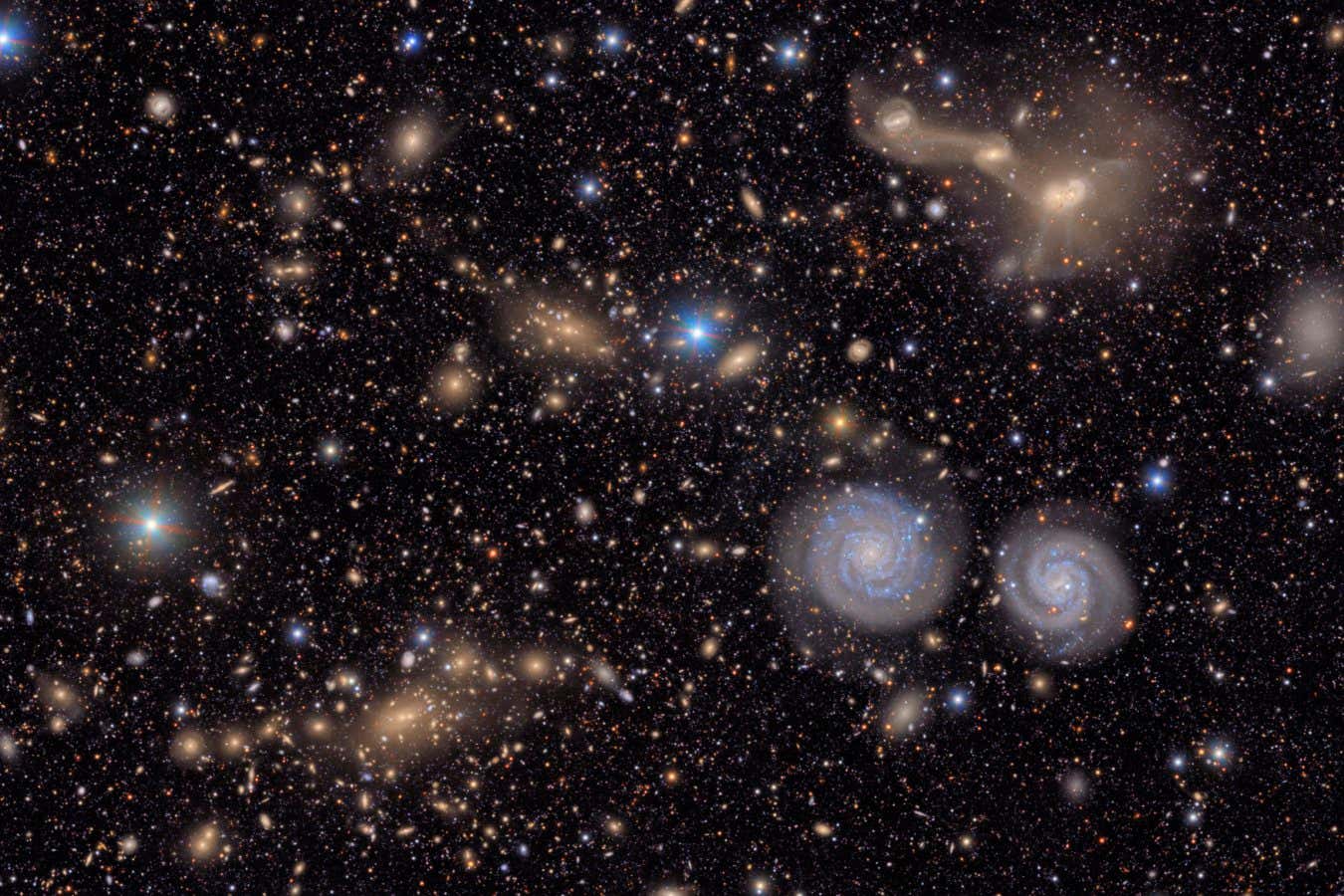
    Amid the millions of distant stars and galaxies captured in the first images released from the Vera C. Rubin Observatory are thousands of never-before-seen asteroids whizzing around the solar system.

    “These two beautiful galaxies were photobombed by asteroids,” said Željko Ivezić at the University of Washington in Seattle, presenting an image showing several asteroids streaking past two spiral-armed galaxies during a press briefing on 23 June.

    During just 10 hours of observing the night sky, the telescope – situated in the clear air high atop a mountain in the Chilean Andes – captured 2104 previously unknown asteroids. Of these, seven are on a trajectory that would pass near Earth, though none pose a risk of hitting us, said Ivezić.

    Researchers identified and tracked newly discovered asteroids in images taken over 10 hours

    NSF-DOE Vera C. Rubin Observatory

    The telescope was not primarily designed to detect near-Earth objects, but to conduct a decade-long survey expanding our view of the entire universe. But the same qualities that make it useful for that purpose are also good for asteroid detection: “You need to scan the sky very fast, with a very large field of view, for a long time,” said Ivezić.

    The asteroids were identified by scanning the same region of sky and noting what was moving. In a composite image Ivezić displayed during the briefing, the asteroids appeared as coloured streaks on a background of bright objects in deeper space. This gives us a better picture of our planetary neighbourhood and its inhabitants. “They were not a surprise,” he said. “We have exquisite simulations.”

    During the course of its 10-year survey, the telescope is expected to detect about 5 million new asteroids, quintupling the number identified in previous centuries of searching.

    Video title: A swarm of new asteroids Caption: In about 10 hours of observations, NSF-DOE Vera C. Rubin Observatory discovered 2,104 never-before-seen asteroids in our solar system, including seven near-Earth asteroids (which pose no danger). Annually, about 20,000 asteroids are discovered in total by all other ground and space-based observatories. Rubin Observatory alone will discover millions of new asteroids within the first two years of the Legacy Survey of Space and Time. Rubin will also be the most effective observatory at spotting interstellar objects passing through the solar system. Credit: NSF-DOE Vera C. Rubin Observatory

    Asteroids are marked in coloured dots in front of an image of galaxies visible in the southern sky

    NSF-DOE Vera C. Rubin Observatory Copyright: NSF-DOE Vera C. Rubin Observatory

    Any new detections will be reported on a daily basis to the Minor Planet Center in the US, which will analyse their orbital trajectories and identify any objects that could pose a threat to Earth. “Within 24 hours, everyone in the world will know that there is a particular object which could be hazardous,” says Ivezić.

    Matthew Payne at the Minor Planet Center says only an estimated 40 per cent or so of the near-Earth objects large enough to pose a threat have been found. The radical increase in the number of detections from the Vera Rubin Observatory will help quickly find the rest of them, he says.

    The huge increase in observations of other objects in the solar system – from the main belt asteroids between Mars and Jupiter to objects further out beyond the orbit of Neptune – is also expected to give us new insight into our immediate cosmic neighborhood. “It will revolutionise, broadly, solar system science,” says Payne.

    Topics:


    Source link

    Team_NationalNewsBrief
    • Website

    Keep Reading

    See last night’s ‘blood moon’ eclipse from around the world

    How the brain learns to read is an evolutionary mystery—a new study offers clues

    What Nepal’s floods reveal about “cascading hazards”

    Climate change is supercharging El Niños, coral records show

    Tropical Storm Dolly forms in the Atlantic

    Is the keto diet better than the Mediterranean? New clinical trial reveals health benefits

    Add A Comment

    Comments are closed.

    Editors Picks

    Smart has strong message for CFP committee after win over Tennessee

    November 18, 2024

    SoftBank to Buy Silicon Valley Chip Start-Up Ampere for $6.5 Billion

    March 20, 2025

    Denmark converts farmland to forest in bid to revive nature – and Europe’s climate ambitions

    November 21, 2025

    20-Year-Old Tomas Rivas and Three Teens Arrested in Deadly Las Cruces Park Shooting, Leaving 3 Dead and 15 Injured | The Gateway Pundit

    March 24, 2025

    It’s up to local governments in WA to lead on clean energy

    August 25, 2026
    Categories
    • Arts & Entertainment
    • Business
    • International
    • Latest News
    • Lifestyle
    • Opinions
    • Politics
    • Science
    • Sports
    • Technology
    • Top Stories
    • Trending News
    • World Economy
    About us

    Welcome to National News Brief, your one-stop destination for staying informed on the latest developments from around the globe. Our mission is to provide readers with up-to-the-minute coverage across a wide range of topics, ensuring you never miss out on the stories that matter most.

    At National News Brief, we cover World News, delivering accurate and insightful reports on global events and issues shaping the future. Our Tech News section keeps you informed about cutting-edge technologies, trends in AI, and innovations transforming industries. Stay ahead of the curve with updates on the World Economy, including financial markets, economic policies, and international trade.

    Editors Picks

    Tiny Mechanical TV Drum Delivers Shockingly Sharp 4K

    August 28, 2026

    Beware the Ides of October?

    August 28, 2026

    San Antonio Christian Takes on Randolph in Friday Night Football

    August 28, 2026

    Rosie O’Donnell Reveals Sweet Exchange With Daughter

    August 28, 2026
    Categories
    • Arts & Entertainment
    • Business
    • International
    • Latest News
    • Lifestyle
    • Opinions
    • Politics
    • Science
    • Sports
    • Technology
    • Top Stories
    • Trending News
    • World Economy
    • Privacy Policy
    • Disclaimer
    • Terms and Conditions
    • About us
    • Contact us
    Copyright © 2024 Nationalnewsbrief.com All Rights Reserved.

    Type above and press Enter to search. Press Esc to cancel.