


SIHANOUKVILLE, Cambodia — For hundreds of people who believed they had purchased a permanent home aboard a cruise ship, the end came with astonishing speed. On October 27, 2026, residents of the Villa Vie Odyssey were ordered to leave the vessel in Cambodia, some with only hours to collect their belongings and find somewhere else to live.
Many had paid hundreds of thousands of dollars. Some had sold their homes, liquidated investments and reorganized their retirements around the promise of spending the rest of their lives traveling the world.
Villa Vie Residences, the Florida-based company behind the ship, blamed soaring fuel prices resulting from the war involving Iran. Executives said the vessel’s operating expenses had become impossible to sustain.
But the financial warning signs extended far beyond the price of marine fuel.
By November 10, the Odyssey was under arrest in Singapore pursuant to a court order. Creditors had assumed responsibility for the vessel and its remaining crew. The ship that had been marketed as a permanent floating community was no longer carrying its residents. Reuters+1
A review of Villa Vie’s own investment presentation, a publicly available share subscription agreement, court-filed residential contracts, published financial figures, and disclosures by affiliated residential-cruise ventures reveals a troubling pattern: extraordinary long-term commitments, optimistic projections, repeated emergency fundraising and a business apparently dependent on continued inflows of new money.
The evidence raises an uncomfortable question.
Was Villa Vie operating a fundamentally unsustainable cruise business—or had its financing begun to resemble the mechanics of a Ponzi scheme, in which money from newer participants sustains promises made to earlier ones?
The distinction matters. The available documents demonstrate serious financial weaknesses and potentially misleading investment projections. They do not yet establish that Villa Vie deliberately operated a Ponzi scheme, or that money raised from later investors was fraudulently used to pay earlier investors. Proving that allegation would require bank records, accounting ledgers, transaction histories and other evidence not publicly established in the materials reviewed.
What the documents do establish is a business that appears to have sold more financial certainty than its recurring revenue could support.
The $300,000 Promise That Could Last a Lifetime
The attraction was extraordinary.
Villa Vie offered something that traditional cruise companies generally do not: the opportunity to abandon conventional retirement expenses and instead spend one’s life at sea, visiting hundreds of destinations aboard a single ship.
Its Endless Horizons program offered lifetime cruising for one upfront payment, without recurring maintenance charges.
Earlier versions were advertised at approximately $299,999 for one person or $499,999 for two. Other advertised versions started at $349,999. The company promoted unlimited stays, meals, accommodation, housekeeping, internet access and onboard activities.
A more extensive program, Unleashed Endless Horizons, was introduced in March 2025 for $399,999 for one person or $699,999 for two. It added benefits including alcoholic beverages, spa treatments and medical visits. Fortune+2
The company’s selling proposition was that residents could lock in the cost of major living expenses even as prices elsewhere continued to rise.
Yet that proposition contained a financial vulnerability: the company would receive a large payment at the beginning, but many of its expenses would continue for as long as residents used the ship.
Crew members would need to be paid. Food purchased. Fuel supplied. Repairs performed. Insurance renewed. Ports paid. Medical services maintained.
Those obligations would not disappear when the original purchase money was spent.
The arithmetic behind a lifetime
Consider the implications of the original $299,999 single-resident offer.
| Hypothetical occupancy period | Upfront payment averaged per month |
|---|---|
| 15 years | $1,667 |
| 20 years | $1,250 |
| 30 years | $833 |
| 50 years | $500 |
| 60 years | $417 |
These are simple arithmetic averages, not monthly cash receipts or actuarial projections. The 50- and 60-year illustrations are especially speculative for an aging cruise ship. A sustainable lifetime offer could, in principle, invest its upfront proceeds and fund future services from investment earnings, reserves and other recurring revenue.
But it would require a disciplined, defensible financial model to do so.
Villa Vie has not publicly established, through audited financial statements reviewed for this report, that it maintained adequate dedicated reserves to fund these commitments.
And the company’s later financial disclosures cast doubt on whether the recurring revenue was sufficient.
Financial Documents Show a Business That Could Lose Money Even When Full
One of the most important pieces of evidence emerged from internal Villa Vie documents reviewed by CBS News in October.
According to that reporting, the company’s financial projections showed:
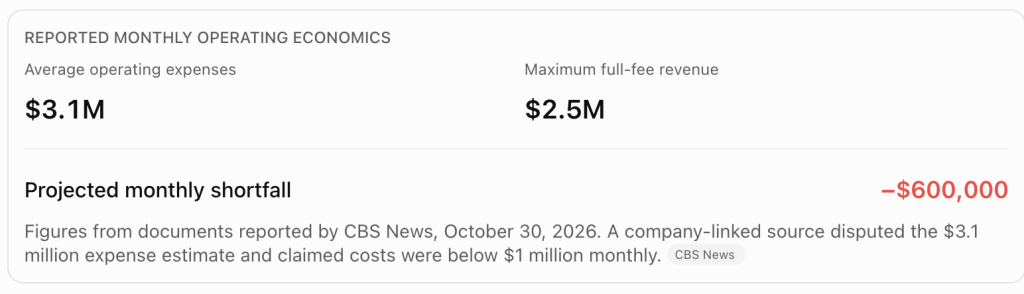
The significance is considerable.
If the figures were accurate, the Odyssey could not generate enough regular fee revenue to cover its reported operating expenses even with every cabin occupied and every resident paying the full applicable charges.
On an annual basis, that would imply a $7.2 million operating deficit before considering additional unmodeled obligations.
An operation in this position would need sustained outside financial support, more revenue from other activities, significant cost reductions, or some combination of all three.
Selling additional cabins could provide temporary cash. But it could also generate additional long-term liabilities, particularly when the newly sold cabins were accompanied by lifetime rights and little or no continuing maintenance revenue.
In August, according to the reported internal figures, 139 of 490 cabins remained unsold. That suggests approximately 72 percent of the referenced inventory had been sold, although the accounting may not be directly comparable with the company’s separate marketing claim of 85 percent sold the previous month. CBS News+1
Another measure comes from former residents themselves.
Paul Montoya, a Villa Vie resident interviewed by Cruise Critic, said the business was spending approximately $3.2 million monthly while bringing in only about $700,000.
If accurate and measured on a consistent basis, that would represent a cash shortfall of roughly $2.5 million every month.
Those figures are Montoya’s account, not independently audited results. But a report in The New Yorker described a message in which Villa Vie chief executive Kathy Villalba acknowledged that operating costs exceeded fee revenue by more than $2 million monthly. Cruise Critic+1
That is a potentially devastating finding.
Under those conditions, the financial question is not merely why fuel eventually became unaffordable.
It is how the company expected to meet its obligations without continually obtaining additional cash.
A 93 Percent Return: The Investment Document That Deserves Scrutiny
Among the most revealing records is a Villa Vie Founders Club investment presentation dated April 5, 2024, published in the Fraud Files archive maintained by forensic accountant Tracy Coenen.
The presentation offered prospective participants different tiers of membership tied to investments in the company.
The amounts ranged from $25,000 for Silver membership to $500,000 for Black membership.
In addition to onboard benefits, the presentation described share ownership and forecasted increases in share value.
Its most striking figure was an average investment return of 93 percent per year, displayed across the membership tiers. April 15th 2024
That projection requires particularly close examination.
The presentation used an initial share price of 50 cents and a forecast share price of $1.40 by July 2026. It presented forecasted three-year share values of $70,000, $280,000 and $1.4 million for the respective investment tiers.
For example, $25,000 purchasing 50,000 shares at 50 cents would result in holdings worth $70,000 if the share price reached $1.40.
The total profit would be $45,000, or 180 percent of the initial investment over the modeled period.
Spread evenly over three years, that profit represents 60 percent per year on a simple, non-compounded basis. The compound annual growth rate would be about 41 percent.
Neither is 93 percent.
The presentation’s $23,333 annual forecast for the $25,000 tier appears to divide the entire $70,000 projected ending share value by three years, including the original capital rather than subtracting it.
That produces approximately 93 percent of the initial investment annually, but it is not a conventional calculation of annual investment profit.
This does not establish fraud. The presentation contained explicit risk disclosures and described the figures as forecasts rather than guaranteed investment results.
It does, however, expose an important problem with the way the investment opportunity was presented: extraordinarily optimistic projected returns were accompanied by a calculation that could lead readers to misunderstand what they might actually earn.
Such projections are especially consequential when the underlying business has substantial fixed operating expenses and requires large amounts of continuing capital.
The presentation also advertised substantial onboard discounts, credits and travel benefits. Those benefits could make the offering more attractive to investors while potentially reducing the company’s future cash receipts or creating additional service obligations.
The document did not, by itself, establish that sufficient investment earnings or operating profits existed to support those projected benefits.
When Residents Became the Emergency Lenders
The most troubling chapter in Villa Vie’s financial history may have begun in April 2026.
According to Cruise Industry News and a contemporaneous report from Coenen, the company approached residents with an emergency financing proposal seeking at least $3 million.
The proposal was structured through Residential Cruise Holdings, a holding company associated with the Villa Vie business and other residential-cruise ventures.
Residents were invited to provide loans in increments of $25,000, with amounts reportedly ranging up to $500,000.
The offered annual interest rates were 12, 18 or 24 percent, depending on the amount invested.
The principal was to be repaid after 12 months, with interest payments in the meantime. Cruise News+1
A business offering to pay as much as 24 percent annually for short-term loans from its own customers is signaling an unusually high need for capital, unless it can demonstrate an equally compelling and credible source of repayment.
At 24 percent, every $1 million borrowed generates $240,000 in annual interest obligations before any principal is repaid.
If $3 million were borrowed entirely at that rate, the annual interest obligation alone would be $720,000.
And the full principal would still be due at the end of the year.
The arrangement raises several questions. How would a company already struggling to cover operating expenses produce the cash necessary to service these loans? Were anticipated repayments tied to future cabin sales, outside financing or expected operating profits? And what safeguards protected residents if the company failed?
By November, some residents were describing exactly that outcome.
Craig and Cindy Voight told CBS News they had spent more than $300,000 on their residence and monthly dues and loaned another $100,000 to the company. They said the promised interest had not been paid.
Petterson told CBS that the financing was arranged through Residential Cruise Holdings because restrictions prevented Villa Vie Residences from borrowing directly. He acknowledged residents’ concerns and said individual disputes should be addressed through the legal process. CBS News
The financial pattern was stark: people who had purchased the right to receive future services were being asked to become lenders so those services could continue.
That resembles one of the warning signs associated with financially dependent investment structures.
But borrowing from existing customers is not itself proof of a Ponzi scheme. The crucial question is whether new investor funds were deliberately and deceptively used to make payments represented as profits or returns to earlier investors.
That question remains unresolved.
The Related Cruise Company That Exposes the Pricing Problem
One of the most revealing comparisons comes from a residential-cruise business connected to Villa Vie’s own founders.
In January 2026, Cruise Industry News reported the creation of Residential Cruise Holdings, a corporate group associated with Villa Vie and a newer luxury residential-cruise venture called Avora Residences.
Avora’s proposed vessel, Lumina, was promoted as a more luxurious version of the residential cruising concept. Although marketing materials described the companies as maintaining separate operating identities and ownership arrangements, the businesses shared important leadership and commercial relationships. Cruise News+1
What makes Avora relevant is its pricing.
Unlike Villa Vie’s no-monthly-fee lifetime offering, Avora’s published prices required substantial upfront payments and substantial continuing monthly charges.
According to Avora’s published residence pricing, a Dawn Suite carried a starting purchase price of $545,000, followed by monthly charges of $8,185 for one occupant or $11,185 for two.
Larger suites carried still higher prices. Avora
Consider the comparison:
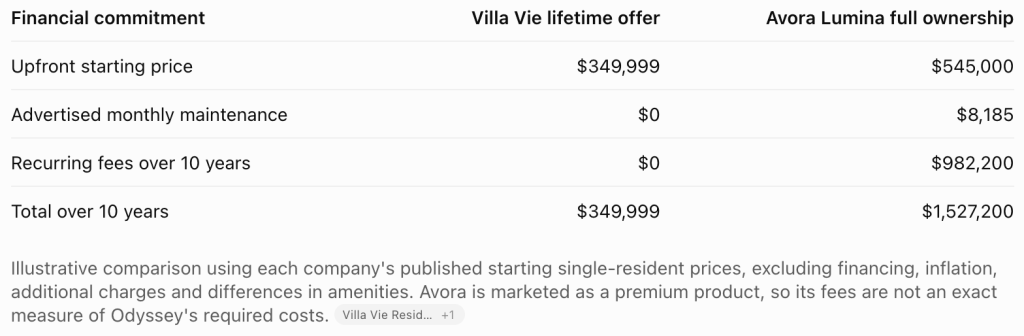
The difference is dramatic.
Avora was offering a more upscale residential product, so the services and economics are not identical. Nevertheless, the scale of its continuing charges illustrates the financial burden associated with keeping a residential ship operational.
It also raises a legitimate question about the earlier business model: How could Villa Vie credibly guarantee years or decades of continuous service without monthly payments when a related residential-cruise venture was budgeting thousands of dollars in recurring fees for each residence?
The answer would have to be found in documented operating efficiencies, substantial capital reserves, investment earnings or another durable source of cash.
Publicly available Avora pricing is not an audited financial statement. Nor does the relationship establish that money from Avora customers was transferred to support Villa Vie. No such transfer is proven by the records reviewed.
But the disparity underscores why Villa Vie’s original no-fee model requires further financial examination.
What an Established Cruise Company’s Financial Statements Reveal
The financial statements of an established cruise operator provide another useful comparison.
Norwegian Cruise Line Holdings reported approximately $5.64 billion in cruise operating expenses for 2025, according to its annual Form 10-K filed with the Securities and Exchange Commission.
During that year, the company’s ships generated approximately 25.28 million passenger cruise days.
Dividing operating expenses by passenger cruise days produces an average expense of approximately $223 per passenger per day, or around $6,690 over 30 days.
Those costs include such items as fuel, payroll, food, passenger-related expenses and other ship operations. The calculation does not represent the amount Norwegian must charge each individual customer to break even, nor does it include all corporate expenses. SEC
Norwegian’s larger fleet, occupancy rates, onboard revenue and operating structure make it an imperfect comparator to Villa Vie.
Still, its audited financial reporting demonstrates the basic reality of cruise operations.
A passenger’s accommodation occupies only one part of a complex and expensive infrastructure. Ships require crews, engineering support, insurance, repairs, maintenance and a vast supply network.
This is why a simple lifetime-payment calculation averaging less than $500 per month is so concerning.
It cannot establish insolvency by itself. But against actual industry operating costs, it demands an explanation of how future obligations would be funded.
The evidence that Villa Vie failed to maintain sufficient recurring revenue is much more compelling than the hypothetical $500 figure alone.
Did the Residents Actually Own Their Homes?
An additional issue could become critical if creditors ultimately force a sale of the Odyssey.
Villa Vie promoted its cabins as residences that could be purchased, occupied and in some cases sold or rented.
But a contract included in litigation filed in Broward County, Florida, described the interest being purchased as a contractual right to occupy, valid for the ocean-going life of the ship, subject to its terms.
That is not necessarily equivalent to owning a separately titled real-estate condominium or an unrestricted share of the vessel itself.
The distinction may become especially important in a bankruptcy or maritime foreclosure. ChiMil Forensic Expert Witness
In May 2025, SignalWave LLC sued Villa Vie over a residential agreement involving a $469,000 cabin purchase and $8,000 in monthly maintenance charges.
The complaint alleged that Villa Vie had represented its business model as financially sound and capable of supporting the promised benefits throughout the ownership period.
Those are allegations in a civil lawsuit, not judicial findings that fraud occurred.
Nevertheless, the filing establishes that questions regarding the company’s representations, contractual obligations and financial reliability predated the late-2026 collapse. ChiMil Forensic Expert Witness
For passengers, the practical consequences could be severe.
If the ship is sold to satisfy secured creditor claims, residents may discover that the value of their contractual rights depends on the ship’s ownership structure, the priority of creditors, and the enforceability of their agreements.
That could leave some residents with claims against an insolvent company rather than the permanent homes they believed they had acquired.
The Fuel Explanation—and the Questions It Cannot Answer
Villa Vie has consistently pointed to fuel prices as the immediate cause of the suspension.
The company said fuel expenses per cabin in certain Asian regions had risen from approximately $1,800 a month to between $6,000 and $8,000.
Petterson told CBS News the company had previously paid about $700 per ton for fuel, compared with prices reaching $2,000 to $3,000 per ton after the war escalated.
A large increase in fuel expenditure could unquestionably destroy the profitability of a business operating on narrow margins. Travel Weekly+1
But that explanation leaves several crucial questions unanswered.
Why was a company selling lifetime services so vulnerable to a relatively short-term commodity-price shock?
Why had it needed emergency resident loans months earlier?
Why were residents reportedly being asked to advance additional money for essentials?
And why was a company with substantial long-term obligations marketing an expanded fleet while its existing ship was confronting severe liquidity problems?
In July 2026, Villa Vie announced plans for a second ship, the Legacy, expected to enter service in 2029. The company said lifetime residency rights could eventually extend across both vessels, without additional purchase charges for qualifying participants. Villa Vie Residences
This announcement raises another question for financial investigators: whether management had identified enough additional revenue and capital to meet the resulting commitments, or whether the proposed expansion was dependent on attracting more purchasers.
Expansion can rescue a struggling business when it creates genuine economies of scale and sustainable profits.
It can also worsen a cash crisis when new sales create future obligations greater than the resources available to fulfill them.
The critical issue is which mechanism Villa Vie was relying upon.
A Previous Cruise Venture Had Already Failed
Villa Vie was not the first long-term cruise project associated with Mikael Petterson.
Before establishing Villa Vie, Petterson was involved with Life at Sea Cruises, a venture promoted with an ambitious three-year global itinerary.
That project collapsed before passengers could begin their voyages after the operator failed to secure the ship required for the journey.
Some customers had sold their homes in anticipation of departure, and refunds became contentious.
Petterson had left the project after a dispute with its Turkish cruise-company partner, Miray Cruises. The companies were legally distinct, and the earlier failure does not establish misconduct in Villa Vie. The Washington Post+1
Nevertheless, the succession of ventures raises reasonable questions about the financial controls and experience necessary to deliver extraordinarily long-term travel commitments.
The industry has demonstrated that residential cruising can work.
The privately owned residential vessel The World, for example, has operated for decades under a substantially different model involving affluent owners and large ongoing financial commitments.
Villa Vie’s selling point was affordability.
The emerging evidence suggests that affordability may have been precisely the feature that made the business so difficult to sustain.
Was It a Ponzi Scheme?
The Securities and Exchange Commission describes a Ponzi scheme as a fraudulent investment arrangement in which funds from newer investors are used to pay purported returns to earlier participants rather than returns generated through legitimate profits. Investor
Villa Vie’s collapse displays several characteristics that merit investigation against that definition.
The company offered extraordinarily attractive long-term benefits, circulated unusually high investment projections, sought repeated emergency contributions, and continued to depend on new sources of cash while mounting expenses threatened its ability to operate.
Some residents reportedly received no interest on loans they had provided, while others say promised cabin repurchases were suspended.
The company’s financial difficulties eventually became so severe that its customers were ordered off the ship and creditors assumed control.
Taken together, these facts raise the possibility of a financing structure in which new cash was necessary to keep promises to existing participants.
But a Ponzi scheme is more specific than an enterprise that repeatedly loses money or relies on new customers to remain solvent.
To establish that Villa Vie operated such a scheme, investigators would need evidence showing the actual movement of funds and whether management intentionally misrepresented their source, purpose or expected returns.
There is a distinction between spending money received from new cabin purchasers on normal operating expenses—something cruise companies regularly do—and fraudulently using new investment capital to pay supposed investment returns to earlier investors.
The public financial evidence has not yet resolved that distinction.
The Documents That Could Determine Whether Fraud Occurred
The most important financial evidence may now rest with the company’s creditors, banks, accountants and any future bankruptcy trustee.
A meaningful investigation would examine the original financial projections alongside actual operating statements, cash receipts, shareholder subscriptions, loans and cabin sales.
It would seek to identify how much money residents paid, how much of that money remained available to support their future benefits, and how much had been used to repay borrowing or satisfy earlier obligations.
It would also examine the relationship between Villa Vie Residences, Residential Cruise Holdings, Avora and other associated companies, looking for intercompany transfers or obligations that might explain how cash moved through the corporate structure.
Financial investigators would need to determine whether investors were given accurate information about the company’s liquidity, debts and projected costs when additional investments were requested.
They would also need to establish what management knew about the company’s actual financial condition when it continued marketing long-term residences.
These are not peripheral accounting questions.
They go to the heart of whether the Odyssey was an ambitious but unsuccessful business or something more troubling.
A Permanent Home That Lasted Two Years
For former residents, the financial debate is no longer theoretical.
Some surrendered their homes and paid substantial portions of their life savings for what they believed would be a permanent retirement.
Others advanced additional money when the ship needed fuel and other essential supplies.
Now they face an uncertain future, with the vessel detained in Singapore, creditors in control and the value of their financial and residential rights in doubt.
The human consequences are inseparable from the business model.
Villa Vie marketed its product not simply as a vacation but as an alternative way of life—a promise that customers could exchange the financial uncertainty of land-based retirement for a predictable and permanent existence at sea.
In the end, those customers encountered the very risks they had hoped to escape.
Soaring expenses. Unpaid obligations. Uncertainty over ownership. And the possible loss of investments that could not easily be replaced.
The company’s explanation is that fuel prices finally overwhelmed its finances.
The records point to a more complicated story: extraordinary commitments and financial strains that existed before the final crisis.
Whether those events ultimately produce findings of investment fraud, contractual misrepresentation, financial mismanagement or simply a failed commercial venture remains to be determined.
But the financial records already establish a central failure.
Villa Vie sold the promise of a lifetime. Its business could not finance the promise long enough to deliver it.
Research report: Documentary evidence and what it establishes
The following records provide the strongest foundation for a more formal investigation. The primary documents are particularly important because they allow the financial claims to be evaluated without relying exclusively on interviews or company statements.
| Document or financial source | Principal evidence | Evidentiary limitation |
|---|---|---|
| Villa Vie Founders Club investor presentation (PDF) | Share-price forecasts and stated 93% average annual investment return | Forecasts, not actual realized returns |
| Villa Vie Share Subscription Agreement (PDF) | Share terms, resale restrictions and investment-risk disclosures | Does not show where subscription proceeds went |
| SignalWave v. Villa Vie complaint and contract (PDF) | $469,000 cabin transaction, $8,000 monthly fees and alleged financial assurances | Complaint’s assertions are disputed allegations unless adjudicated |
| CBS News reporting on internal financial documents | Reported $3.1 million monthly costs and $2.5 million maximum full-fee monthly revenue | Underlying complete accounting records are not publicly available here; company-linked source disputed costs |
| Avora Lumina residence pricing | Substantial ongoing monthly fees on top of upfront residence purchases | Advertised pricing, not audited operating-cost data |
| Norwegian Cruise Line Holdings 2025 Form 10-K | Published cruise expenses and passenger-day figures supporting the industry cost comparison | Different ships, business model and cost structure |
