

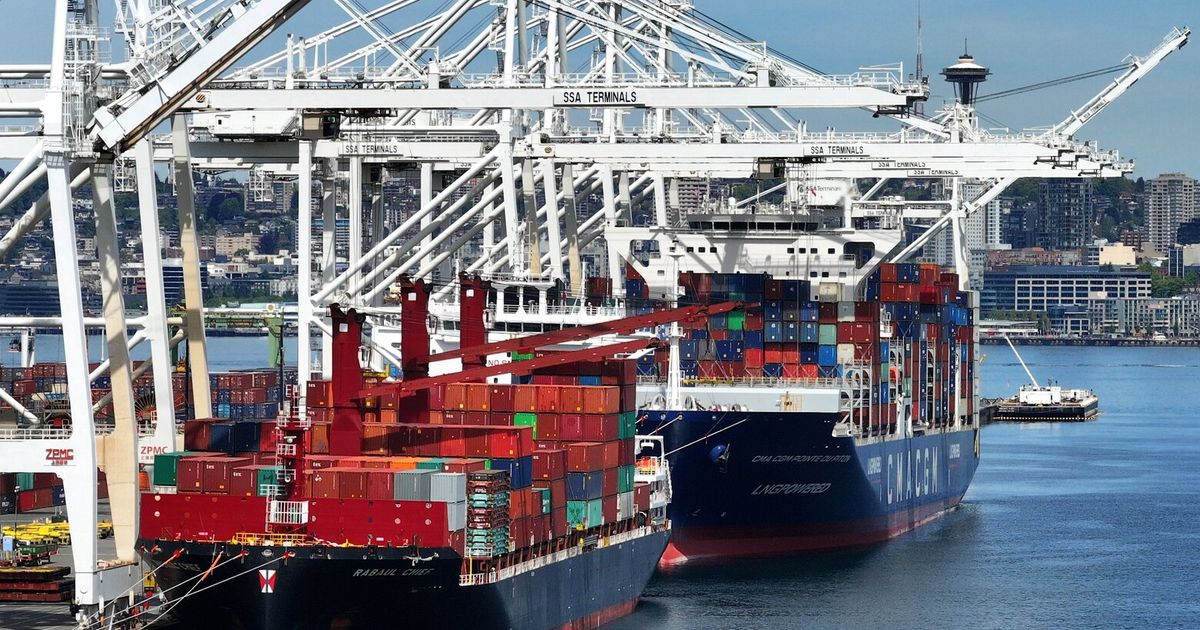
The consequences of the Trump administration’s trade-stifling tariff policies are beginning to sting in Washington state as summer approaches. Container ships sailing to Seattle and Tacoma ports have dropped off more than a third less imported cargo compared to last May. Canadians are making only about half the trips they made across our state’s northern border a year ago.
No two ways about it. These broad new barriers to global trade, in a state where more than 40% of jobs depend on international commerce, will be crushing to many areas of Washington’s economy.
This is no time for the state’s leaders to concede to trade protectionism. They cannot accept that farmers, manufacturers and other businesses here will simply have to operate with fewer places and people to sell their goods and services. An estimated $60 billion in annual exports is at stake.
“We know this: That when you start trade wars, usually that means you end up closing markets,” Washington U.S. Sen. Maria Cantwell said in late May, below the cranes of the Port of Seattle.
The Edmonds Democrat has fought as hard as any politician against the on-and-off-again tariffs. She seeks to move both legislative and judicial levers of government in defense of her home state’s access to overseas markets, introducing legislation to reassert Congress’ authority on tariffs and also fighting to legally rein in the president’s overreach of emergency powers.
Last week, the senator added her name to an amicus brief part of a lawsuit aiming to declare President Donald Trump’s tariffs unconstitutional.
The Times editorial board strongly supports the Trade Review Act of 2025, sponsored by Cantwell and Republican Sen. Chuck Grassley of Iowa. It would reestablish congressional oversight on trade, as outlined in Article 1 of the Constitution.
More members of Congress should emulate Cantwell’s championing of Washington’s leadership role as a critical international trade center perched on the Pacific Rim. U.S. Rep. Dan Newhouse, a Republican from Central Washington’s 4th District, is also pushing back on the tariffs, demonstrating this work can be bipartisan.
“Our communities, agricultural producers, and manufacturers rely on economic and political freedom to serve worldwide markets,” Newhouse wrote in a Seattle Times op-ed with Ed Schweitzer, founder of Pullman-based Schweitzer Engineering Laboratories. “Unnecessary tariffs minimize that freedom, discourage free trade, and can harm international relationships.”
Washington’s Democrat-dominant delegation can’t simply push back against Trump on tariffs. They must make their own case for why economic policy — free but fair trade — is at its best when Washington’s workers and business owners have access to foreign markets.
At the state level, there’s also ways of circumventing the dark clouds of the administration’s protectionist impulses. Gov. Bob Ferguson and state leaders should seek a unified trade strategy that smooths the rails, highways and paths to Washington’s ports to make gateways more competitive.
President Trump acknowledged in May that fewer and costlier products may await American consumers, but the reality for Washington state goes beyond inflated prices.
When international shippers cancel trips to Seattle and other ports due to a lack of U.S.-bound goods, the exports Washington produces — apples, beef, wheat and more — go undelivered to foreign ports without those ships to transport them out.
Leaders also should strive to optimize imports and exports through Washington, as former Seattle Port Commissioner Stephanie Bowman recently penned in these pages. The Northwest Seaport Alliance’s Inland Rail Hub Strategic Initiative, for example, is partnering with ports and seeking new logistic hubs in places including the Tri-Cities, helping the state’s farmers move products more rapidly and cheaply.
Think this is small potatoes? It’s not. Speaking of potatoes: Washington farmers sent more than $400 million worth of frozen French fries to Japan in 2024 alone, according to state Agriculture Department data.
In the face of tariffs, Washington should identify countries where partnerships could help its own companies and workers best swim against the tariff tide. No where is this more important than in Washington’s relationship with British Columbia — a province with which this state shares the fragile saltwater of the Salish Sea, vast and increasingly fire-prone forests and a mighty Columbia River vulnerable to the vagaries of climate change.
In the face of Trump’s tariffs and threats to Canadian sovereignty, Lt. Gov. Denny Heck also led a delegation in May to Victoria. The effort laid the groundwork for an effort the Legislature approved in 2024 to establish annual “interparliamentary exchanges” with B.C.’s government.
After a freeze decimated B.C.’s grape harvest for its wineries last year, Heck led a legislative trade mission that uncorked a partnership to send Washington grapes north of the border to help.
“We rely upon one another for trade, to protect our waters, the close ties between our peoples, and lift each other up in times of tragedy,” Ferguson wrote of the U.S.-Canada relationship on social media after meeting with the Canadian consul general in Seattle.
That’s right. Trade, after all, is a tool of diplomacy.
The tariffs have fueled economic uncertainty and the prospects for inflation at a time Washington already has among the highest costs of living in the U.S. Time for state leaders at every level to defend the state’s ability to trade within the international, rules-based system. Washington has much to lose if they don’t.
