

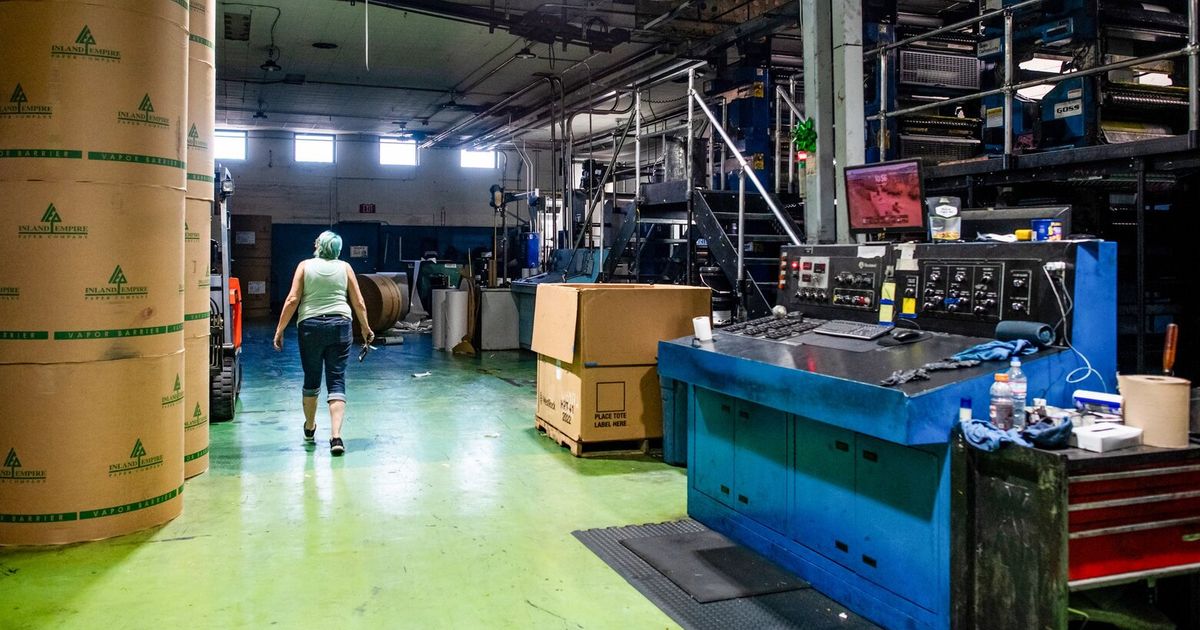
One of the last remaining newspaper presses in Washington is closing this month, leaving just one in the state’s eastern half.
The Walla Walla Union-Bulletin, a subsidiary of The Seattle Times, will cease print operations Sept. 15 and outsource production to The Lewiston Tribune in Idaho.
“With recent staffing departures and the continued rise in the cost of operating the press, maintaining printing operations in Walla Walla has become increasingly difficult from both a staffing and financial standpoint,” Charles Horton, The Times senior director of operations and affiliates, told the Union-Bulletin. “After careful consideration, we determined that continuing to operate the facility is no longer sustainable.”
Historically, newspapers operated their own presses but after decades of closures, mergers, downsizing and cost cuts, most now outsource that work.
Newspapers are designed on computers and sent electronically to presses. Printed papers are then sent via truck to distribution points, usually local postal facilities that handle delivery for a large share of America’s small papers.
These arrangements are complicated and push deadlines earlier and earlier. They also make newspapers’ arrival more vulnerable to bad weather and road closures. Even so, remote production is the only option for outlets that can no longer afford to operate their own presses.
I hate to see presses go and worry about the fragility of newspapers’ infrastructure and their growing dependence on others for production and distribution.
But with news increasingly consumed online, production cuts are inevitable and it’s better to cut there than in newsrooms. The shift also helps newspapers that continue to operate presses because it brings them additional customers.
I’m also nostalgic about the Walla Walla press because I used to bring pages of the Whitman College Pioneer there, sometimes via bicycle, to be printed. It’s different equipment now, though; the Union-Bulletin installed a newer press that the Bend Bulletin gave away when it downsized in 2020.
The Spokesman-Review last year closed its press and outsourced production to Coeur d’Alene, Idaho, cutting 68 jobs.
Ten full- and part-time jobs will be lost when the Walla Walla press closes.
“The reality of the reduced print quantities forced us to reconsider printing in Walla Walla,” Times CEO Alan Fisco told me Tuesday. “It’s always difficult when people’s jobs are impacted. We’re doing our best to mitigate the impacts to those affected.”
The Yakima Herald-Republic, another Times subsidiary, closed its press in 2021 and moved production to Walla Walla. Starting this month, it will be printed at The Times press in Kent.
Other remaining newspaper presses in Washington include those operated by The Wenatchee World, The Columbian in Vancouver, the Skagit Valley Herald in Mount Vernon and Pacific Publishing, a community newspaper publisher in Seattle.
Greg Halling, executive editor of the Yakima paper and senior news director of The Times’ affiliate papers, said new deadlines are still being worked out.
Halling said there hasn’t been a lot of feedback from readers since the closure was announced last week.
“We’ve been working very hard to make sure people understand this doesn’t mean the U-B is closing and it doesn’t mean the print editions are going away,” he said.
The newsroom will remain at its current level, he said, and print editions will continue to be produced Tuesdays, Thursdays and Saturdays.
Google feeling lucky: This is a rough week for news publishers in the courts, where they were hoping for relief from monopolistic tech giants hoovering up their work and rigging the online advertising market.
A federal judge today declined to force Google to divest its dominant ad exchange, even though she earlier ruled that the company illegally monopolizes the market. The case revealed how Google manipulated its system to harm publishers, who have no choice but to use this central clearing house for online ads.
Judge Leonie Brinkema’s decision isn’t fully released yet and requires behavioral changes sought by prosecutors. But it appears to be another victory for Google. The company is emerging intact and largely unscathed from two major, federal antitrust cases over its search and advertising monopolies.
The U.S. Department of Justice wanted Google to share or divest its ad exchange software to remedy its ad-tech monopoly. Last year it failed to convince another judge that Google must divest its Chrome browser to remedy its search monopoly.
“Nothing short of a structural divestment is sufficient to bring meaningful change,” DOJ litigator Julia Tarver Woods said during the opening of the ad-tech case, per The New York Times.
The Google prosecution began under the first Trump administration, in 2020. Now the DOJ is siding with other tech companies that allegedly violated copyright law.
On Tuesday the DOJ intervened in a lawsuit alleging OpenAI and Microsoft violated the copyright of The New York Times and other content creators, by using their work to train AI systems without permission or compensation.
The DOJ sided with OpenAI, defending the unauthorized use of others’ work and arguing that compensating publishers would hinder AI development. That reflects the attitude of tech investors who have the current Trump administration’s ear.
A telling footnote in the DOJ’s filing suggests that American AI companies should be able to act like foreign companies that ignore U.S. law:
“Whether or not requiring paid licensing would pose an existential threat to the American AI industry, it would at least hamper innovation and put American AI companies at a competitive disadvantage relative to competitors located in other countries that do not consistently respect U.S. intellectual property law.”
So because foreign companies flout our law and steal from American companies, our AI vendors should be free to do the same? What an awful take by our country’s top law enforcement agency.
