

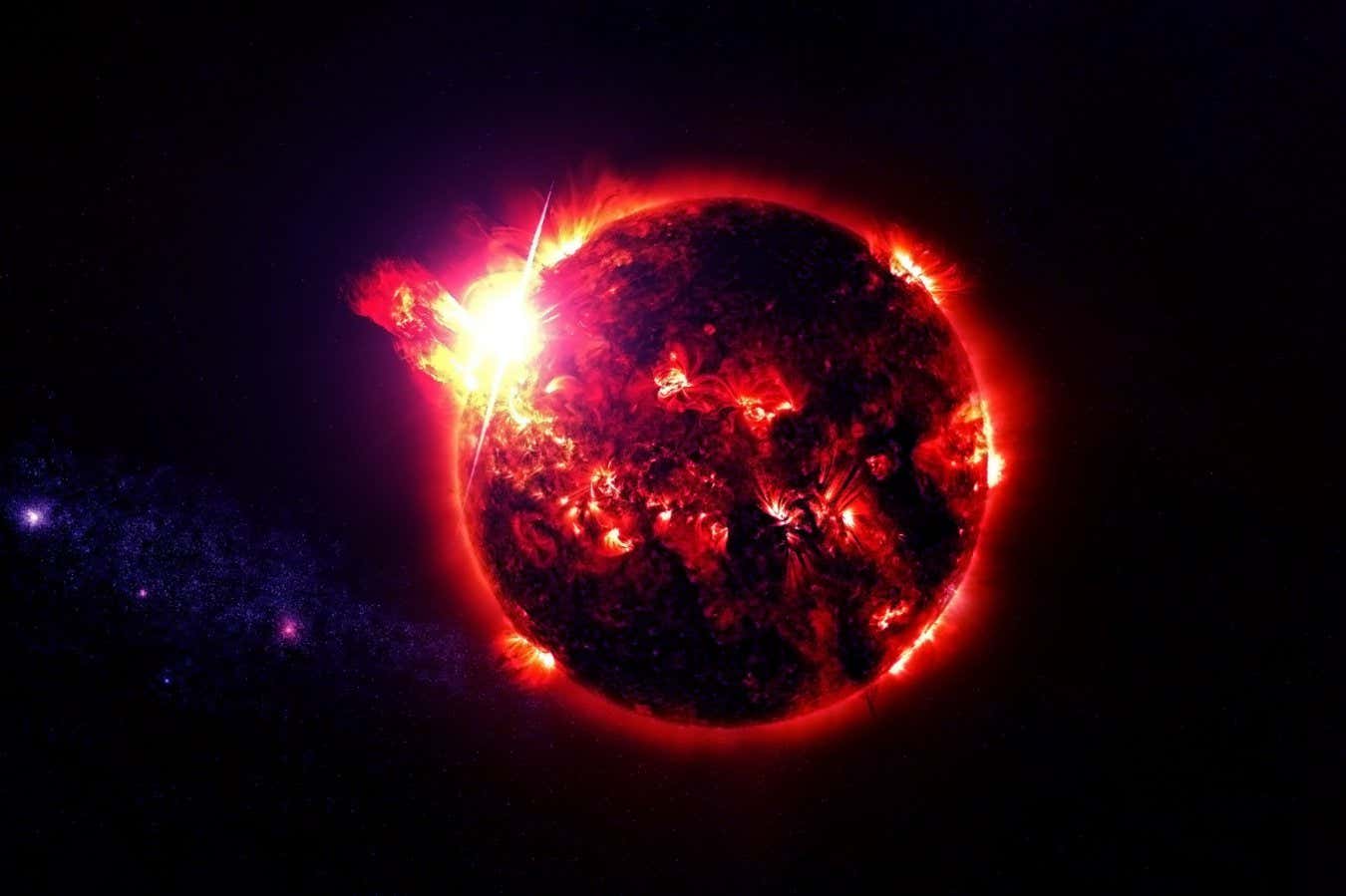
A strange type of star could be powered by dark matter
Artsiom P/Shutterstock
Astronomers have found the strongest evidence yet for the existence of dark stars, a type of enormous star in the early universe that is partially powered by dark matter. If confirmed, these hypothesised stars could help explain why we see mysteriously large black holes in the early universe – but not all astronomers are convinced by the discovery.
The idea of a dark star was first floated in 2007 by Katherine Freese at the University of Texas at Austin and her colleagues. They suggested that vast clouds of hydrogen and helium in the early universe could have mixed with a self-annihilating form of dark matter to form massive, stable stars. Without dark matter, such large clouds of gas would collapse to form a black hole, but the energy from the self-annihilating dark matter can prevent this, allowing the gas to heat up and form a star-like object, even though the nuclear fusion that takes place in most ordinary stars is absent.
There was scant evidence for these exotic objects until 2022, when the James Webb Space Telescope (JWST) began spotting an unusually high number of very bright, distant objects from just a few million years after the big bang, which astronomers thought were likely galaxies. Freese and her team showed that three of these galaxies also matched several properties from dark star simulations, such as their round profile and a similar intensity of light, but they lacked detailed spectroscopic data to make a conclusive discovery.
Now, Freese and her colleagues say that new spectroscopic observations of these early galaxies from JWST lines up well with theoretical predictions for how dark stars should look, as well as identifying another two dark star candidates. One of these newer candidates also contains a tantalising hint of a specific kind of helium – missing an electron – that, if confirmed, would be a unique identifier of dark stars. “If it’s real, then I don’t know how else you’d explain it other than with a dark star,” says Freese. However, the evidence for this is limited so far, she says.
But Daniel Whalen at the University of Portsmouth, UK, favours an alternative interpretation, arguing that supermassive primordial stars, a dark matter-free alternative theory of giant, early stars, match the JWST data equally well. “They ignore an entire body of literature on the formation of supermassive primordial stars, some of which could give signatures very similar to the signatures that they show,” says Whalen.
Freese disagrees, however, saying that the only plausible route to make such massive stars is for them to be burning dark matter: “There’s really no other way to make them,” she says.
One potential wrinkle is that separate observations of the objects studied by Freese and colleagues, from the Atacama Large Millimeter Array (ALMA) in Chile, indicate the presence of oxygen. As this element wouldn’t be found in dark stars, it suggests that these dark stars are mixed in with other stars or companions, says Freese. But Whalen sees the oxygen as a clear sign that these objects can’t be dark stars, as their formation would have been disrupted by regular stars exploding in supernovae.
If Freese and her colleagues can prove that these objects are dark stars, then it could help solve another cosmic conundrum, which is the abundance of very large black holes recently discovered by JWST. Our current understanding is that such black holes can exist only if they start from extremely large clumps of matter to seed them, but nothing in the early universe should be large enough to do this – apart from dark stars, says Freese: “We’ve got an explanation for big, unresolved astrophysical problems.”
Topics:
