

Updated at 11:30 AM
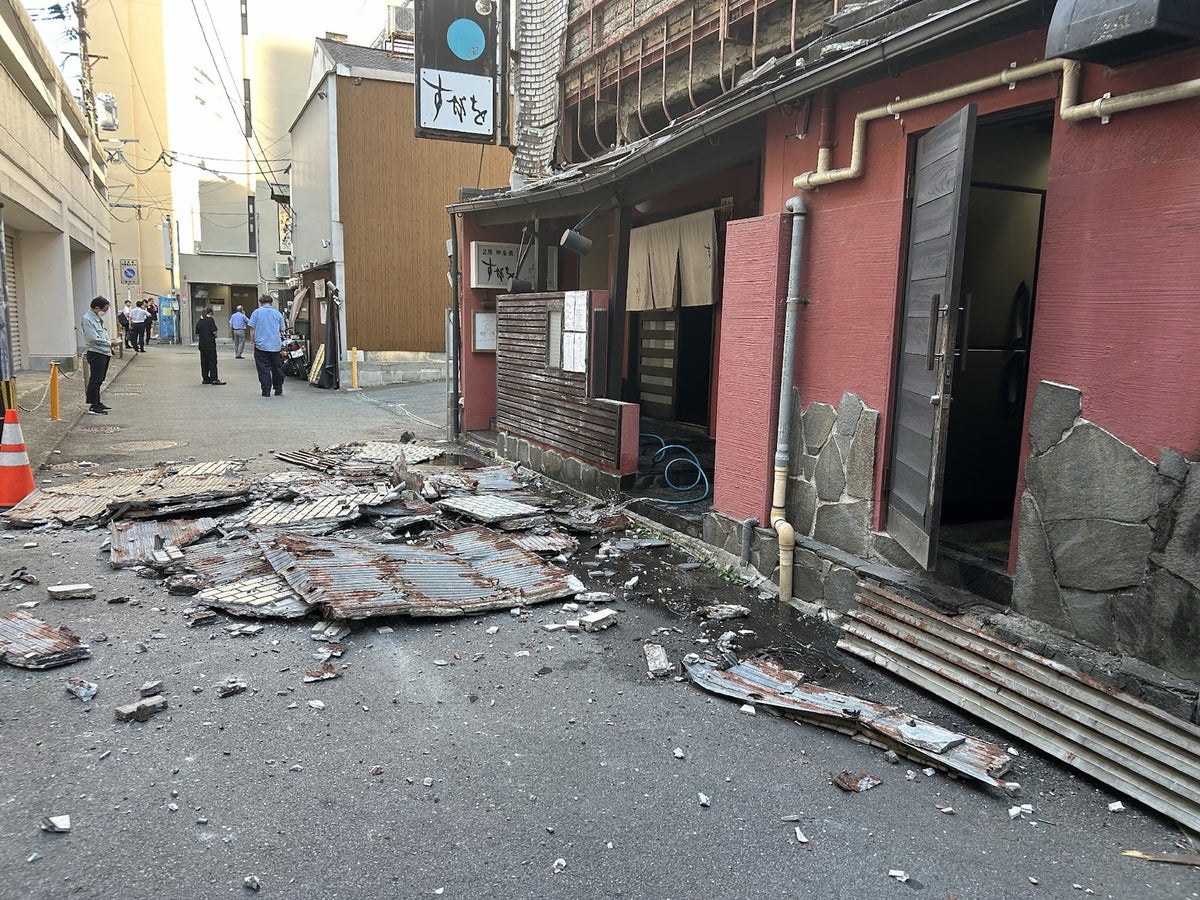
A magnitude 6.8 earthquake struck just south of the city of Kumamoto on the southern Japanese island of Kyushu on Tuesday afternoon local time. The earthquake has ignited fires and damaged roads and buildings, including a mall where rescue workers are seeking to extract trapped people.
The earthquake occurred along a strike-slip fault, where the two sides of a fracture in Earth’s crust slide past each other, located in what independent earthquake scientist Amilcar Carrera-Cevallos calls “one of the most seismically complex spots in Japan.”
“Kyushu sits at a real tectonic crossroads,” he says. On one side, the Philippine Sea Plate is subducting under the Eurasian Plate at a rate of about 40 to 50 millimeters (1.6 to two inches) per year. But on the other side, there is also a so-called back-arc basin that is pulling apart. “That stretching reaches into central Kyushu and creates the Beppu-Shimabara graben, a rift zone riddled with active faults and volcanoes like Aso and Unzen,” Carrera-Cevallos says. “So you’ve got subduction pushing from one side and rifting pulling from the other, all crossed by a major strike-slip fault, the Median Tectonic Line.”
On supporting science journalism
If you’re enjoying this article, consider supporting our award-winning journalism by subscribing. By purchasing a subscription you are helping to ensure the future of impactful stories about the discoveries and ideas shaping our world today.
The earthquake occurred in a local fracture inside the crust of the Eurasian Plate and was very shallow, at about 10 kilometers (six miles) below the surface. That shallowness “is a big part of why the shaking reached Shindo 7—the highest level on Japan’s scale—and why buildings and bridges collapsed,” Carrera-Cevallos says. It was also right under a population center, says Allen Husker, a California Institute of Technology geophysicist. If the quake had occurred closer to the subduction trench, the damage would’ve been less severe.
This earthquake happened along the same fault zone as a spate of deadly temblors in 2016. Those were also strike-slip earthquakes and hit some of the same towns. “The big difference is what happens next,” Carrera-Cevallos says. “In 2016 a smaller [magnitude] 6.2 earthquake struck first, and then, about a day and a half later, a much bigger [magnitude] 7.0 hit nearby on a different fault. Nobody expected that second, larger quake.”
Carrera-Cevallos says he is struck by how it did not take a strong subduction quake to create the highest level of shaking and cause substantial damage. This creates a difficult problem in structural engineering that aims to contend with seismological risk. Local faults “are numerous [and] poorly mapped compared to subduction interfaces, and they produce very high peak ground accelerations close to the source—exactly the kind of near-fault, high-frequency shaking that’s toughest on older, unreinforced structures,” he says. “This is a seismically mature, well-monitored region, but events like this remind us that even well-understood tectonic settings can still surprise us in their details.”
Additional reporting by Jackie Flynn Mogensen.
Editor’s Note (7/28/26): This story will be updated as new information becomes available.
It’s Time to Stand Up for Science
If you enjoyed this article, I’d like to ask for your support. Scientific American has served as an advocate for science and industry for 180 years, and right now may be the most critical moment in that two-century history.
I’ve been a Scientific American subscriber since I was 12 years old, and it helped shape the way I look at the world. SciAm always educates and delights me, and inspires a sense of awe for our vast, beautiful universe. I hope it does that for you, too.
If you subscribe to Scientific American, you help ensure that our coverage is centered on meaningful research and discovery; that we have the resources to report on the decisions that threaten labs across the U.S.; and that we support both budding and working scientists at a time when the value of science itself too often goes unrecognized.
In return, you get essential news, captivating podcasts, brilliant infographics, can’t-miss newsletters, must-watch videos, challenging games, and the science world’s best writing and reporting. You can even gift someone a subscription.
There has never been a more important time for us to stand up and show why science matters. I hope you’ll support us in that mission.
