

If you heard about a high school where college enrollment among graduates leaped by 34 points in a decade, you might ask: What’s the secret and how can it be replicated?
The answer is staring straight at us. It’s not in the North End schools typically hailed for scholastic success, but at Rainier Beach, once among the lowest-performing high schools in the state. Fifteen years ago, Beach was being eyed for closure because it could barely attract 300 students. These kids were not viewed as college material — not even by their own families.
Today, however, Beach students are being invited into the Ivy League and receiving full-ride scholarships to the University of Washington.
What happened? Two things: Parents, determined to save their storied high school, demanded that Seattle do something to make Rainier Beach more desirable; and what they got was the International Baccalaureate, a program of rigorous scholarship conceived in Switzerland for the children of diplomats.
Back when this was announced, in 2012, students at other Seattle schools (and a few teachers) smirked. Though IB had taken root at Ingraham and Chief Sealth high schools, it would never work at Rainier Beach, they said. Those kids were ballers, not scholars. They would never be able to excel in classes built on deep reading and critical thinking. If they did, it must mean Beach was offering a watered-down version.
Advanced education is a sticky subject in Seattle, where the approach to accelerated learning has been fairly uncreative. Mostly, it consists of testing elementary school children for membership in the “Highly Capable Cohort,” where students remain with the same group of smarty-pants kids through middle school.
Then, as teenagers, they funnel into Advanced Placement courses, which exist in greater numbers at some high schools than others.
This exclusionary approach came to look like racial segregation because there were so few Black or Latino kids in Highly Capable classrooms, and it rankled parents for years. In 2017, a Black mom told me access to accelerated learning was a civil rights issue.
But since the pandemic, complaints have grown about low expectations districtwide. No wonder, since Seattle Public Schools decreed in 2020 that teachers would no longer give out F’s, virtually every test could be retaken and it was OK to turn in homework assignments late. These policies were passed during the height of COVID-19 panic, though the relaxed standards have lingered.
But the International Baccalaureate program? At Beach, it pushed teenagers more comfortable rattling off sports stats to debate philosophy in a required class called Theory of Knowledge. Earning the vaunted IB diploma would also mean writing a 4,000-word research paper, performing substantial community service and passing multiple exams, graded not by their teachers but faceless academics thousands of miles away.
“If it’s watered down, why are some of my students scoring above the world average on their math scores?” said Steven Miller, who coordinates IB at Beach. “I have kids choosing between Cornell, Northwestern and Brown this year. I have Gates scholarship kids. We have kids at Pomona and USC, kids getting into Smith College, Santa Clara, Macalaster, Emory — everywhere.”
That would be an impressive alumni list for any high school. But what’s really striking are IB’s effects on students who don’t pursue the full diploma and might never enroll in a bachelor’s degree program. For them, too, the deep inquiry approach of the IB has made a difference, teachers say.
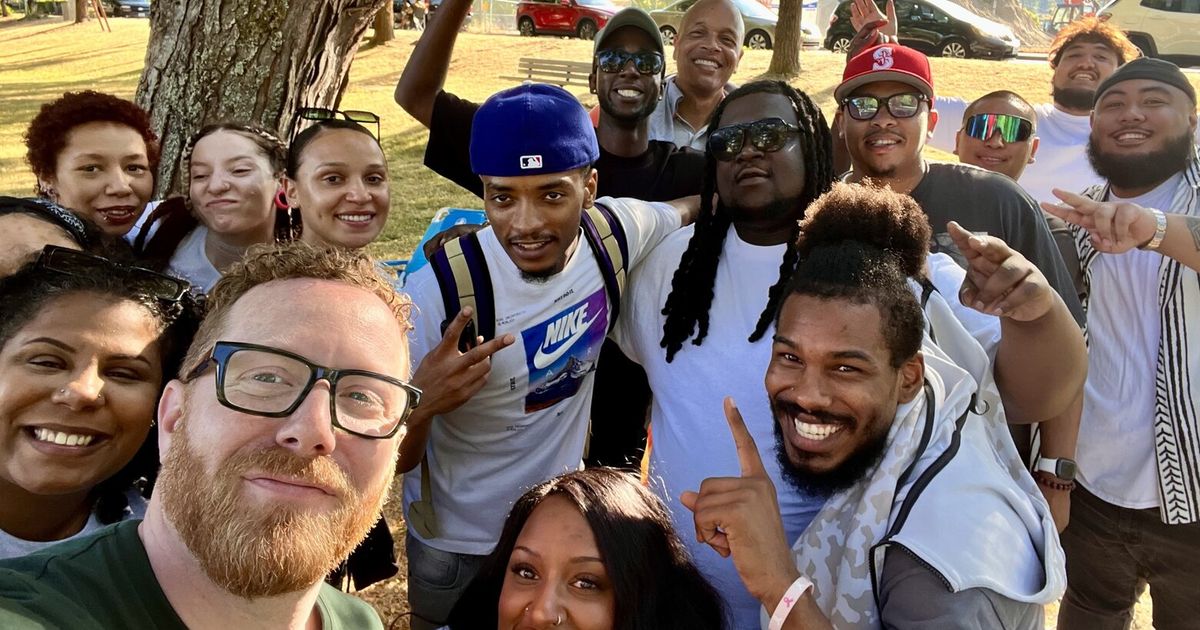
So I was happy to reconnect with Beach’s Class of 2015, the school’s first group of IB scholars, for a where-are-they-now update.
Some had gone to universities out-of-state and made lives far from South Seattle. Those who showed up for an informal reunion across the street from their old school were the hometown crew. At least one was shot while still a student. Most had gone straight from senior year into the working world. They were managing warehouses or doing physical jobs.
Yet they treasured their experience with the IB. They said it changed their worldview and their view of themselves in the world.
Emani Royster, 28, had wanted to become an educator. But her best friend was killed. Life doled out other bumps and bruises, and Royster, who’d enrolled at Eastern Washington University, returned to Seattle, eventually finishing her education at Renton Technical College. She works now as a phlebotomist.
Did IB transform her life? That depends on how you’re counting.
“Having all this world knowledge made me dream bigger,” she said. “It gave you another lens to look at life, something more than just the basic chemistry and math.”
Is this not the point of education? To open a young person’s mind? To inspire ambition and dreams, then give kids the tools to reach them?
Seattle Public Schools, smarting under criticism of its racially segregated Highly Capable program, has vowed to dismantle it. But there are other ways to go. Such as the “IB for all” approach at Rainier Beach. In practice, it means virtually every junior and senior in the building now takes IB literature and IB history. And this fall, they will be attending those classes in a new $275 million building.
At first, few believed the Beach kids would even complete their courses — forget about expecting IB to transform the school. In 2012, when Colin Pierce was coordinating the program, Beach had just 366 students.
In those early days, I watched him trying to drum up enthusiasm through community meetings held in the school library. There were four people at the one I attended, with more cookies in the room than humans.
Pierce smiled through it all, convinced that advanced learning could be a tool to promote equity, rather than a wedge to separate kids. Set high expectations with demanding coursework for everyone, he said, then help students reach up. By last fall, enrollment at Beach had more than doubled, to 855. This September, 900 students are expected, even as the numbers in SPS overall have declined.
Pierce never focused on how many students were taking a full load of advanced courses in pursuit of the high-polish IB diploma. All he asked was that they taste what could be, try something new.
And they did. At 17, Dajaun Hill-Rose had never been out of the country. But he flew to Montreal to attend the IB World Conference.
“It opened up my eyes,” he said. “After that, I wanted to see more, do more.”
The evolution in their aspirations is perhaps the greatest evidence of IB’s success.
At 28, Jamika Pugh is finishing her associate degree at Highline College, with plans to become a school psychologist.
Amina Mohamed, who works for the city helping low-income families with their utility bills, transferred from community college to the University of Washington, earned her bachelor’s degree and is on the road toward a master’s.
Her proposed major? Education.
