

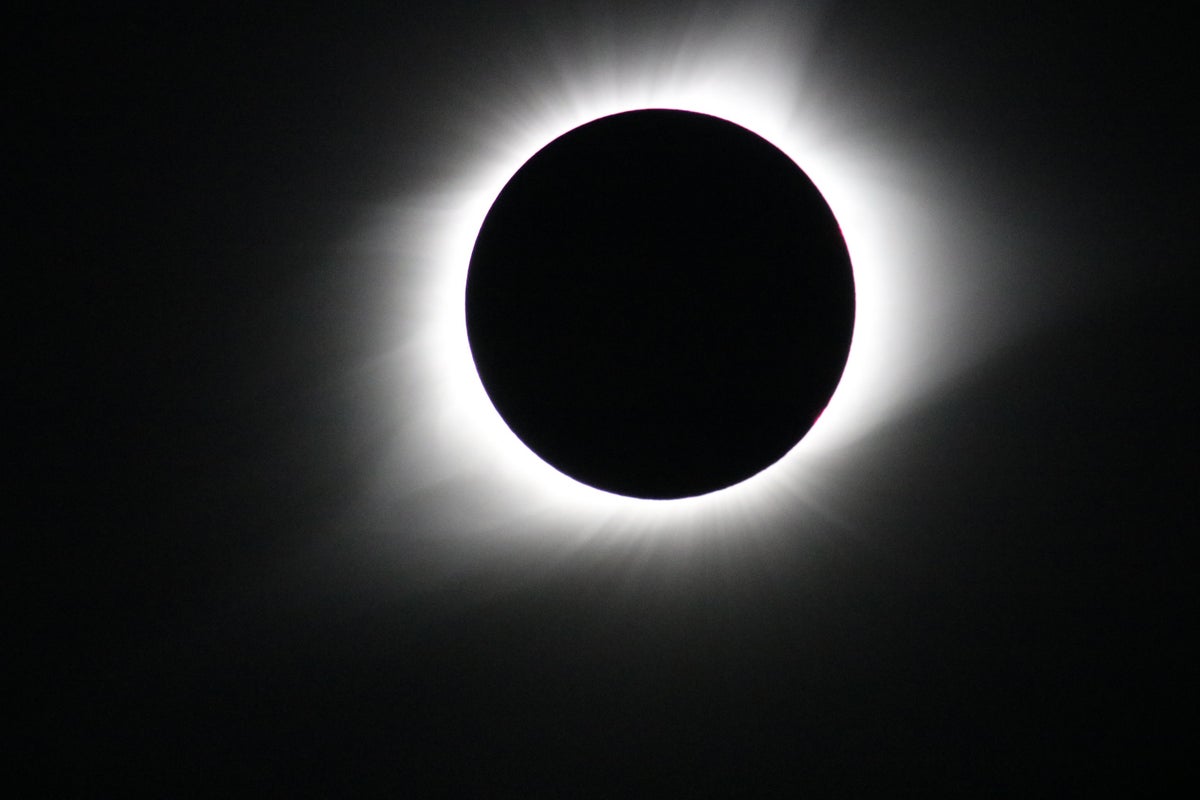
If you happen to find yourself in Greenland, off the west coast of Iceland or along a narrow path in central Spain on August 12, 2026, then you’re very lucky (or very adept with your scheduling): you’ll get to see a total solar eclipse.
This is without a doubt one of the most—if not the most—beautiful astronomical events a human can witness. The moon—hidden in the daytime sky until its silhouette cuts a narrow curve at the sun’s edge—slowly slides across the disk of our star toward totality, the time when the moon completely blocks the sun. As totality nears, the light around you changes timbre, shadows sharpen, birds stop chirping and crickets start singing as if night is falling. And then the moment arrives. The sun’s brilliant disk is fully blocked, and the ethereal wisps of the corona—the sun’s gaseous atmosphere—come fully into view. Brighter stars and a few planets appear in the darkened sky as well.
Part of an eclipse’s emotional impact is how fleeting that moment of totality is; this August’s will max out at just more than two minutes. Not that a longer one necessarily lessens the feelings—totality during the “Great American Eclipse” of 2024 lasted more than four minutes but was still an incredible experience for viewers.
On supporting science journalism
If you’re enjoying this article, consider supporting our award-winning journalism by subscribing. By purchasing a subscription you are helping to ensure the future of impactful stories about the discoveries and ideas shaping our world today.
This raises an obvious question, however: Just how long can an eclipse be?
The answer depends on a lot of factors. For example, the moon orbits Earth on an elliptical path, so sometimes it’s farther from us than other times. When it’s closer, it’s also bigger in the sky, so totality takes longer to elapse. Conversely, Earth also orbits the sun on an ellipse, so when our planet is at aphelion (its greatest solar distance), our star appears at its smallest in the sky, extending totality.
Latitude matters as well. We live on a spinning planet, and the moon orbits Earth in the same direction as that rotation. The lateral speed of Earth’s spin is greatest at the equator, where it reaches more than 1,600 kilometers per hour. This maximizes the length of an eclipse there because a viewer follows along the moon’s motion.
Complicating matters is that the moon is closest to an observer (and therefore is largest in the sky) when directly overhead, at the zenith. Earth is at aphelion in July, however—a time when it’s impossible for the sun to be at the zenith as seen from the equator! The way the geometry works out, the best spot for a maxed-out “equatorial” eclipse would be at a latitude of 5 degrees north.
There are more subtle effects as well—such as gradual changes in the shape of Earth’s orbit as a result of the gravitational effects of other planets—that make this calculation difficult. But it’s not impossible: Jean Meeus, a Belgian amateur astronomer and bona fide expert in celestial mechanics, did the math. Across the time range of 2,000 B.C.E. to C.E. 7,000, the longest eclipse that he found was seven minutes and 35.9 seconds. Unfortunately, we already missed it because it occurred around 120 B.C.E.
In the more modern era, the longest eclipse will happen in northern South America on July 16, 2186. This one will peak at seven minutes and 29 seconds in a spot in the Atlantic Ocean north of Brazil—not too bad, though perhaps a bit farther in the future than those of us alive now can wait.
Mind you, these durations only apply if you’re stuck on the ground. But what if you flew eastward along the eclipse path, following its motion? The moon’s shadow typically moves at about 1 km/s along the ground, so a carefully arranged airplane flight could add quite a bit of time to totality. In 1973 the supersonic Concorde jet flew along an eclipse path over Africa, extending the seven-minute eclipse to an amazing (and still-held) record of 74 minutes!
That must have been quite the adventure, but I suspect that if an eclipse lasts too long, the thrill wanes. Humans are cursed to become inured to anything that persists long enough, and even the staggering beauty of a total solar eclipse may begin to fade after, say, an hour.
Which really means that extending totality can only take you so far before other factors become more important. The most obvious one would be location. For example, I saw the 2017 U.S. eclipse in Wyoming, which was lovely, but not exactly scenic at our location. But in 2045 a total eclipse will play out over Arches National Park in Utah; a canny observer (and photographer!) would do well to frame that one between towering red sandstone buttes.
As another example, the path of this August’s eclipse crosses over the Spanish island of Mallorca. Sure, it will happen during the island’s scorching summertime, but, on the other hand, you’ll be in Mallorca.
Specific timing would be helpful, too. Basking in totality at sunrise or sunset would be spectacular. Malaysian photographer Teoh Hui Chieh created a stunning time-lapse video of an Australian annular solar eclipse transpiring at sunrise in 2013. More generally, an eclipse when the sun is magnetically active—as it will be for August’s occurrence—means more sunspots and more structure in the corona, adding a bit of extra spice.
More realistically, of course, weather plays a dominant role. What’s the point of being present for a celestially superlative eclipse if a thunderstorm prevents you from properly experiencing it? This means you should probably prioritize those occurring at places and times offering the best chances for clear skies. Flying in an airplane helps here, too, because you can get above the weather. Cruise lines commonly have eclipse excursions as well, and they have the advantage of steaming to a different locale along the path of totality if the weather looks iffy.
For me, I think the most fantastic perspective would be an eclipse in the sky above an erupting volcano—two of nature’s most magnificent displays, both visible simultaneously. Imagine one over Italy’s Mount Etna during a strombolian eruption or in Hawaii with Kilauea’s fountains in the foreground. Sadly, neither location will host a total eclipse in the next decade, though.
Still, despite all these exotic maneuvers and locations, in the end, the optimal place to see an eclipse is wherever one can be seen. Whether it’s the most exciting spot on Earth or the most boring place imaginable, you get to see an eclipse—an all-too-rare event throughout the entire solar system! And that’s worthwhile all by itself.
