

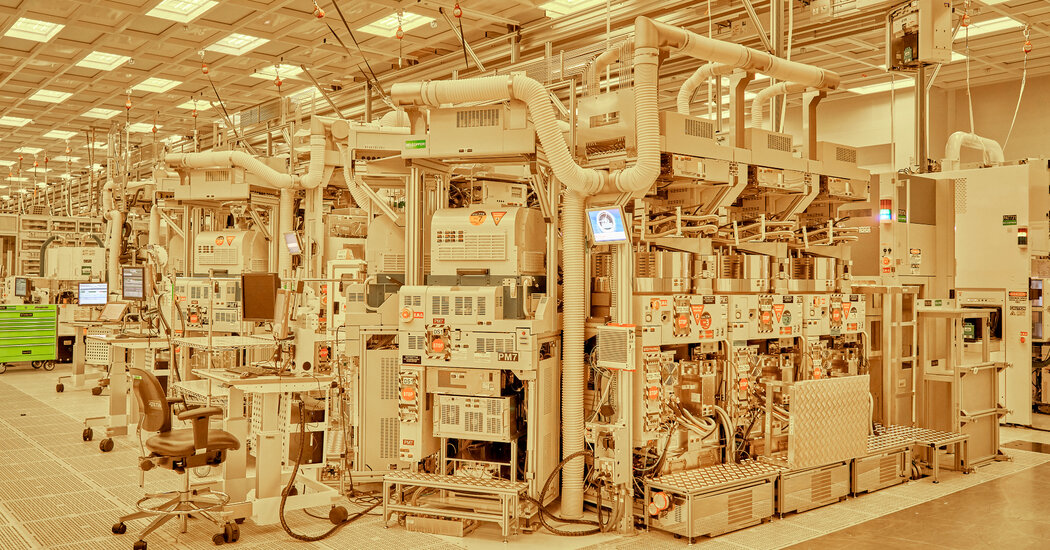
Intel, a fallen Silicon Valley icon trying to restore its reputation as America’s most prominent semiconductor company, is working with the Trump administration on a plan to turn over the operation of its chip-making plants to a giant Taiwanese rival.
Over the past few months, Frank Yeary, the interim executive chairman of Intel, has spoken with administration officials and leaders of Taiwan Semiconductor Manufacturing Company about a deal that would separate Intel’s ailing manufacturing business from its semiconductor design and product business, according to four people with knowledge of the plan, who spoke on the condition of anonymity.
TSMC, which produces an estimated 90 percent of the world’s most advanced semiconductors, would assume control of Intel’s manufacturing business and take a majority stake in the business alongside a consortium of investors that could include private equity firms and other tech companies, the four people said.
The Trump administration has encouraged TSMC to do the deal. Howard Lutnick, President Trump’s nominee for commerce secretary, has been involved in the conversations and considers them one of the most consequential challenges of his new job, two of the people familiar with the discussions said.
It’s not clear how much of Intel’s manufacturing business TSMC would take over or how much money the Taiwanese company would invest. The deal could be limited to Intel’s domestic plants, in states including Oregon, Arizona and New Mexico, or also include facilities in countries like Ireland and Israel, the people said.
Intel’s business prospects soured after it failed to develop smartphone and artificial intelligence chips. Despite the government’s best efforts to revive the company by promising it billions of dollars of subsidies through the Biden administration’s CHIPS Act, Intel has continued to struggle.
Intel and TSMC declined to comment. Mr. Lutnick did not respond to a request for comment.
Late last year, Intel’s board approached TSMC to gauge its interest in some sort of partnership, two of the people familiar with the talks said. In January, TSMC’s chief executive, C.C. Wei, met separately with Mr. Lutnick and Mr. Yeary to discuss how a tie-up might work.
Mr. Yeary has been speaking to Mr. Lutnick regularly about the idea since then, three of these people said. The Intel chairman’s interest in cleaving the company has also opened the door for suitors interested in acquiring Intel’s product business, including Qualcomm. A Qualcomm spokeswoman declined to comment.
Some details of the discussions were previously reported by Digitimes, a Taiwanese news outlet, and Bloomberg.
The question now is whether the Trump administration thinks an ailing national champion like Intel is better off in the hands of a foreign company or if the administration needs to search for another solution.
“Even with potential U.S. government support from the CHIPS Act and officials eager to see the firm rebound and lead the renaissance of advanced manufacturing in the U.S., the road ahead will be tough,” said Paul Triolo, a partner at Albright Stonebridge Group who tracks the industry.
Hanging over the negotiations are questions about Mr. Trump’s approach to the chips industry and Taiwan, which is sharply different from former President Joseph R. Biden Jr.’s strategy. Mr. Trump has criticized the Biden administration’s investments in domestic chip manufacturing, threatened to impose tariffs on foreign-made chips, accused Taiwan of stealing the semiconductor industry away from the United States and questioned U.S. military support for the island, which is seeking to defend itself against Beijing’s encroachment.
In remarks to Republican lawmakers in late January, Mr. Trump said a significant tariff, not subsidies, was all that was needed to force chip companies back to the United States.
“We want them to come back, and we don’t want to give them billions of dollars like this ridiculous program that Biden has,” the president said.
In his Jan. 29 Senate confirmation hearing, Mr. Lutnick appeared to walk a careful line on the CHIPS program. He described it as “necessary and important” and a “down payment” on bringing manufacturing back to the United States. But Mr. Lutnick refused to commit outright to honoring contracts that companies had already signed with the government.
To placate Mr. Trump, Taiwanese officials and businesspeople have been cultivating ties with people in his orbit, floating new deals in the gas sector and trying to explain how Taiwanese semiconductor manufacturing benefits the United States.
Taiwanese officials are also monitoring the talks over Intel’s future. For Taiwan, TSMC’s dominance of advanced chip manufacturing has become what some commentators call a “silicon shield” that deters military action by China and encourages support from the United States.
Taiwan’s president, Lai Ching-te, said on Friday that his government would work with the island’s semiconductor companies to develop a strategy addressing Mr. Trump’s grievances while protecting Taiwan’s role in the chip sector.
“Taiwan’s government will be in mutual contact and discussions with the semiconductor sector to formulate the right strategy, and then there’ll be further deliberation over the proposals with the United States,” Mr. Lai said in a news conference.
TSMC could address Mr. Trump’s demands by simply building more manufacturing capacity in the United States, said Stacy Rasgon, a semiconductor analyst at Bernstein Research. TSMC, which received up to $6.6 billion in grants from the CHIPS Act, is building three factories in Arizona and has the ability to expand there.
The idea of breaking up Intel speaks to how much the company’s fortunes have changed. Founded in 1968, it became the world’s most valuable semiconductor company by designing and manufacturing chips for personal computers and data centers. But the company has struggled in recent years to innovate and ceded ground to rivals like Nvidia, the dominant maker of A.I. chips.
Pat Gelsinger, who was named Intel’s chief executive in 2021, promised to turn the company around by reinvigorating its manufacturing business, but the effort faltered. In November, Intel’s board forced Mr. Gelsinger to resign.
Intel’s manufacturing business, which it calls Intel Foundry, reported an operating loss of $13.4 billion in 2024 as sales from customers decreased 60 percent. Last year, the company said it planned to make the business an independent subsidiary.
With Intel’s stock price down nearly 50 percent over the past year, splitting Intel could make it vulnerable to a takeover, said Patrick Moorhead, founder of Moor Insights and Strategy, a tech research firm.
“Intel as we know it would cease to exist,” he said. “It would be the absolute end of an era.”
Chris Buckley contributed reporting from Taipei, Taiwan.
