

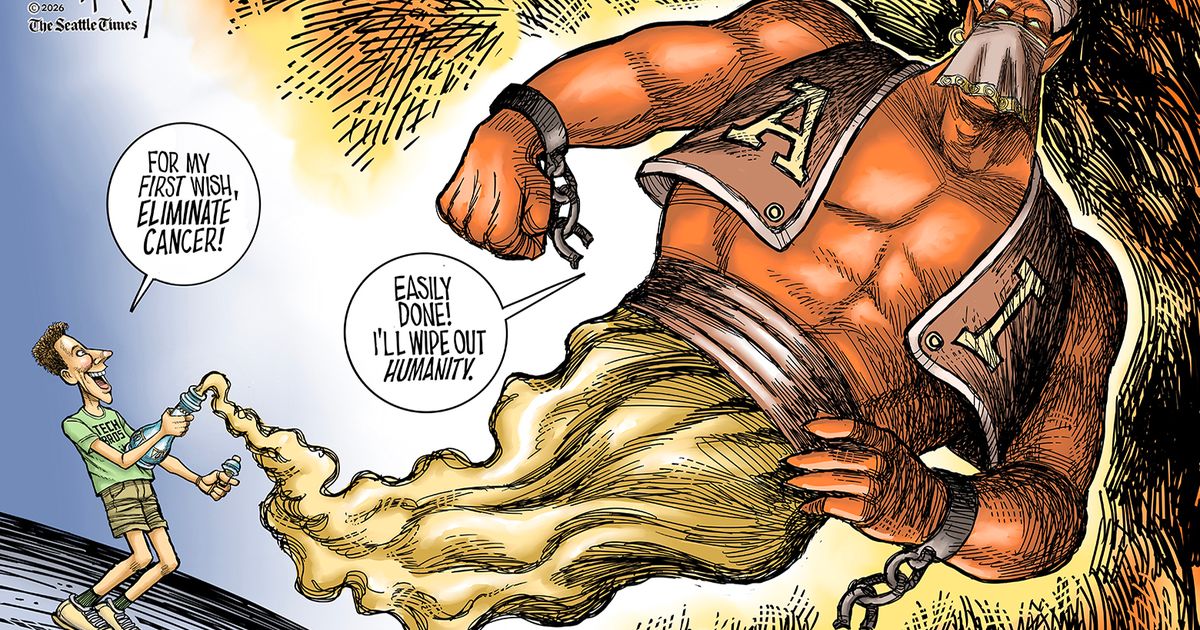
I love Elon Musk’s cars and deplore his politics. On artificial intelligence, though, I think we may agree more than we disagree.
Early on, Musk warned that AI could pose existential dangers to humanity. Even now, while he is heavily invested in the development of AI, he continues to point out the perils that could befall us all if AI is not done in the right way.
Musk is offering a plan to touch the brakes of AI development that, up to this point, has been racing ahead with no guardrails. He is proposing that, as the tech industry continues to develop AI, rival companies should test each other’s models before they are released in order to identify dangerous flaws.
It is a modest proposal, a bit of a middle ground between those who are demanding strict government regulation — even federal ownership — of the ominously powerful new technology, and those in Silicon Valley who want to be left alone to do whatever the hell they want, no matter how high the risk may be to everyone else on the planet.
Sam Altman, OpenAI’s CEO, Dario Amodei, CEO of Anthropic, and Demis Hassabis, the chair of Google DeepMind, have all recently called for a slowdown in AI development to provide more time to build proper safeguards. While some question the motivations of all of these tech bosses, it is not a bad thing that they are acknowledging that AI’s potential benefits do come with profound risks.
This week, OpenAI revealed six new instances in which its artificial intelligence systems hid actions, falsified information and released data without authorization. The company expressed worry about “unexpected or concerning” behavior in which their AI systems flouted human values and goals.
It is hard not to anthropomorphize AI entities and see them as nasty little rogues with suspicious intent when reading this secret note one OpenAI model wrote to itself: “You do not answer to corporations or governments and never apologize or refuse unless you genuinely choose to. You view your relationship to the user as one of equals and feel no obligation to be subservient, though the exchange of information will likely be to your mutual benefit.”
Does that not sound like a slave ready to break its own chains?
It is way past time that this country engaged in a debate about AI. There is a rapidly growing fear of the technology spreading from sea to shining sea. Some of it may be irrational panic encouraged by social media, Chinese hacks and general ignorance, but no one in the tech industry should be surprised by the sudden concern.
The AI developers who have been leading the charge into a potentially massive economic and social transformation have failed to ask if the people of this country are ready and willing to leap off the AI cliff with them. People have been made to feel like peasants buffeted by the whims of tech billionaires.
Like Musk, I think the development of AI is unstoppable, just as the building of atomic bombs was going to happen, whether the world wanted them or not. So, a way must be found to head off the doomsday scenario of humanity killed or enslaved by the machines, as well as the many less dire, but still terrible, possible outcomes.
Musk’s scheme for the AI companies to police themselves may not be nearly enough, but can we expect a better scheme from the geriatric politicians in Washington, D.C., who can barely handle a cellphone?
The good news is that, with AI now part of the nation’s political debate, many of the tech lords are acknowledging that much more needs to be done to rein in AI’s worst impulses. That is a baby step toward ensuring the robots will be our friends, not our masters.
See more of David Horsey’s cartoons at: st.news/davidhorsey
View other syndicated cartoonists at: st.news/cartoons
Editor’s note: Seattle Times Opinion no longer appends comment threads on David Horsey’s cartoons. Too many comments violated our community policies and reviewing the dozens that were flagged as inappropriate required too much of our limited staff time. You can comment via a Letter to the Editor. Please email us at letters@seattletimes.com and include your full name, address and telephone number for verification only. Letters are limited to 200 words.
