

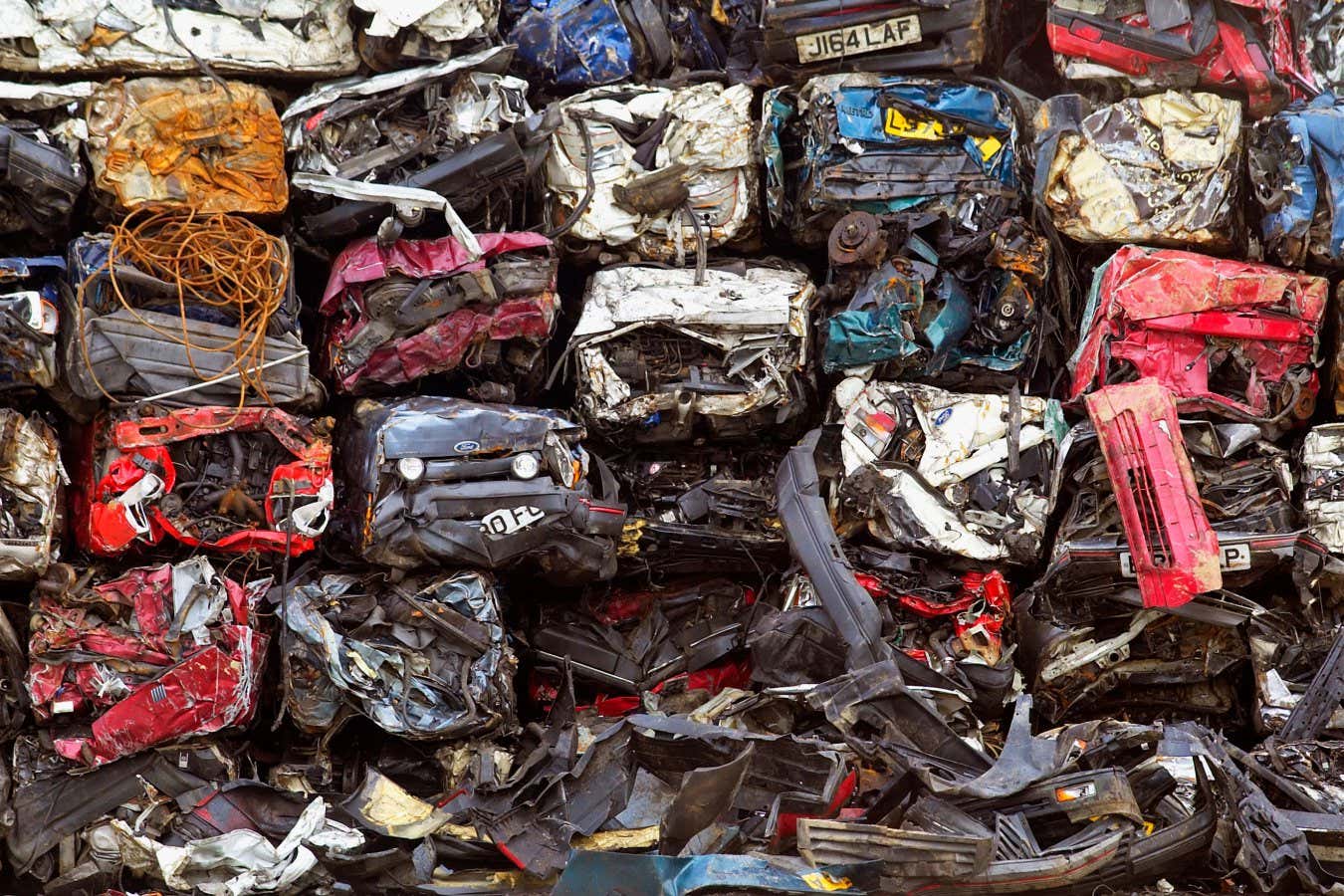
Scrap vehicles contain many different metal alloys, which can be hard to recycle
Marc Hill/Alamy
A new way to recycle the metal from scrap cars could eliminate millions of tonnes of waste each year and cut the carbon emissions from producing virgin aluminium.
For decades, much of the scrap aluminium in cars has been recycled into a low-grade cast alloy for use as engine blocks in new combustion engines. But as the car industry transitions to building only electric vehicles, there is nowhere for this low-grade scrap metal to go.
Without a solution, the world risks creating “mountains” of unusable scrap and emitting millions of tonnes of additional carbon dioxide by producing more virgin aluminium for vehicle manufacturing, warns Stefan Pogatscher at the University of Leoben in Austria.
“If the engine blocks go away because of electrification, at the moment we have no sink for the scrap,” he warns. “That means it cannot be used any more.”
Together with colleagues, Pogatscher has developed a new process to recycle the metal from scrap cars – which in Europe alone amounts to between 7 and 9 million tonnes of waste per year – into a new high-grade aluminium alloy that can be used to make a variety of components for new cars.
The solution lies in retaining a wide range of alloy materials from scrap cars to make the new product, he explains.
Normally, when cars are scrapped the materials are sorted, with plastics, fabrics, steels and aluminium all dealt with separately. Next, the aluminium alloys – of which there can be up to 40 in a single car – are separated as much as possible for different recycling streams. What can’t be separated is then melted and cast into engine blocks, a component of combustion engines.
The new recycling method developed by Pogatscher’s team involves melting down all of the scrap aluminium from an old car in one go, therefore including a much wider range of alloys and impurities than standard.
This produces a slab of very brittle material that is “more like a ceramic than like a metal”, says Pogatscher. But the team found that reheating this material to about 500°C, for a 24-hour period, helps to change the structure of the metal to make it stronger and more mouldable. “You turn out in the end with mechanical properties that are in some cases better than what is out there for primary-made wrought alloys,” he says.
The team claims the new material rivals typical automotive alloys with its “impressive” strength and could be used to make a wide range of car parts, including chassis and frames. It can be made using common industrial processes and therefore could be immediately scalable, says Pogatscher. He admits that it will be challenging to get the “conservative” manufacturing sector to adopt the new alloy at scale, but the research team is already in talks with industry partners about developing the process.
Geoffrey Scamans at Brunel University of London says although the idea is “very interesting”, more work is needed to prove that the new alloy can pass the stringent tests necessary to allow its use in car body parts, for example.
He also warns it may prove challenging to produce a consistent high-grade alloy given that vehicles are scrapped “at random and not as individual vehicle types”. “It’s difficult to see how the individual alloy compositions could be collected in a practical way,” he says. “Scaling from lab-scale experiments to full-scale production of sheet [metal] is notoriously difficult.”
Mark Schlesinger at the Missouri University of Science and Technology says the content of the new alloy will need to be specified and controlled if it is to be commercially produced. “Simply throwing scrap into a furnace at random and melting it down will not produce an acceptable product,” he says. “This means that identification of the chemistry of scrap will still be needed, raising the cost of processing it.”
Topics:
