
Close Menu
    National News Brief
    Sunday, May 3
    • Home
    • Business
    • Lifestyle
    • Science
    • Technology
    • International
    • Arts & Entertainment
    • Sports
    National News Brief
    Home»Science

    Ancient lead exposure may have influenced how our brains evolved

    Team_NationalNewsBriefBy Team_NationalNewsBriefOctober 16, 2025 Science No Comments3 Mins Read
    Share
    Facebook Twitter LinkedIn Pinterest Email


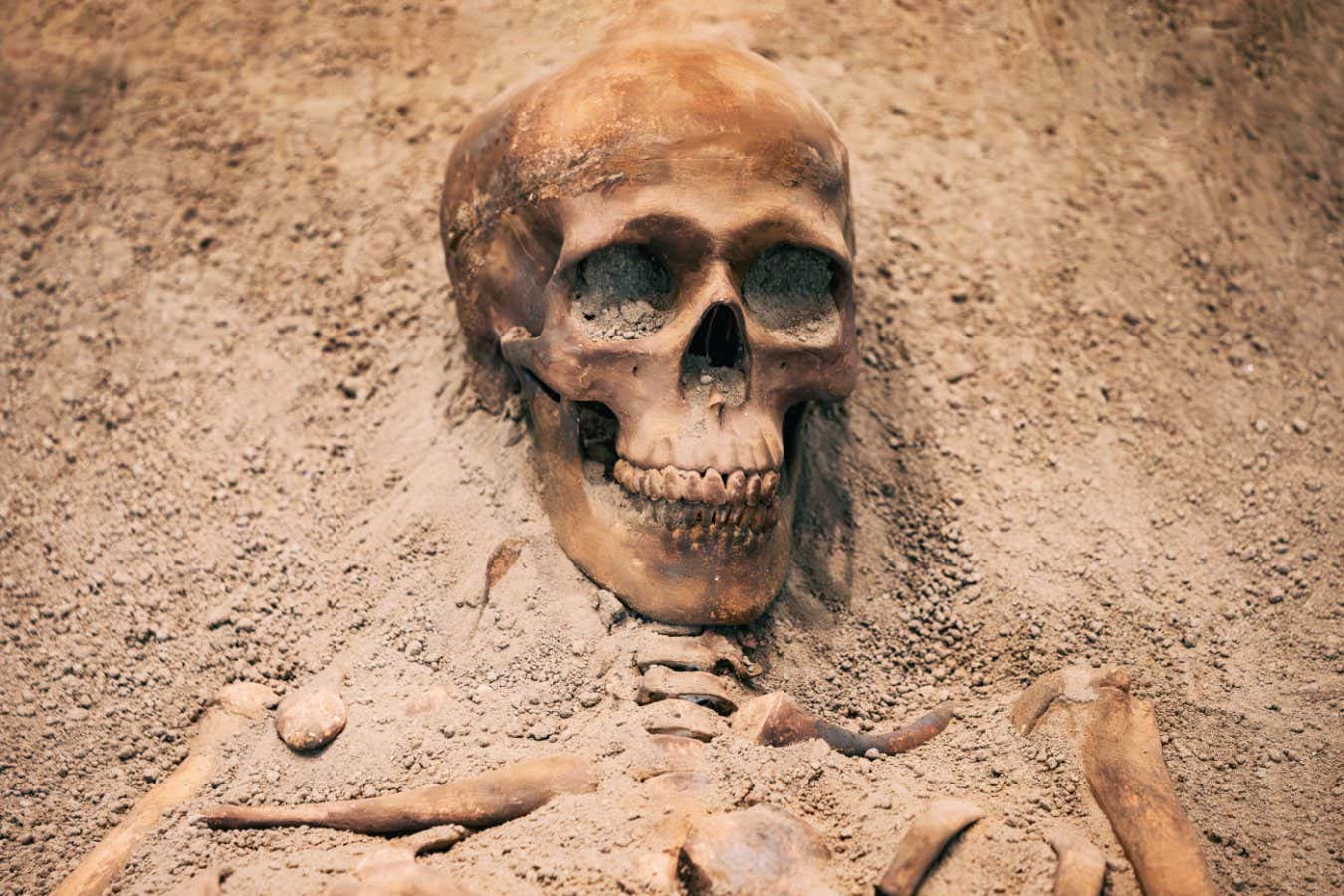
    Homo sapiens may have evolved to be more tolerant of lead exposure than other hominids

    frantic00/Shutterstock

    Prehistoric hominids have been exposed to poisonous lead for at least 2 million years, a study of fossil teeth suggests, and modern humans may have evolved to cope with the toxic metal better than our ancient relatives.

    Lead poisoning has long been thought to be a uniquely modern problem tied to industrialisation, poor mining practices and its use as an additive in fuel, which has been phased out since the 1980s.

    It is particularly dangerous for children, impacting their physical and mental development, but it can also cause a range of severe physical and psychological symptoms in adults.

    Renaud Joannes-Boyau at Southern Cross University in Lismore, Australia, and his colleagues wanted to find out whether our ancient relatives were also exposed to lead.

    They analysed 51 fossil teeth from hominids including Australopithecus africanus, Paranthropus robustus, Gigantopithecus blacki, Homo neanderthalensis and Homo sapiens. The fossils were from Australia, South-East Asia, China, South Africa and France.

    The scientists searched for lead signals in the teeth using laser ablation, which revealed bands of lead taken up by the teeth during periods of exposure when the hominids were still growing. This exposure could have come from environmental sources such as contaminated water, soil or volcanic activity.

    Joannes-Boyau says the team was particularly struck by the amount of lead in the teeth of Gigantopithecus blacki, an ancient giant relative of today’s orangutans that lived in what is now China. “If it was a modern human that had this amount of lead in their body, then I would say this person was facing high exposure from industry or anthropogenic activities,” he says.

    Next, the team investigated if there was any difference between the way modern humans coped with lead compared with Neanderthals. Using lab-grown models of the brain, called organoids, they studied both the Neanderthal and human versions of a gene called NOVA1 and tested the neurotoxicity of lead to the organoids.

    “What we see is modern NOVA1 is much less stressed by the neurotoxicity of lead,” says Joannes-Boyau.

    Most importantly, when organoids with archaic NOVA1 were exposed to lead, another gene called FOXP2 was severely disrupted.

    “These genes are linked to cognition; they’re linked to language and linked to social cohesion,” says Joannes-Boyau. “And it is less neurotoxic for modern humans than it is for Neanderthals, which would have given a very big advantage to Homo sapiens and implies lead has played a role in our evolutionary journey.”

    But Tanya Smith from Griffith University in Brisbane, Australia, isn’t convinced about the extent of lead exposure or whether work on organoids can be extrapolated to an evolutionary advantage for modern humans.

    “This is a really complex paper that makes some highly speculative claims,” says Smith. “While it is no surprise to me that wild primates and ancient hominins were exposed to lead naturally, as we’ve published in multiple papers over the last seven years, the limited distribution, number and type of fossils included simply does not demonstrate that human ancestors were consistently exposed to lead over 2 million years.”

    New Scientist. Science news and long reads from expert journalists, covering developments in science, technology, health and the environment on the website and the magazine.

    Neanderthals, ancient humans and cave art: France

    Embark on a captivating journey through time as you explore key Neanderthal and Upper Palaeolithic sites of southern France, from Bordeaux to Montpellier, with New Scientist’s Kate Douglas.

    Topics:

    • human evolution/
    • ancient humans


    Source link

    Team_NationalNewsBrief
    • Website

    Keep Reading

    The Eta Aquarid meteor shower peaks this week—here’s how to get the best view

    A SpaceX rocket booster may be on track to hit the moon in August

    Do octopus brains work like humans’—or is there another way to be smart?

    Ann Leckie continues to shine with new sci-fi novel Radiant Star

    Why the FDA rejected a ‘breakthrough’ melanoma drug

    An unorthodox version of quantum theory could reveal what reality is

    Add A Comment

    Comments are closed.

    Editors Picks

    Could LeBron James return to Cleveland next season?

    January 29, 2026

    JPMorgan’s Jamie Dimon Hopes Elon Musk’s DOGE Is Successful

    February 25, 2025

    What’s behind the wave of egg recalls — and why it’s not slowing down

    October 22, 2025

    Frankie Muniz Set To Return In ‘Malcolm In The Middle’ Reboot

    December 14, 2024

    Will the truce between India and Pakistan resolve differences over Kashmir? | TV Shows

    May 10, 2025
    Categories
    • Arts & Entertainment
    • Business
    • International
    • Latest News
    • Lifestyle
    • Opinions
    • Politics
    • Science
    • Sports
    • Technology
    • Top Stories
    • Trending News
    • World Economy
    About us

    Welcome to National News Brief, your one-stop destination for staying informed on the latest developments from around the globe. Our mission is to provide readers with up-to-the-minute coverage across a wide range of topics, ensuring you never miss out on the stories that matter most.

    At National News Brief, we cover World News, delivering accurate and insightful reports on global events and issues shaping the future. Our Tech News section keeps you informed about cutting-edge technologies, trends in AI, and innovations transforming industries. Stay ahead of the curve with updates on the World Economy, including financial markets, economic policies, and international trade.

    Editors Picks

    Anna Wintour Bans Certain Ingredients From The Met Gala Menu

    May 3, 2026

    Trump says he is likely to reject peace proposal as Iran has ‘not yet paid a big enough price’

    May 3, 2026

    On World Press Freedom Day, Pope honours journalists killed in war zones | Freedom of the Press News

    May 3, 2026

    This John Harbaugh decision could define the Giants’ season

    May 3, 2026
    Categories
    • Arts & Entertainment
    • Business
    • International
    • Latest News
    • Lifestyle
    • Opinions
    • Politics
    • Science
    • Sports
    • Technology
    • Top Stories
    • Trending News
    • World Economy
    • Privacy Policy
    • Disclaimer
    • Terms and Conditions
    • About us
    • Contact us
    Copyright © 2024 Nationalnewsbrief.com All Rights Reserved.

    Type above and press Enter to search. Press Esc to cancel.