

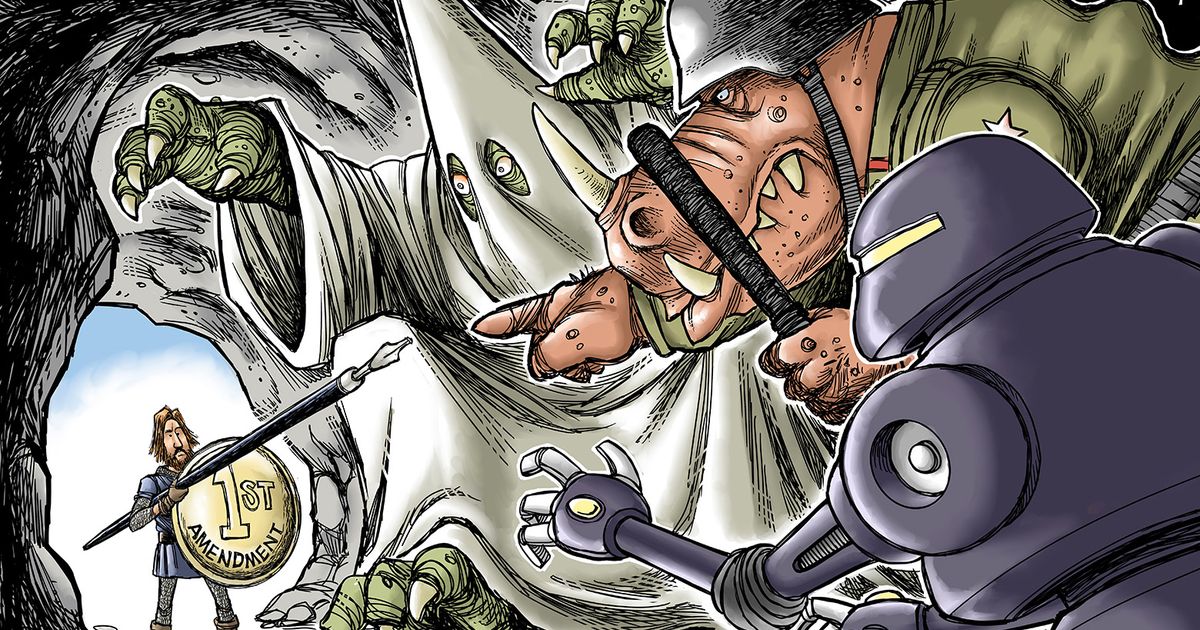
(Editor’s note: This column is part of a Seattle Times Opinion series exploring the First Amendment and its five freedoms.)
In 1831, French caricaturist Charles Philipon was sentenced to six months in prison and fined 2,000 francs for drawing cartoons lampooning King Louis-Philippe. At his trial, Philipon gained notoriety for demonstrating how to draw the king as a pear. This was at a time when, in Parisian slang, the word for pear — poire — meant “fool” or “fathead.”
I have drawn Bill Clinton in his underwear. I’ve drawn George W. Bush with Karl Rove popping out of his head. I’ve drawn Barack Obama as a drone. And I’ve drawn Donald Trump as a whining baby in diapers, a mafia don, a dragon, a clown, Dracula, Frankenstein’s monster, Gollum and the Wicked Witch (not as a pear — yet), but I have never gone to jail for my caricatures of powerful leaders.
And neither has any other American cartoonist. My colleagues and I are free to affront because we draw political cartoons in a country where freedom of speech is usually respected and almost always backed up by the courts. Satire is protected by the First Amendment.
This is not true in most countries. There are many examples of cartoonists being jailed, censored, physically attacked or forced to flee their homeland because something they drew offended their government or some militant group. One of the most horrific incidents was the massacre of cartoonists at the French satire magazine, Charlie Hebdo, in 2015. They were murdered by Islamic extremists outraged by the artists’ depiction of the Prophet Muhammad.
And yet, even when under grave threat, political cartoonists cannot stop.
American political cartooning may have come into its own when a German immigrant, Thomas Nast, bravely took on the corrupt New York political bosses and robber barons of the Gilded Age in the late 1800s. But there were cartoonists at work in the United States even before there was a United States, including Benjamin Franklin, who created the most famous cartoon of his time — a drawing of a segmented snake representing the disunited colonies with the caption: “Join or die.”
In the 20th century, it was almost expected that any newspaper, even of modest size, would employ an editorial cartoonist. Some were primarily illustrators of their publishers’ ideas, but there were also plenty of bold cartoonists who defied authority to expose the truth through their work.
As a young G.I. drawing for Stars and Stripes during World War II, Bill Mauldin enraged the prickly Gen. George Patton with his gritty depictions of life in the foxholes. But Mauldin did not bend and, even in the military in the midst of a war, the First Amendment protected him.
Herblock had a 50-year career cartooning for The Washington Post, bravely skewering Sen. Joseph McCarthy for his political witch hunts in the early 1950s and showing no mercy to President Richard Nixon as the Watergate scandal unfolded in the 1970s. And Herblock — Herbert Lawrence Block — was never silenced, either.
The one thing that has been true since even before Philipon drew the French monarch as a pear is that political cartoons always make someone angry. Creating outrage is unavoidable in the practice of what the late, great political cartoonist Pat Oliphant dubbed “the jugular art.” At least if it is done right. Credit is due to the many stalwart publishers who employed and defended their editorial cartoonists, even though they knew the cartoons were offending half their readers on a daily basis.
Perhaps no other Americans have been more free to express their opinions than political cartoonists, despite the complaints and anger of presidents, governors, mayors and a fair share of voters. But the First Amendment has not been able to protect cartoonists from their most effective censors: Bean counters.
As the newspaper industry has imploded, staff editorial cartoonists have often been the first to be laid off because the guys in suits who do the numbers cannot imagine why any newspaper needs political cartoons.
And winning Pulitzer Prizes does not provide any protection.
Hearst Newspapers dumped a very popular, Pulitzer-winning editorial cartoonist, Nick Anderson, from the Houston Chronicle simply to save a few bucks. The McClatchy newspaper group dumped three Pulitzer winners in one day in 2023: Jack Ohman of The Sacramento Bee, Joel Pett of the Lexington Herald-Leader and Kevin Siers of The Charlotte Observer.
Then there are the stellar cartoonists who have lost their jobs for doing them too well. Rob Rogers was fired from the Pittsburgh Post-Gazette for drawing critical cartoons of President Trump (his publisher was a Trump fan). Kevin Kallaugher had to part ways with the Baltimore Sun when the newspaper was purchased by a Trump booster. And, most recently, Ann Telnaes left The Washington Post because her editor refused to run a cartoon critical of the Post’s owner, Jeff Bezos.
Newspaper editorial cartooning is in its twilight, but political cartoons are not dead. All of the great cartoonists who recently lost their platforms have found a new one on Substack. Telnaes, in fact, makes more money from her Substack page than she did at The Post.
That’s the thing about free speech. Nobody can permanently shut us up.
See more of David Horsey’s cartoons at: st.news/davidhorsey
View other syndicated cartoonists at: st.news/cartoons
Editor’s note: Seattle Times Opinion no longer appends comment threads on David Horsey’s cartoons. Too many comments violated our community policies and reviewing the dozens that were flagged as inappropriate required too much of our limited staff time. You can comment via a Letter to the Editor. Please email us at letters@seattletimes.com and include your full name, address and telephone number for verification only. Letters are limited to 200 words.
